PODCAST EPISODE 3: From Books to Bedrock: Student life with Keira Hum
In this episode, we sit down with Keira Hum, a passionate Integrated Science student at McMaster University, to explore the ins and outs of student life in the world of Earth Sciences. Keira shares her journey from the classroom to the field, offering invaluable advice for balancing academics, personal growth, and career aspirations. Whether it’s navigating coursework, finding opportunities in the geoscience community, or preparing for a future in the field, Keira’s relatable stories and practical tips are sure to inspire students and geoscience enthusiasts alike. Tune in for a fun and insightful conversation packed with guidance for thriving in geoscience studies! 🌍🎙️ Listen now: You can also listen to our podcast on these platforms: Audible Apple Podcasts Spotify Read along with the podcast transcript: Introduction Hello, everyone. Welcome to Beneath Your Feet, a geoscience podcast. I’m Veronica Klassen, science communicator, geology enthusiast and your host. Here at the APGO Education Foundation, our mission is to spark curiosity and passion for the geology of Ontario. Whether you’re a geology nerd, science enthusiast, or nature lover, this podcast is for you. Join us as we geek out over fascinating geology, uncover the hidden storiesand secrets of our extraordinary planet and explore the captivating world beneath your feet. Veronica Klassen Thanks so much for joining me. Today I’m here with Keira Hum, a third year university student at McMaster. We’re going to be talking about some tips and ideas for being in school, studying geology,all those sorts of things. And I think it’ll be a really good conversation. I’m really excited to talk with you. Keira Hum I’m really excited to talk to you, too, Veronica. I’m excited to kind of talk about my job and experience going through a geoscience program. VeronicaYeah, for sure. All right, so why don’t you just start by introducing yourself? Who are you? What do you do? KeiraSo, yeah, my name is Keria Hum. I go to McMaster, and I’m in the Integrated Science program. I’m going into my fourth year of study and I have a concentration in Earth and Environmental Science. So I do a lot of, like, scientific research and take a lot of environmental electives. VeronicaAwesome. How does it feel being almost done? KeiraPretty good. I know I’m going to miss my friends a lot so that I’ll be going over my mind throughout the year and kind of thinking about master’s programs too, right now. So that’s been what I’ve been doing. VeronicaYeah. And how did you get where you are now? So how did you originally become interested in geoscience and what was that journey like for you? KeiraSo in my first year of undergrad in my Integrated Science program, we did have an introductory lecture and course in Earth and Environmental Science, and I really enjoyed that compared to like all the other courses that we had to take. And I just thought the Earth Science course was so much more fun and so much more interactive. And I also took an intro to Environment, Climate and Water, and I thought that was really interesting too. And I had a bunch of field events, which was really fun, and I thought, you know, can’t hurt to try going into that concentration. And I’m so glad that I did. VeronicaYeah, that’s awesome. And I think I remember you saying that you were not imagining that you would do Earth Science before university. You had a different track in mind. Is that the case? KeiraYeah. I was thinking I would go into biology. That’s kind of what I was interested in during high school. But getting introduced to the course at a university level and the concepts I thought was really interesting. I really like the idea of sitting in the classroom, learning about the concepts and then doing labs outside and in the field. That was really interesting to me and I learn so much better in those kind of environments. So it was kind of perfect for me. Yeah, and I just thought, it’s so applicable to so many different types of disciplines, like I could do biology and geoscience if I wanted, or earth and environmental science and biology. And I really liked how the discipline can, kind of, interact with so many other ones. VeronicaYeah, definitely. That’s one of the things that I also love about geology is just like how universal is and like it relates to so many different scientific and also nonscientific areas of study. KeiraYeah, for sure. VeronicaAnd you also said that you decided to try to get your PGO certification. So could you tell us a bit about how that process has been for you? KeiraYeah. So I first got introduced to what PGO is and the importance of it in my first year of study. So I was kind of thinking about it and trying to plan my courses for the PGO and because I’m in ISci, it’s hard to manage my electives just because I have limited space every year. So I had to do a lot of planning field courses and extra courses during the summer and spring terms just so I can make up all the knowledge requirements to get the PGO certificate. So it’s been a lot of planning and stress, but I know it’ll be worth it in the end. Yeah, I love the courses that I’m taking anyway that are required for the PGO knowledge requirements, so I find it, you know, not too difficult and pretty enjoyable because I’m getting more exposure to courses I might not have noticed or taken if it wasn’t for the PGO requirement list and seeing the course offerings on that document. VeronicaRight? Yeah, it’s different things that necessarily you would always get to get to explore. So that’s cool. On that note, do you have any other piece of advice that you would give for younger students who are maybe considering PGO or geoscience in general? What
Geoscience Meets AI: Imagining Tomorrow’s Possibilities
Mary-Anne Hildebrandt, P. Geo., FGC Energy and minerals power our lives, and while we Canadians live in a land of abundance, global projections of natural resource consumption far exceed what is readily available. Economic geologists are increasingly challenged to locate near-surface mineral resources that are feasible to extract. Today’s evolving business models focus on creating more precise, surgical methods of extraction, not only to reduce the environmental impact of mining, but also to unlock economic potential in deposits that, in the past, would not have met the threshold for Reasonable Prospects for Eventual Economic Extraction (RPEEE). In parallel, we are working in the era of Big Data. In 2020, NASA reported that its Earth Science data collection had reached 40 petabytes (PB), a unit 1000 times the size of a terabyte (TB) and that this collection was expected to expand to 250 PB within six years. Geoscience data in the mineral and mining industry follows a similar trend. Big data and increased complexity of the deposits make it essential that Professional Geoscientists (P. Geos) leverage Artificial Intelligence (AI) because traditional methods of analysis are often insufficient to handle the scale and complexity of modern datasets. There are many companies and software developers trying to deliver solutions that produce high-quality results in real-time such as geochemistry, mineralogy, and structural measurements collected and analyzed in real-time at a drill rig using either powerful downhole tools or field core scanners. Some experts in the field believe that these advancements may reduce the necessity for geoscience professionals; however, it is far more likely that AI will strengthen our ability to understand, analyze, and model vast amounts of data, giving us insights that would otherwise be unattainable in a short amount of time. Consider society’s approach to earthquakes and how advanced we have become in creating predictive models over the last century. There are AI applications in use today that allow P. Geos the ability to analyze large datasets that aid in the creation of robust, predictive models. These detailed models allow P. Geos to have a better understanding of risk to the public and offer greater guidance to inform early warning systems. By integrating AI into our professional toolkit, we will be able to make more informed decisions, streamline complex analyses, and better allocate limited resources. Professional regulators, such as Professional Geoscientists Ontario (PGO), also stand to benefit from AI. For example, AI could be used to identify patterns and anomalies that would allow regulators to detect unethical behaviour more effectively. Rather than waiting for another Bre-X-type incident, where a company reported falsified assay results that inflated the gold reserves to attract investors, it is in the public’s best interest for our profession—and its regulators—to develop advanced tools to stay ahead. It is certain that bad actors will also leverage AI to attempt to bypass existing legal frameworks, making it essential to reinforce our defences. However, as powerful as AI is, its use must be carefully guided. As a profession, we bear the responsibility to harness AI in ways that ensure its development and applications remain ethical, transparent, and fair. We need greater dialogue and a robust framework to guide this evolving area. Inherently, AI lacks an understanding of ethical intentions. It makes decisions based on the algorithms and code designed by humans, as well as the dataset on which it is trained. However, developers have the ability to instil AI with ethical or unethical subroutines either intentionally or unintentionally. Developers might choose to design it with an underlying malicious intent, such as spreading misinformation, or creating harmful automated decisions that negatively affect individuals, groups, or the natural world. Unintentional biases could also emerge if the AI is trained on a limited or biased dataset, leading to skewed decisions or outputs. For example, a mining company using AI to identify mineral exploration targets might train the system on a flawed dataset that lacks sufficient diversity in the geological dataset used for training. As a result, the AI could misunderstand key aspects of the mineralization controls if its training dataset is incomplete or biased. This could lead to the AI relying on surface-level features like rock type or mineral traces that resemble those found in resource-rich areas. However, without accounting for other critical factors such as depth, geological history, geochemistry, alteration, or other favourable conditions needed for mineral formation, the AI might incorrectly predict the presence of valuable deposits in barren areas. This misinterpretation could lead to the company and its shareholders to invest millions in unproductive exploration, wasting time and money. Meanwhile, the AI might overlook other areas with better prospects due to the skewed training dataset. Without the critical and well-trained eye of a P. Geo. guiding AI and validating its outputs, AI has the potential to cause not only financial losses, but also unnecessary environmental damage. PGO’s Code of Ethics calls on P. Geos to demonstrate “integrity, competence and devotion to service and to the advancement of human welfare”, and it is imperative that AI systems embody these principles as part of the original code. Responsible integration of AI is critical to upholding the public’s trust in our profession, and a balanced approach is needed to ensure that we seize opportunities while safeguarding the public and the natural world from harm. After using the wrong ingredients to bake a cake, Anne Shirley reflects “…isn’t it nice to think that tomorrow is a new day with no mistakes in it yet?” (Anne of Green Gables, Ch. 21, by L. M. Montgomery). In the age of AI, geoscientists must remain committed to continuous learning and ethical practice. AI will inevitably become more integrated in our daily activities. To ensure that AI has the right ingredients that will prevent harm to society or the natural environment, we need greater discussion and more collaboration with each other and our peers in data science to build a framework that guides the use of AI in geoscience practice. A proactive approach focusing on the development of an
Pukaskwa National Park: A Geological Gem in the Northern Ontario Landscape
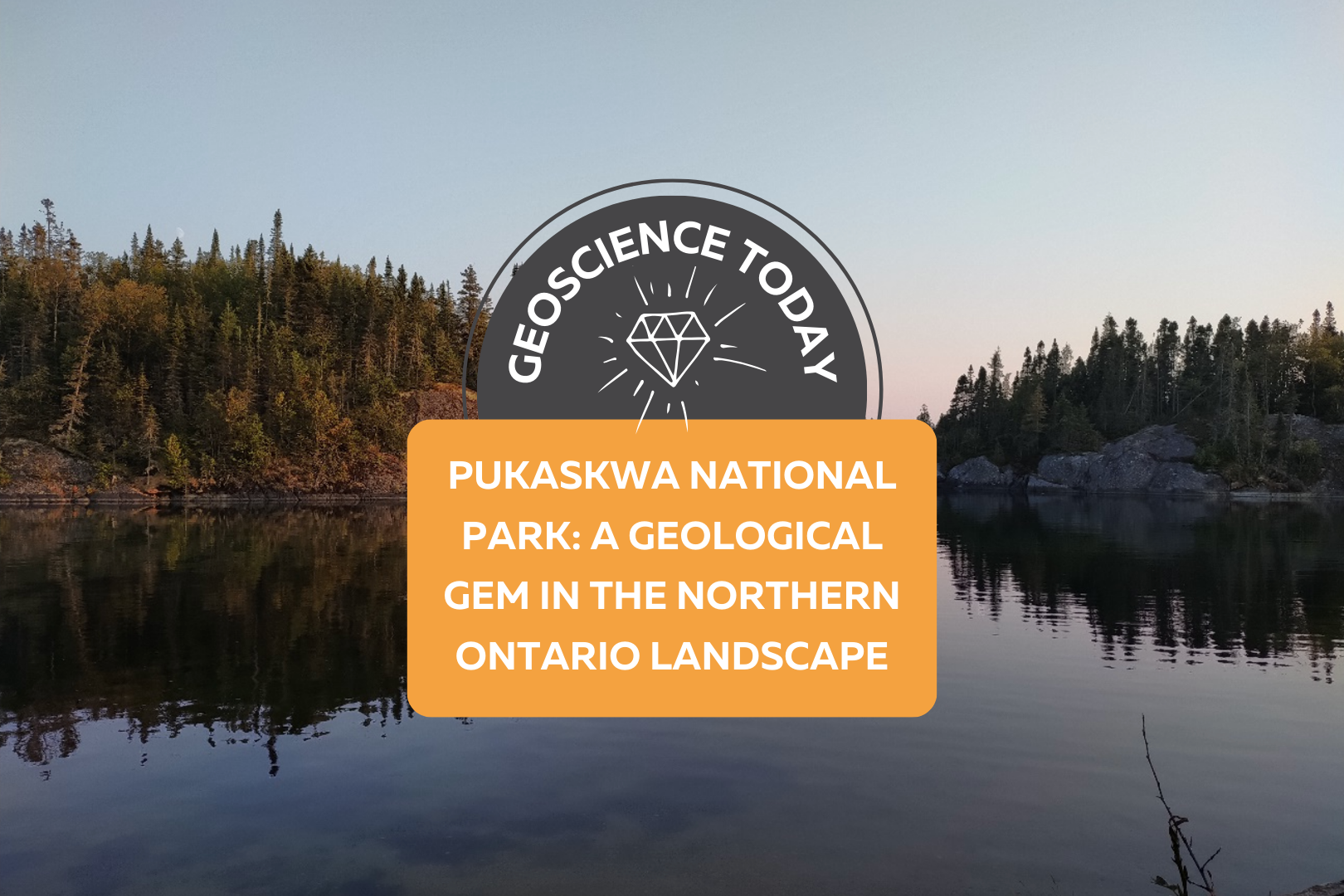
Author: Cyndy Broughton, Minerals Engineering Technologist The APGO Education Foundation is pleased to support the Geologist-in-Residence program at Pukaskwa National Park. Gazing out over the calm waters of Hattie Cove near the visitor centre at Pukaskwa National Park, I realized the allure of the park. Many of the people that I had recently met during my walks around the park were repeat visitors, coming back year after year to experience the wonders of nature. Some visitors travelled thousands of kilometers each year to experience the solitude and beauty that the park has to offer. Some came to relax and enjoy family time; others came to paddle the waters of Lake Superior or hike the many trails in the park. My goal that day was to help park visitors view the vistas of Pukaskwa through the lens of geology. In August 2024, I had the opportunity of being the Geologist-in-Residence at this beautiful national park located on the shores of Lake Superior near the community of Marathon, Ontario. My last visit to Pukaskwa National Park was in 1984 as a young geological technologist enjoying a day off from work and taking the opportunity to swim in the clear waters of Lake Superior. Now I was returning at the invitation of the Canadian Federation of Earth Sciences and Parks Canada near the end of a career spent mostly in geological education. The role of the Geologist-in-Residence (GIR) program is to highlight the significant geological evidence and history on display within the park and increase public awareness and appreciation of geoscience. The mandate of Parks Canada is to protect and present nationally significant examples of Canada’s natural heritage. Parks Canada’s goal, written in its vision statement, is to make Canada’s treasured natural and historic places a living legacy, connecting hearts and minds to a stronger, deeper understanding of the very essence of Canada. Two of the guiding principles that govern the system of national parks are Education and Presentation and Human-Environment Relationship. Successful natural interpretive programs allow park visitors to discover and learn about ecosystems. Sharing knowledge about sustainability and the connections between people and our environment are important tools in ensuring that our efforts to protect our natural heritage are successful. When we provide the opportunity to experience nature and we share knowledge of ecosystems, we can foster the desire in citizens to protect and appreciate the world around us. To understand the very essence of Canada, we need to share geoscience knowledge, as well as knowledge of wildlife and botany. The geology of our country is literally the ground beneath our feet. Knowledge of geology can help make connections to soil formation, biodiversity, water quality, mineral resources, energy resources, and so much more. The Geologist-in-Residence program is an important program that helps to develop interpretive geology hikes and drop-in sessions where visitors to the park are invited to engage in interactive, hands-on programs. Programming is developed by geoscience educators to help park staff share the geological wonders of the park. This year’s guided hike to Pukaskwa National Parks North Beach helped visitors travel back through geological time to explore the formation of the 2.7-billion-year-old rocks. We discussed the formation of the Lake Superior basin through mid-continent rifting 1 billion years ago and ended our hike examining the impact that glaciation had on the rocks and sand deposits along the coast. During drop-in sessions, we tested the chemistry of Lake Superior waters and connected our results to the geology of the Canadian Shield. Children had the chance to learn basic rock and mineral identification skills and were able to apply those skills when they explored the rocks on the hike. With the assistance of Parks Canada Interpretation Officer and Coordinator Carly Robillard, the support of the Canadian Federation of Earth Sciences (CFES), and the financial support of the APGO Education Foundation, my time spent at Pukaskwa National Park was a rewarding experience that offered me the opportunity to showcase the geological wonders of the park and help visitors make those important connections between geology and world around us. Cyndy Broughton is a Minerals Engineering Technologist and a Professor with 36 years of experience teaching geology and environmental science at Fleming College. She encourages everyone, young and old, to head outside and discover the connections between geology and the living world.
PODCAST EPISODE 2: Stories, Science and Society: Reframing Geoscience Communication with P.Geo. Paul Hubley
Join podcast host Veronica Klassen and guest Professional Geoscientist and CEO of Geoscientists Canada Paul Hubley in this discussion of geoscience communication and the future of geoscience. Hear from Paul on his career, life advice, and how we can start to create a more accurate perception of geoscience in society. Join us in discussing how Earth Science can help us wrestle with the big issues of our time, and the importance of relationship building, storytelling, and listening in addressing these issues. Episode Audio: You can also listen to our podcast on these platforms: Episode Transcript: Veronica Klassen Hello, everyone. Welcome to Beneath Your Feet, a geoscience podcast. I’m Veronica Klassen, science communicator, geology enthusiast and your host. Here at the APGO Education Foundation, our mission is to spark curiosity and passion for the geology of Ontario. Whether you’re a geology nerd, science enthusiast, or nature lover, this podcast is for you. Join us as we geek out over fascinating geology, uncover the hidden stories and secrets of our extraordinary planet, and explore the captivating world beneath your feet. Today I’m meeting with Paul Hubley, and we’re going to be talking a little bit about his career, we’re going to be talking about advice for students, the perception of geoscience in society and some other really cool things. So yeah, if you want to just do like a quick introduction to yourself, that would be great. Paul Hubley, P. Geo Fantastic. Thank you very much. Thanks for inviting me here today, I’m excited to be here. So, Paul Hubley, I’m a male in my in my 50s, born in Halifax, living with my wife, Caroline, and on any given day, between two and three of our five kids are living with us as. We also have a little chihuahua. And I’m a professional geoscientist. Before we go further, geoscience is a regulated profession, just like engineering. So I’m a P. Geo. I’ve been in environmental consulting for 35 years, and the vehicle that brought me there is an education in Earth Sciences. I’ve got a Bachelors of Science with Honours in Geological Sciences from Brock University and a Master’s of Science in Earth Science from the University of Waterloo. That was way back when, in 1995 before the turn of the century, turn of the millennium. Other than being a father and geoscientist, I’m a self described serial volunteer. Just to pick up skills and contribute in ways that work didn’t bring bring to me. I like to landscape and build things outside, as long as it doesn’t have to be too fancy, then count me in. I’m a measure once, cut twice, kind of person. So I like to dabble. And I found out recently I like to do some creative writing, so I’m a bit of a groundskeeper as well. Veronica Yeah. And you’ve been doing some creative writing for our blog, which has been very fun. So you can check out those articles on our website. Paul Yeah, it’s more of a dabbler. So the groundskeeper is the landscaping and the creative writing is a bit of a dabbler. So yeah, I hope that people do check it out. Veronica Yeah. Yeah, for sure. All right. Thanks so much. Yeah. So tell us a little bit about how you first got interested in geoscience. Like what drew you to geology? Paul Well, I had always been drawn to the ocean. Being born in Halifax and going to Nova Scotia almost every year and summer, the ocean was just part of my life. And somewhere around grade 10 or 11, I was convinced that I wanted to be in the Coast Guard. It would take me to the East Coast that I loved, keep me on the water for my entire life. That’s what I was thinking and I thought I’d like to push myself, I like to travel, all those things. And for some reason I just got the feeling that that particular thing was going to be too limiting. And also the 1980s were the time of deep sea exploration. Jacques Cousteau was sending submarines down to deep sea vents and they were finding these black smokers in the bottom of the Mariana Trench and things like that. And I just thought, this is amazing stuff. So then I switched from the Coast Guard to wanting to be a marine biologist. I was absolutely convinced I was going to be a marine biologist until I took a Grade 13 biology class and felt it wasn’t connecting. It was just a lot of memorization and just technical terms I just wasn’t connecting with. And I also had the opportunity to take a geology class in high school, which is pretty rare. That was inspiring. So, at the same time, the biology bubble was deflating and the geology bubble was inflating. And I thought, wow, I decided that I really wanted to work on environmental issues. And this could be a vehicle to do it. And it is. It has been. And I never looked back. I don’t know where I got it in my head. I thought it was my idea and nobody else had this idea, but apparently I was wrong. There was a whole industry that was building up at the time, so I probably picked it up somewhere else, but I took it on as my own. Veronica That’s awesome. Yeah. So you’ve been on quite a journey. What’s your best piece of advice for young students and how how can they figure out, kind of, what they are interested in, what they want to do? Paul Yeah, ultimately the journey was convoluted and it was difficult and there’s a lot of choices and that can be difficult for people. I guess I could say a couple of things here. One is that what you choose, if you’re lucky enough to feel, it feels right like I was, then go for it, do it.