

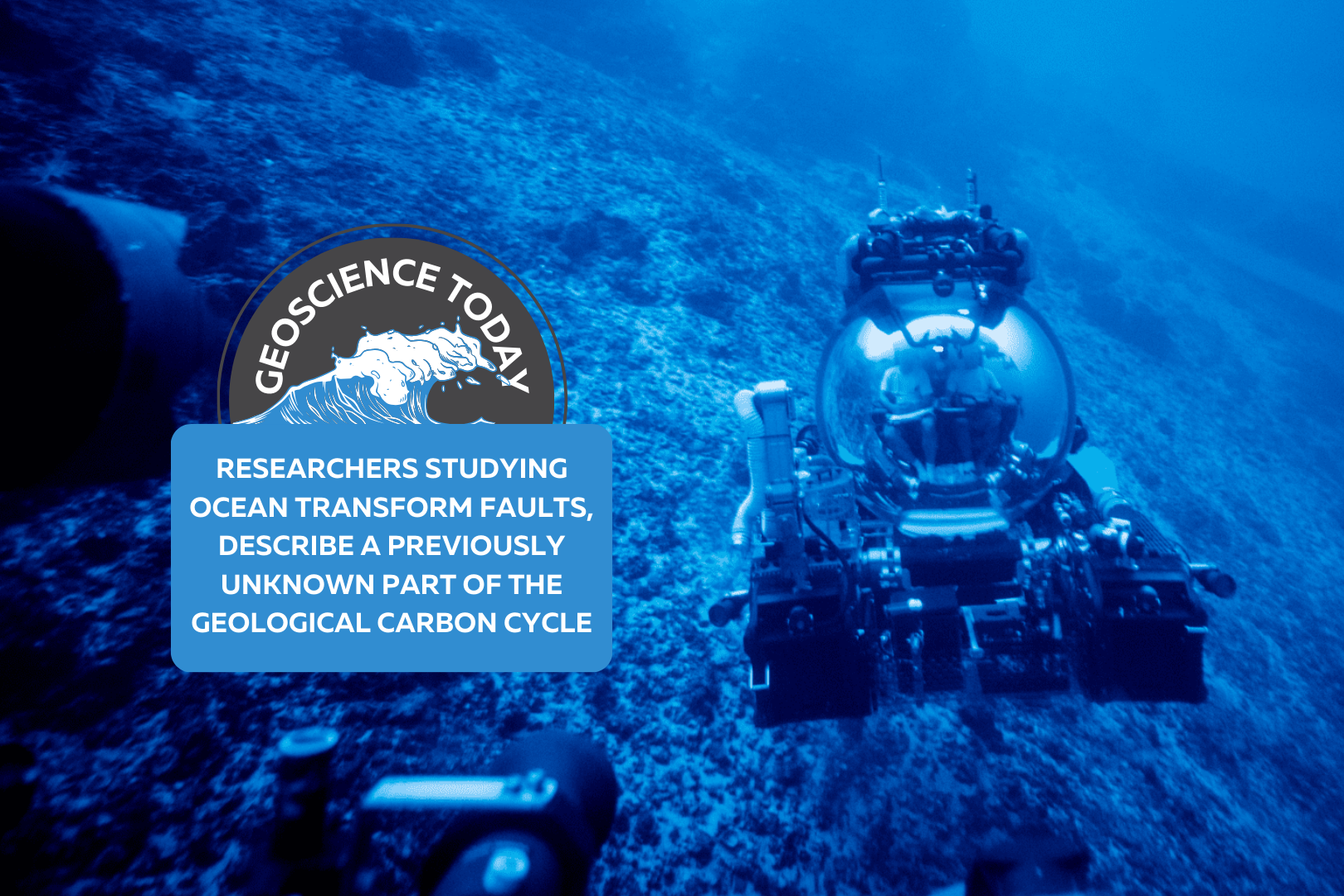
Submarine in the ocean. Text reads: "Geoscience Today: Researchers Studying Ocean Transform Faults, Describe a Previously Unknown Part of the Geological Carbon Cycle"

Researchers Studying Ocean Transform Faults, Describe a Previously Unknown Part of the Geological Carbon Cycle

Chief Scientist Frieder Klein and Deep Rover Pilot Alan Scot exploring a submerged carbonate platform. (Photo by: Novus Select) Woods Hole, Mass. Republished with permission. Original article here. Studying a rock is like reading a book. The rock has a story to tell, says Frieder Klein, an associate scientist in the Marine Chemistry & Geochemistry Department at the Woods Hole Oceanographic Institution (WHOI). The rocks that Klein and his colleagues analyzed from the submerged flanks of the St. Peter and St. Paul Archipelago in the St. Paul’s oceanic transform fault, about 500 km off the coast of Brazil, tells a fascinating and previously unknown story about parts of the geological carbon cycle. Transform faults, where tectonic plates move past each other, are one of three main plate boundaries on Earth and about 48,000 km in length globally, with the others being the global mid-ocean ridge system (about 65,000 km) and subduction zones (about 55,000 km). Carbon cycling at mid-ocean ridges and subduction zones has been studied for decades. In contrast, scientists have paid relatively scant attention to CO2 in oceanic transform faults. The transform faults were considered “somewhat boring” places for quite some time because of the low magmatic activity there, says Klein. “What we have now pieced together is that the mantle rocks that are exposed along these ocean transform faults represent a potentially vast sink for CO2,” he says. Partial melting of the mantle releases CO2 that becomes entrained in hydrothermal fluid, reacts with the mantle closer to the seafloor, and is captured there. This is a part of the geological carbon cycle that was not known before,” says Klein, lead author of a new journal study “Mineral Carbonation of Peridotite Fueled by Magmatic Degassing and Melt Impregnation in an Oceanic Transform Fault,” published in the Proceedings of the National Academy of Sciences (PNAS). Because transform faults have not been accounted for in previous estimates of global geological CO2 fluxes, the mass transfer of magmatic CO2 to the altered oceanic mantle and seawater may be larger than previously thought.” ”The amount of CO2 emitted at the transform faults is negligible compared to the amount of anthropogenic – or human driven – CO2,” says Klein. “However, on geological timescales and before humans emitted so much CO2, geological emissions from Earth’s mantle – including from transform faults – were a major driving force of Earth’s climate.” As the paper states, “global anthropogenic CO2 emissions are estimated to be on the order of 36 gigatons (Gt) per year, dwarfing estimates of average geological emissions (0.26 Gt per year) to the atmosphere and hydrosphere. Yet, over geological timescales, emissions of CO2 sourced from Earth’s mantle have been pivotal in regulating Earth’s climate and habitability, as well as the C [carbon]-concentration in surface reservoirs, including the oceans, atmosphere, and lithosphere.” Klein adds that “this is before anthropogenic combustion of fossil fuels, of course” “In order to fully understand modern human-caused climate change, we need to understand natural climate fluctuations in Earth’s deep past, which are tied to perturbations in Earth’s natural carbon cycle. Our work provides insights into long-timescale fluxes of carbon between Earth’s mantle and the ocean/atmosphere system,” says co-author Tim Schroeder, member of the faculty at Bennington College, Vermont. “Large changes in such carbon fluxes over millions of years have caused Earth’s climate to be much warmer or colder than it is today.” To better understand carbon cycling between Earth’s mantle and the ocean, Klein, Schroeder, and colleagues studied the formation of soapstone “and other magnesite-bearing assemblages during mineral carbonation of mantle peridotite” in the St. Paul’s transform fault, the paper notes. “Fueled by magmatism in or below the root zone of the transform fault and subsequent degassing, the fault constitutes a conduit for CO2-rich hydrothermal fluids, while carbonation of peridotite represents a potentially vast sink for the emitted CO2.” The researchers argue in the paper that “the combination of low extents of melting, which generates melts enriched in incompatible elements, volatiles and particularly CO2, and the presence of peridotite at oceanic transform faults creates conditions conducive to extensive mineral carbonation.” The rocks were collected using human-occupied vehicles during a 2017 cruise to the area. Finding and analyzing these rocks “was a dream come true. We had predicted the presence of carbonate-altered oceanic mantle rocks 12 years ago, but we couldn’t find them anywhere,” says Klein. “We went to the archipelago to explore for low-temperature hydrothermal activity, and we failed miserably in finding any such activity there. It was unbelievable that we were able to find these rocks in a transform fault, because we found them basically by chance while looking for something else.” Funding for this research was provided by the Dalio Ocean Initiative, the Independent Research & Development Program at WHOI, and the National Science Foundation. Authors: Frieder Klein*, Timothy Schroeder, Cédric M. John, Simon Davis3, Susan E. Humphris1, Jeffrey S. Seewald1, Susanna Sichel, Wolfgang Bach, and Daniele Brunelli,1 Affiliations: *Corresponding author About Woods Hole Oceanographic Institution: The Woods Hole Oceanographic Institution (WHOI) is a private, non-profit organization on Cape Cod, Massachusetts, dedicated to marine research, engineering, and higher education. Established in 1930, its primary mission is to understand the ocean and its interaction with the Earth as a whole, and to communicate an understanding of the ocean’s role in the changing global environment. WHOI’s pioneering discoveries stem from an ideal combination of science and engineering—one that has made it one of the most trusted and technically advanced leaders in basic and applied ocean research and exploration anywhere. WHOI is known for its multidisciplinary approach, superior ship operations, and unparalleled deep-sea robotics capabilities. We play a leading role in ocean observation and operate the most extensive suite of data-gathering platforms in the world. Top scientists, engineers, and students collaborate on more than 800 concurrent projects worldwide—both above and below the waves—pushing the boundaries of knowledge and possibility. For more information, please visit www.whoi.edu
Read More »
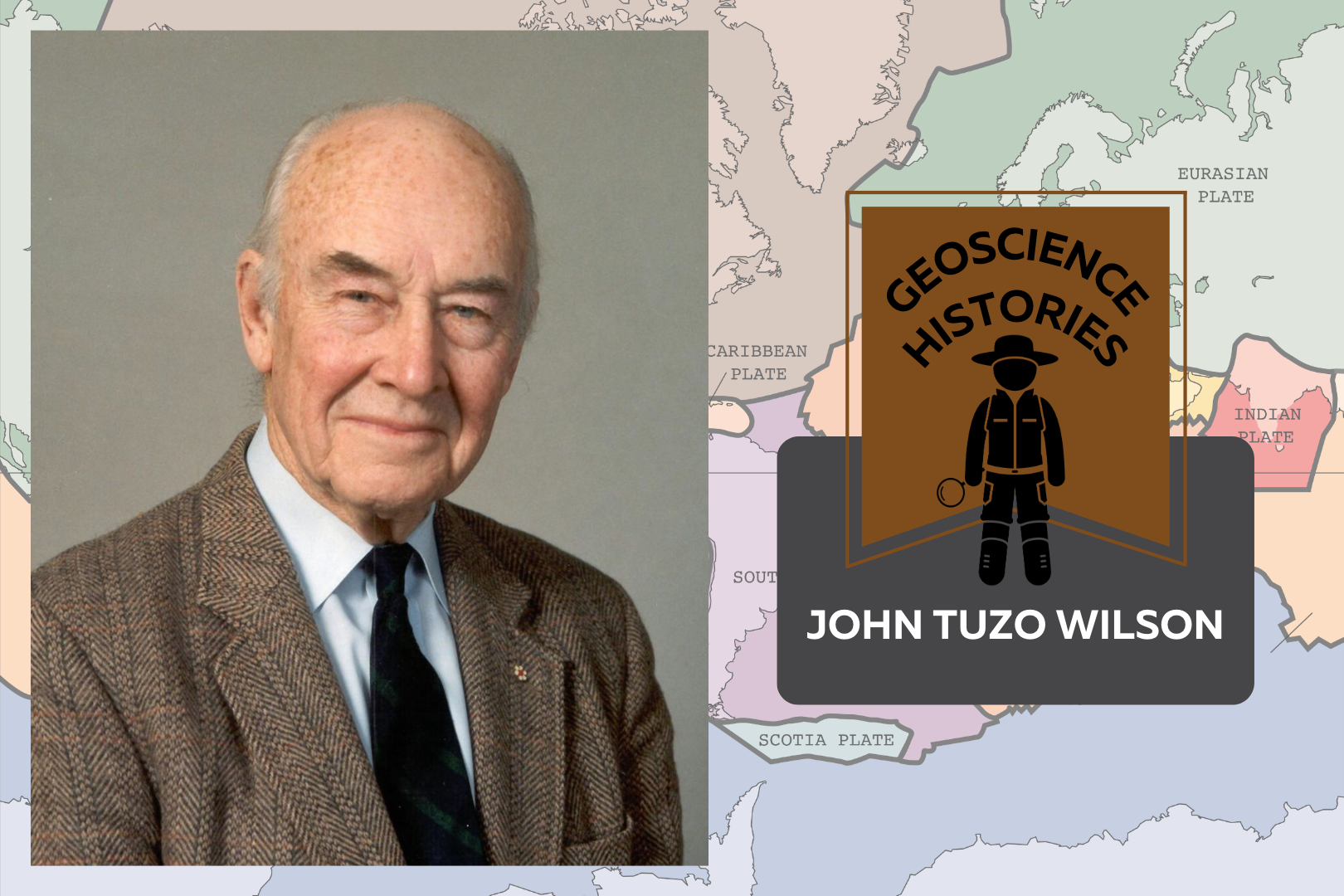
Headshot of John Tuzo Wilson beside text saying: Geoscience Histories: John Tuzo Wilson. In the background there is a colourful map of the world with the tectonic plates outlined

Geoscience Histories: John Tuzo Wilson

Canada’s history is full of geoscientists who have made important discoveries in the field of geoscience. Geoscientists work to help advance technology, solve problems, preserve the environment, and understand Earth’s processes. One important geologist in Canada’s history is John Tuzo Wilson, known for his contributions to the field of plate tectonics.  John was born in Ottawa, in 1908, to Robert Wilson and Annie Tuzo. His father worked for the Canadian government as an engineer and his mother was an adventurous mountain-climber. Annie had a mountain peak named after her, Mount Tuzo, after she and her guide, Christian Bohren, were the first people to ascend the peak. John’s interest in geology began when he was quite young, and he used to collect rocks and fossils on family trips growing up. John studied physics and geology in his undergrad at the University of Toronto (U of T), graduating in 1930. At the time there was no geophysics program at U of T, however, John found instruction wherever he could and did a joint degree instead. He then moved to England on a Massey Fellowship to study at Cambridge. John moved to Princeton for his Ph.D., completing field work on his own in the Beartooth Mountains in Montana.  After his studies, Tuzo Wilson worked for the Geological Survey of Canada as an Assistant Geologist. In 1938, John married Isabel Dickson in Ottawa. When World War II started, he joined the Royal Canadian Engineers, gaining rank to become a colonel. Isabel followed John to England to be closer to him during the war. They returned to Canada together in 1944 and he started a job as a Professor at the University of Toronto. It was here that John Wilson would spend the bulk of the rest of his career.  John Tuzo Wilson via Smorris123 at English Wikipedia, CC BY-SA 3.0, via Wikimedia Commons John’s research at U of T greatly influenced the field of plate tectonics. At the time, Alfred Wegener’s theory of continental drift was largely disputed. Wegener’s theory, published in the early 1900s, asserted that the continents move in relation to one another over long periods of time. But there were inconsistencies in his theory and a lack of evidence. John initially opposed the theory like most of his colleagues, but reconsidered his position later on. This reconsideration ultimately led to Wilson’s theory of plate tectonics.  One of John’s significant contributions to the theory of plate tectonics was the idea of “hot spots.” He drew inspiration from studying the Hawaiian Islands, theorizing that the islands were created as the Pacific tectonic plate moved northwest, over a magma plume in the mantle. This created the chain of volcanoes decreasing in size and intensity to the southwest. This theory resolved some of the contradictions in Wegener’s continental drift theory. Wegner’s theory asserted that volcanoes form solely as a result of movement at the edges of tectonic plates and so was highly disputed because of the lack of explanation for volcanoes located away from plate boundaries (such as Hawaii). Wilson’s new hot spot theory provided an explanation for why there are volcanoes in other places as well as at plate boundaries.  John’s second major discovery was that of transform faults. A transform fault occurs when two plates move past one another,  sometimes resulting in a build-up of stress (e.g., shear stress). Transform faults may cause landforms to break and move past each other, thereby looking offset from each other in aerial view. This new theory of faults explained the topography of mid-ocean ridges and greatly contributed to the larger theory of plate tectonics.  John continued to teach and research at U of T for many years, but even after he retired from the University, he continued to teach his theories, travelling to over 100 countries. He particularly loved travelling to China, and even wrote a book about his trip to China in 1958 entitled “One Chinese Moon.” He produced the tv series “Planet Earth,” and introduced many episodes, continuing his love for teaching. After Wilson retired, he became the director of the Ontario Science Centre, encouraging exploration and interest in science. He famously posted “please touch” signs on the exhibits. He wanted the centre to be a combination of artefacts and hands-on experiments, and often interacted with visitors and school groups. He also supported the introduction of travelling science exhibits in order to make science accessible to remote Ontario communities. The success of the travelling exhibits contributed to the creation of Science North in Sudbury, which Wilson supported.  John Tuzo Wilson’s many discoveries led to our current theory of plate tectonics. His willingness to test the boundaries of science is what gave him great success. His passion for teaching and love for student exploration has greatly impacted the effectiveness of science centres in Ontario.  Nick Eyles recently published a book about John Tuzo Wilson entitled “Tuzo: the unlikely revolutionary of plate tectonics.” It is an enlightening look at Tuzo’s life and career. APGOEF’s president Dr. Bill Pearson describes the book such: Nick has done a tremendous job pulling together a vast amount of historical information not just on the remarkable life and prodigious achievements of Tuzo Wilson but also documenting in fascinating detail the long and protracted battle between those that believed in a contracting earth versus those that believed in continental drift which eventually evolved into what we now know as plate tectonics…The book wonderfully documents the incredible technical revolution especially following WWII that revolutionized the science of geology and moved it rapidly forward…The account of his WWII service is outstanding, and Nick eloquently outlines how his experiences then gave Tuzo many lifelong skills in communication and leadership that would serve him well in future years…It is a fitting tribute to a remarkable man who is unquestionably Canada’s greatest geoscientist.  Dr. Bill Pearson Check out the book at the University of Toronto Press or Amazon. Sources: Brittanica: J. Tuzo Wilson The Canadian Encyclopedia: John Tuzo Wilson The Canadian Encyclopedia: John Tuzo Wilson’s Theory

Read More »