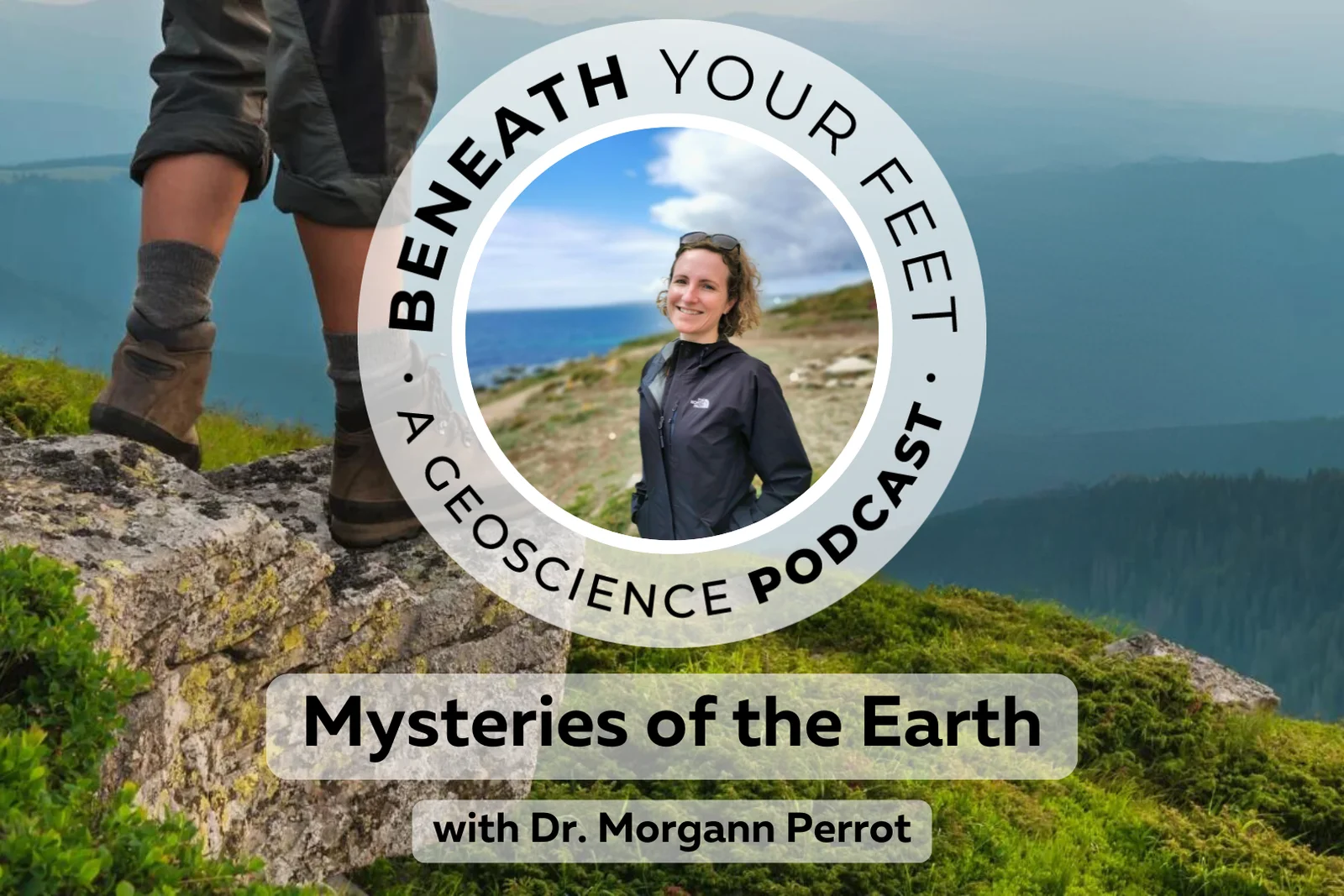
Mysteries of the Earth with Dr. Morgann Perrot
Perrot was never a hiker – she preferred to stay indoors thank you very much. It was much to her parents surprise (and hers!), when she discovered she loves geology. Her love of thriller books and murder mysteries first led her to study medical science, but she wasn’t satisfied. When she found geoscience and learned you can use science to solve mysteries of the earth, she knew that’s where she belonged. Now, Dr. Perrot explores the Appalachian mountains in the summertime, doing as much field work research as possible, and lecturing at McGill University during the rest of the year. Every day is different, and she loves the variety. Tune in to learn more about Perrot’s research and journey! Listen now: You can also listen to our podcast on these platforms: Amazon Music Apple Podcasts Spotify Read along with the podcast transcript: Introduction Hello, everyone. Welcome to Beneath Your Feet, a geoscience podcast. I’m Veronica Klassen, science communicator, geology enthusiast and your host. Here at the APGO Education Foundation, our mission is to spark curiosity and passion for the geology of Ontario. Whether you’re a geology nerd, science enthusiast, or nature lover, this podcast is for you. Join us as we geek out over fascinating geology, uncover the hidden storiesand secrets of our extraordinary planet and explore the captivating world beneath your feet. Veronica KlassenHello, everyone, and welcome to another episode of Beneath Your Feet. Today I am here with Dr. Morgann Perrot, who is a faculty lecturer at McGill University. She studies how the Earth’s crust deforms, breaks and builds mountains with a special interest in the northern Appalachians. She combines fieldwork with isotope geochemistry to piece together the tectonic history hidden in rocks. As a dedicated educator, she brings her research and field experience directly into the classroom, teaching, field mapping and structural geology related courses. I’m so excited that you’re here today with me, Dr. Morgan. Dr. Morgann PerrotHi, Veronica. It’s nice to be here with you. VeronicaSo first question, just tell us a bit about yourself. Who are you and what do you do? MorgannWell, I think you did a good synthesis of what I’m doing and that. So, yeah, I’m a lecturer at McGill University. I’m teaching structural geology, geology in the field. So also a field course about geology. So it’s a lot of geology courses that are linked to going outside, understanding rocks, how they deform when they are under pressure and stress and trying to understand this. And so this is linked to the how mountains are forming and deforming, actually. I’m teaching these courses and on the side I’m also doing some research about deformation too. So looking at how rocks will fold, crack. When do they do that? Looking at around us if we see some deformation and when did that happen? Because the earth is quite old, more than 4.5 billion years old. So some rocks have been deformed for billions of years. Some rocks are deforming just right now under our feet. So yeah, the question is when did that happen and why? So that’s the question I’m trying to answer. VeronicaOkay, that sounds super interesting. So what does a day in the life look like for you? MorgannI guess it really depends on the season, and that’s what I like about my job. Over a year things really change. So for example, during summer I’m going to do more fieldwork, I’m going to go outside. Especially being a researcher in Canada doing fieldwork, looking at rocks during winter, it’s not really possible. Well, especially because my research is also in Canada mostly, so when there is a lot of snow, it’s not really easy. So yeah, we’re doing field work mostly in the summer, so I concentrate my summers doing research, going outside in the fields, but also bringing back rocks in the lab and doing lab work. During fall and winter, I’m more teaching so I’m more in McGill with students, so I’m doing a lot of courses relating to going outside too. So we’re trying to deal with the weather. So when it’s nice weather, we’re going outside in the field. When it’s more snowy or cold, we stay inside and do more theoretical lectures, you know? So every day I’m going to do a bit of, you know, reviewing articles for colleagues, for other students, helping students to look at their thesis, master thesis, PhD thesis. Doing some tasks in the department and some colleagues need some help and support and yeah things like that. What’s fun is that there was not one day where I do the same thing, so I can’t really describe a really ideal day, you know, it changes everyday. VeronicaRight? Yeah, Yeah. There’s a lot of variety that’s awesome. And so are you doing your own research as well or you just like supervising research? How does that all work? MorgannYeah, so my main job as a lecturer is to teach. So I teach most of the semester, every semester, but on the side I’m also involved in some research projects. So it depends. There is some projects that I lead myself for myself mainly for my own interest, but there is also some project in which I’m involved with students for their masters thesis, for their PhD thesis. I’m not the principle supervisor of students at the moment. I just started at McGill. But I’m involved as collaborator in projects like this. I also, so what I’m trying since I started in McGill is to, every summer have an undergrad student working with me to do some initiation, to research, to be in the field, to do a bit of lab work. And I find this very important for students to discover really early on what is research and do they want to continue into masters or not, or into PhDs or not? VeronicaYeah, that’s really awesome and I think really useful for students hopefully to figure