

Headshot of Joanna Northover over image of a hikers boots and mountain landscape. Text reads: Beneath Your Feet. A Geoscience Podcast. FossilTok with Joannasaurus.

FossilTok with Joannasaurus

In our latest episode, we speak with @Joannasaurus — a paleontologist and science communicator who’s using TikTok to make fossils fascinating for everyone. Joanna talks about what it takes to make complex science accessible, the role of humour in online storytelling, and her roundabout journey to paleontology! Listen now: You can also listen to our podcast on these platforms: Amazon Music Apple Podcasts Spotify Read along with the podcast transcript: Introduction Hello, everyone. Welcome to Beneath Your Feet, a geoscience podcast. I’m Veronica Klassen, science communicator, geology enthusiast and your host. Here at the APGO Education Foundation, our mission is to spark curiosity and passion for the geology of Ontario. Whether you’re a geology nerd, science enthusiast, or nature lover, this podcast is for you. Join us as we geek out over fascinating geology, uncover the hidden storiesand secrets of our extraordinary planet and explore the captivating world beneath your feet. Veronica KlassenWell, welcome, everyone, to another episode of Beneath Your Feet. Today, I’m going to be talking to Joanna Northover, who is a science communicator on TikTok. We’re going to be talking about science communication, we’re going to talk about her career in geoscience, we’re going to talk about advice for students and all kinds of exciting things. So thanks so much for joining me, Joanna. JoannaNo problem. It’s my pleasure. It’s going to be a lot of fun. VeronicaAmazing. I’m very excited. All right. So why don’t we just start. Tell me a bit about yourself. Who are you and what do you do? JoannaAll right. Well, as you said, my name is Joanna Northover, but on TikTok, Instagram and YouTube, I go by Joannasaurus and I am a science communicator. But I started out interested in paleontology. So my science communication really centers around paleontology. So fossils, dinosaurs, things like that. And I have loved paleontology for as long as I can remember. And so it was sort of, I had a few stumbles along the way. We’ll probably talk about that later on. But I did do a master’s degree and an undergraduate degree in paleontology. But then I fell in love with science communication, and the rest, as they say, is history. VeronicaThat’s awesome. So yeah, so going a bit back, how did you originally become interested in paleontology and how has that journey sort of changed for you over time? JoannaAll right. So I guess a lot of people go through a dinosaur phase when they’re kids, and I was no exception. My was quite early. I really loved dinosaurs, even at a very young age and as young as the age of four, I declared that I was going to become a paleontologist. And that was a dream that I held for a very, very long time until I hit my teens. And, you know, I kind of got a little discouraged. I thought maybe this wasn’t a practical career, you know, And I thought, oh, well, maybe I’ll be a teacher instead, because I also really loved teaching. Even from a young age. I used to pretend to teach my little brother, you know, with a pointing stick and some little diagrams and stuff. And so when I was in high school, you know, I kind of pivoted a bit and I thought, Oh, I’ll do a degree, and then I’ll go to Teachers College. And I had really good marks in history and chemistry. So that’s what I applied to. I did actually apply to paleontology as well, and I got in at UofT, but I was too nervous to move all the way there because at the time I was one of the first years to do that double cohort thing where, you know, in Ontario we went from having grade 13 to going to grade 12. And so I was 17 when I graduated. I wasn’t even a legal adult, and I just felt like really nervous about going too far away from home all by myself. VeronicaCause where is home for you, sorry? JoannaOttawa. I grew up in Ottawa and that’s where I live now, so I didn’t want to go too far away from home. So I decided I would go to university at Ottawa U. And I decided to go into history and I did my first year of history and I dropped both of my history courses. So I was like, Wow, wow, this isn’t the right major. And I was like, well, maybe I made a mistake here, so that’s not a good sign. So I had done actually a first year geology course as one of my breadth courses when I was at Ottawa U. I’d also taken a lot of philosophy and I almost switched to a major in philosophy. My mom actually, of all people, said, Did you know that Carleton has just started a vertebrate paleontology concentration from the Earth Science Department? And so I applied right away. I switched over. I thought, you know what? I knew more when I was four than I know now. I just I’ll go to school and I’ll figure it out after. I’ll just, I have to study something I love or else this is going to be a disaster. And so I transferred over to Carleton and I started in the Earth Science department there doing my vertebrate paleontology concentration. And it was just magical. Suddenly it was easy to go to school. I wasn’t dropping my courses. I had so much fun. The department there was great, really supportive, and I liked it so much that after I did my bachelor’s degree, I ended up deciding to stay and do a graduate degree. I did a master’s degree also at Carleton. But while I was doing my bachelor’s and master’s, I started working in the summers at the Royal Tyrrell Museum of Paleontology, where I was working in the Science Education Department. And also I did some science education sort
Read More »
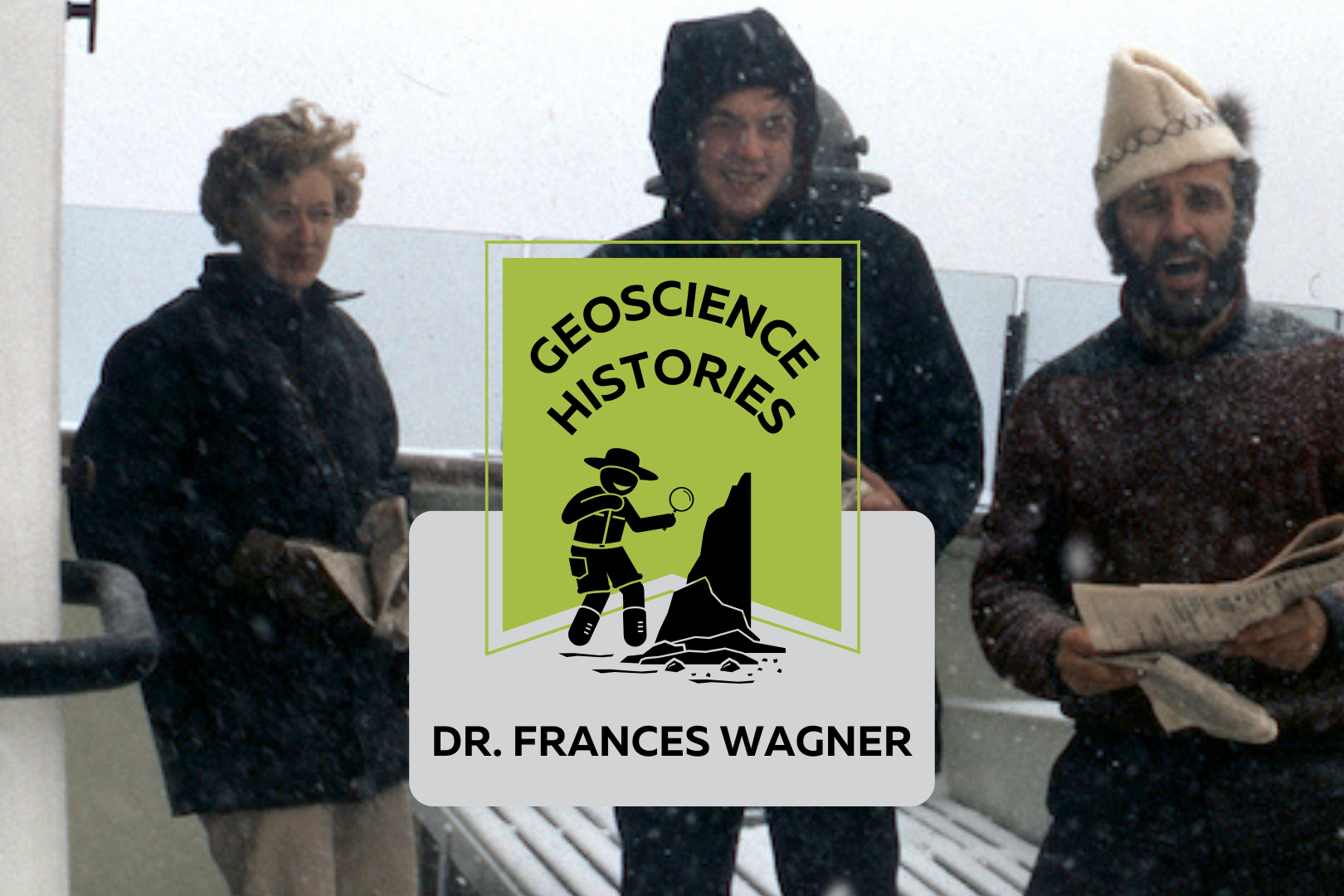
Three people standing on the deck of a boat with snow falling. Text on top of the photo reads: "Geoscience Histories, Frances Wagner"

Geoscience Histories: Dr. Frances Wagner

Frances Wagner was one of Canada’s first female geologists. Her studies in micropaleontology and mapping of Canada’s microscopic fossils were groundbreaking to our understanding of the geology of the continental shelves around Canada, especially the Arctic.  Frances was born in May of 1927 and grew up in Hamilton, Ontario, spending summers enjoying nature at her family’s cottage on Mary Lake. She and her brother would identify the lichens on the Canadian Shield rocks and go canoeing and exploring.  Wagner studied paleontology at the University of Toronto for her undergrad and went on to complete a Master’s degree in invertebrate paleontology at UofT. She researched Ordovician fossils near Ottawa under Dr. Alice Wilson (see our blog post on Dr. Wilson). The summer before she completed her Master’s degree she was hired by the Geological Survey of Canada (GSC) to catalogue fossil samples from the Victoria Museum in Ottawa. She was only the third woman to work at the GSC, in a time where women were considered too weak to do field work. Frances Wagner and her colleague Dr. Helen Belyea were some of the first women to work in the field at the GSC in the summer of 1950 with the support of Dr. Alice Wilson. Wagner went on to complete her PhD in micropaleontology at Stanford University in California. Her thesis was supervised by another groundbreaking female geoscientist Dr. Myra Keen. Her thesis was on marine Pleistocene deposits in southwestern British Columbia. She studied with a Geological Survey of Canada work party on the coast of British Columbia and shipped 350 pounds of samples from British Columbia to California to complete her studies. Her PhD allowed her to pioneer the study of marine micropaleontology. In 1954 Wagner returned to Ottawa to work full time at the GSC and complete her thesis at the same time. In order to complete her PhD she travelled three days by train to Stanford and three days back for her oral exam. In 1964, Wagner’s colleague Charlotte Keen was the first woman to travel on a research ship. The next summer, Dr. Wagner joined Keen and a few other women on the CSS Hudson to map the floor of Hudson’s Bay. The CSS Hudson was the first ship to circumnavigate North America. Wagner joined the ship as it traversed the dangerous Northwest Passage. This was a particularly perlious journey, and they concluded that the Northwest Passage was unsafe for travel. Chief Scientist Dr. Bernard Pelletier wrote in the ship report that at one point, “[the ship] rode up onto a particularly hard floe and slid off one side thereby heeling to port so abruptly and steeply that her guardrail almost touched the broken sea ice.” This is just a taste of the danger that Dr. Pelletier wrote in the report. While on the CSS Hudson, Dr. Wagner studied the ecological history of the Beaufort Sea and published groundbreaking work on the topic. In 1967, Dr. Wagner moved to Nova Scotia to work for the Bedford Institute of Oceanography. She used her experience in marine micropaleontology to study the microbiota of the Arctic and Atlantic continental shelves. In 1973 Dr. Wagner was elected as a Fellow of the Royal Canadian Geographical Society. In 1979 she co-authored a second paper on the Beaufort Shelf, this one focusing on the effects of disturbances, such as hydrocarbon drilling, on the marine ecology of the area. Outside of her career, Frances was an avid horsewoman. She owned two registered Morgan horses, Belle and Jay. She raised Jay from 5 months old and rode him for 24 years. She helped found the Nova Scotia Historical Riding Society and learned to ride sidesaddle in order to do demonstrations of traditional riding techniques at different Museum sites in Nova Scotia. She also researched and sewed traditional clothing for the Uniacke Heritage Society. Wagner was also a dog breeder. She had a kennel called Thicketwood where she bred Shetland Sheepdogs. She helped save the rare Norwegian Lundehund from extinction, importing them to Canada and breeding and showing them. Once she retired in 1984, she focused more of her time and attention on her dog breeding and horseback riding. She always had a love for the outdoors, and was an accomplished canoeist and long distance swimmer.  Wagner never married or had kids. When asked about it she said, “I was a career girl.” In Wagner’s day there was a lot of prejudice against women in the workplace getting married or having families. In Canada there was a law in place that allowed employers to fire female employees if they married. This legislation was only repealed in 1955, when Wagner was already 28 years old. Dr. Wagner had an immense influence on the field of micropaleontology in Canada. You can read one of Dr. Wagner’s publications, “Fossils of Ontario: Part 2: Macroinvertebrates and vertebrates of the Champlain Sea,” published by the Royal Ontario museum. Along with her female colleagues, she defied expectations and made major contributions to her field doing work that was previously considered improper or too difficult for women. Sources:  Science.ca Scientist Profile Frances Wagner Trowelblazers Frances Wagner NecroCanada Obituaries Frances Wagner Ada Lovelace Day Dr Frances Wagner Paleontology and stratigraphy of the marine Pleistocene deposits of Southwestern British Columbia. Fossils of Ontario: Part 2: Macroinvertebrates and vertebrates of the Champlain Sea Author Veronica Klassen is the Manager of the Foundation’s blog – Beneath Your Feet: A Geoscience Blog. She studied Arts and Science at McMaster University with a minor in Earth Science and has a masters in Science Communication from Laurentian University. She is passionate about making science accessible and engaging to the public.

Read More »
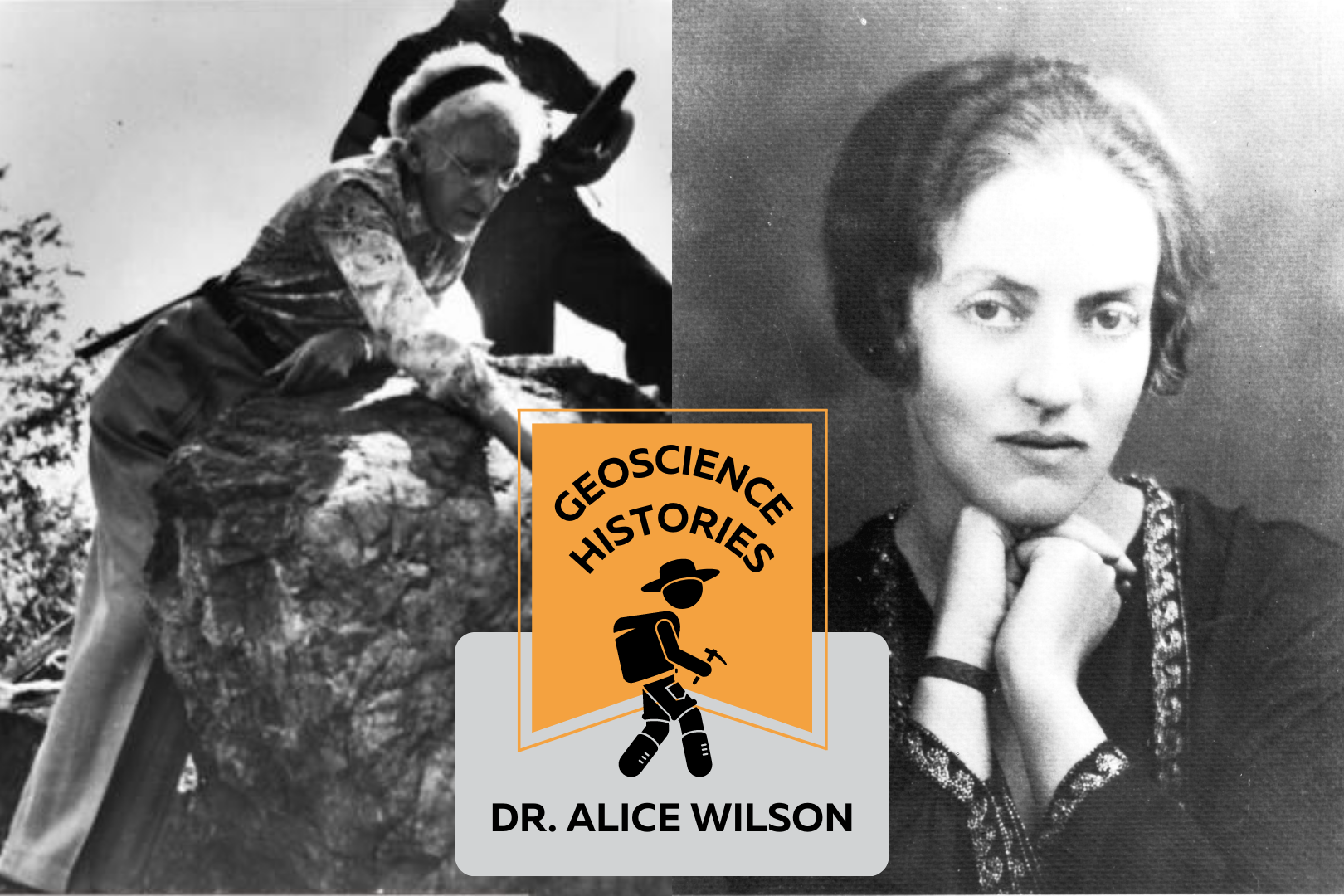
Two black and white images of Alice Wilson side by side. The left image is of Alice bending over a boulder. The right image is a headshot of a young Alice looking at the camera. Over the photos text reads: "Geoscience Histories: Dr. Alice Wilson"

Geoscience Histories: Dr. Alice Wilson

Dr. Alice Wilson, born August 1881, was one of Canada’s first female geologists, and the first female to be hired to work as a geologist at the Geological Survey of Canada. She persevered in the face of many personal and career-related challenges and paved a new path for women in geology in Canada. Alice Wilson grew up in a family that respected and encouraged education and exploration. She spent many summers canoeing, kayaking, and exploring the land and water around her family’s cottage in Ontario. Her father was a professor of Classics at the University of Toronto and both her brothers received PhD’s in their respective fields. When Alice was 20, she decided to study Classics at Victoria College in Toronto, with the goal of becoming a teacher. It’s unclear whether Alice actually wanted to pursue teaching or whether she did this because it was expected of her at the time. According to her friend Winston Sinclair, Alice said that in her youth teaching was the only acceptable field for a young lady. Perhaps this is why she decided to become a teacher. Her career path took a twist in her last year of university when she became very ill with anemia. She was unable to complete her courses and dropped out of school. After a few years in recovery, she started working in 1907 as a clerk at the University of Toronto. She had collected fossils as a child from the Cobourg Limestones near her home and was already passionate about palaeontology. In 1909 she became a museum assistant in the palaeontology department of the Geological Survey of Canada (GSC). In 1911, she finished her degree in Classics and was hired full time at the GSC. During this time, she connected with Percy Raymond who was the Chief Palaeontologist at the GSC. Her knowledge of languages came in handy when Percy needed her to translate a textbook of palaeontology from German to English. Percy connected with Alice and encouraged her to take a leave from the GSC in order to pursue a doctorate degree. Alice applied to take a paid leave in 1915 but she was rejected, despite the fact that other male geologists who applied for the same leave were granted it. Meadowcroft wrote that Alice believed her rejection was based solely on her gender, since the “fundamental reason [for rejection] has been that it would make a woman eligible for the highest positions in the Survey” (Meadowcroft, 1990, p. 208).  While she continued to apply for approval, Alice and Percy published an article on a new species of brachiopod. Unfortunately, when Percy left the GSC, Wilson’s other colleagues were not as eager to include her in their publications, and she was forced to work alone. In 1916, she paid for her own trip to Cold Spring Harbor, Long Island, NY to study comparative anatomy and marine biology for six weeks. When she returned to Canada in 1916, Wilson decided to help in the war effort for World War I. She joined the Canadian Women’s Army Corps (CWAC), an all-female military unit providing aid to the Canadian troops as decoders, drivers, cooks, stenographers, telephone operators and many other positions. The CWAC’s wore uniforms with a badge of three joined maple leaves, and on the collar of every uniform was an image of the helmeted head of Athene– the Goddess of War. As a willing volunteer for the CWAC, it is clear that Wilson didn’t shy away from danger or hard work. Women in the Canadian Women’s Army Corps were often subjected to disdain and discrimination from the Canadian public. General sentiment at the time was that women should be in the home, not in the army, and many people thought that women who joined the CWAC were of low moral standing. Wilson likely had to deal with some of this discrimination while serving with the CWAC.  Once the war was over, Alice Wilson returned to her position at the Geological Survey of Canada and continued to apply for leave to pursue further education. In 1926, she was awarded a scholarship by the Canadian Federation of University Women (CFUW) to fund her education leave. But even with the scholarship, the GSC still denied her leave. The CFUW lobbied for Alice, protesting her denied leave and demanding the GSC let her finish her education. The GSC finally relented and Wilson left to get her doctorate in geology at the University of Chicago. It had taken more than 10 years, but finally she received the education that she wanted.  When she returned to the Geological Survey of Canada, she was required to switch her area of research from Ordovician to Devonian rocks, due to the demand for petroleum in Western Canada. It was the Great Depression, and any research that could help Canada’s economy was prioritized. During this time, Dr. Wilson was responsible for ordering the National Type Collection of fossils, which is still an internationally recognized collection for fossil specimens. As she got older, Alice’s research started gaining recognition. She was the first woman to be elected as a Fellow at the Royal Society of Canada and the second woman to be a Fellow at the Royal Canadian Geographical Society. She received many other notable achievements, one of which was the Order of the British Empire (MBE) in 1935. The GSC, becoming more aware of Wilson’s achievements, promoted her to Assistant Geologist after she received the MBE. This designation should have been automatically given when she received her PhD 7 years earlier. But this wasn’t what Wilson wanted. She requested to be upgraded to Associate Palaeontologist, a title that she was never awarded throughout her career. Additionally, it wasn’t until 1945– nearly 16 years after she received her PhD– that her colleagues finally started referring to her as “Doctor”. During her time at the GSC, it would have been considered very indecent for a woman to join men on field work. So, she did her research by foot and

Read More »