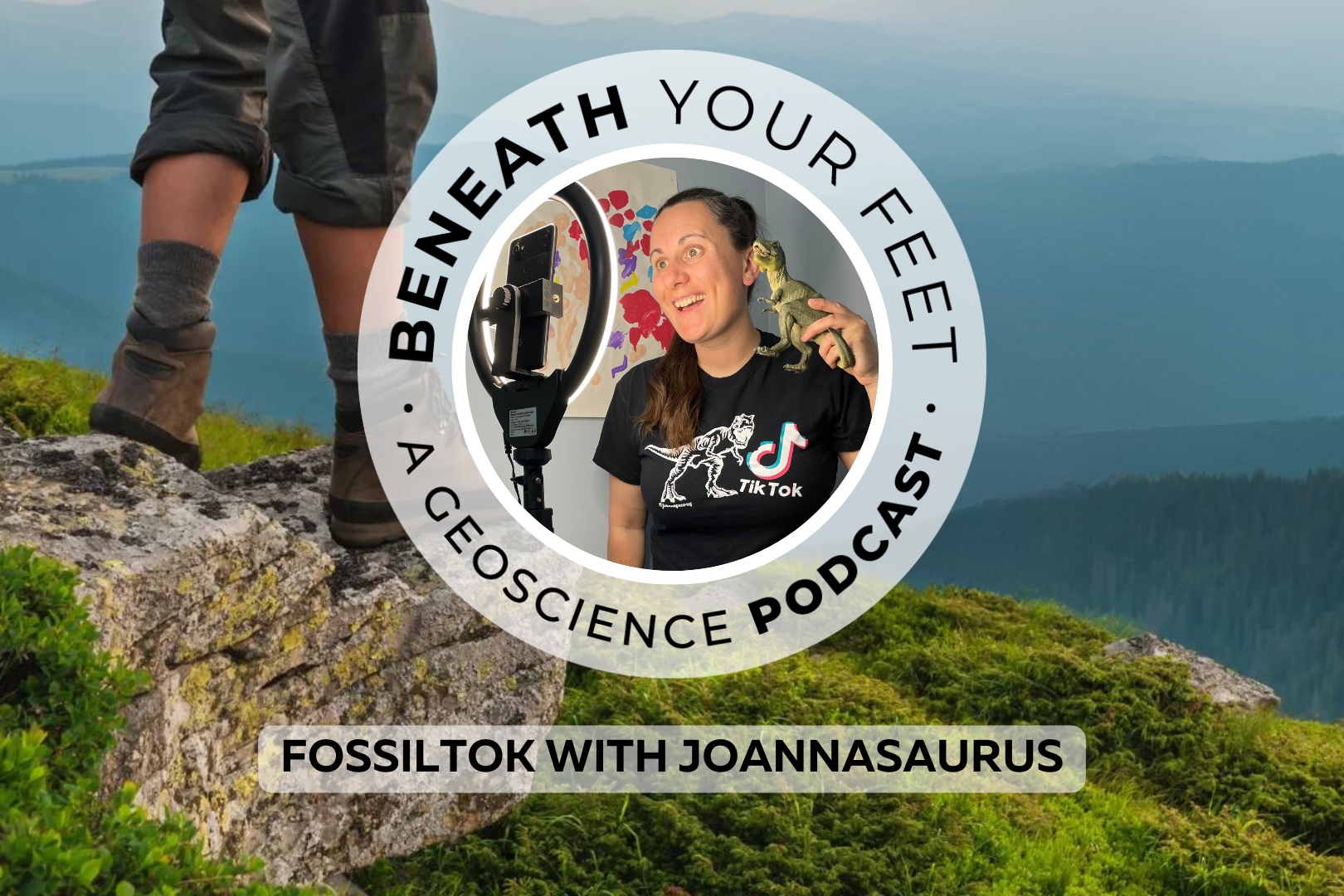
Headshot of Joanna Northover over image of a hikers boots and mountain landscape. Text reads: Beneath Your Feet. A Geoscience Podcast. FossilTok with Joannasaurus.

FossilTok with Joannasaurus

In our latest episode, we speak with @Joannasaurus — a paleontologist and science communicator who’s using TikTok to make fossils fascinating for everyone. Joanna talks about what it takes to make complex science accessible, the role of humour in online storytelling, and her roundabout journey to paleontology! Listen now: You can also listen to our podcast on these platforms: Amazon Music Apple Podcasts Spotify Read along with the podcast transcript: Introduction Hello, everyone. Welcome to Beneath Your Feet, a geoscience podcast. I’m Veronica Klassen, science communicator, geology enthusiast and your host. Here at the APGO Education Foundation, our mission is to spark curiosity and passion for the geology of Ontario. Whether you’re a geology nerd, science enthusiast, or nature lover, this podcast is for you. Join us as we geek out over fascinating geology, uncover the hidden storiesand secrets of our extraordinary planet and explore the captivating world beneath your feet. Veronica KlassenWell, welcome, everyone, to another episode of Beneath Your Feet. Today, I’m going to be talking to Joanna Northover, who is a science communicator on TikTok. We’re going to be talking about science communication, we’re going to talk about her career in geoscience, we’re going to talk about advice for students and all kinds of exciting things. So thanks so much for joining me, Joanna. JoannaNo problem. It’s my pleasure. It’s going to be a lot of fun. VeronicaAmazing. I’m very excited. All right. So why don’t we just start. Tell me a bit about yourself. Who are you and what do you do? JoannaAll right. Well, as you said, my name is Joanna Northover, but on TikTok, Instagram and YouTube, I go by Joannasaurus and I am a science communicator. But I started out interested in paleontology. So my science communication really centers around paleontology. So fossils, dinosaurs, things like that. And I have loved paleontology for as long as I can remember. And so it was sort of, I had a few stumbles along the way. We’ll probably talk about that later on. But I did do a master’s degree and an undergraduate degree in paleontology. But then I fell in love with science communication, and the rest, as they say, is history. VeronicaThat’s awesome. So yeah, so going a bit back, how did you originally become interested in paleontology and how has that journey sort of changed for you over time? JoannaAll right. So I guess a lot of people go through a dinosaur phase when they’re kids, and I was no exception. My was quite early. I really loved dinosaurs, even at a very young age and as young as the age of four, I declared that I was going to become a paleontologist. And that was a dream that I held for a very, very long time until I hit my teens. And, you know, I kind of got a little discouraged. I thought maybe this wasn’t a practical career, you know, And I thought, oh, well, maybe I’ll be a teacher instead, because I also really loved teaching. Even from a young age. I used to pretend to teach my little brother, you know, with a pointing stick and some little diagrams and stuff. And so when I was in high school, you know, I kind of pivoted a bit and I thought, Oh, I’ll do a degree, and then I’ll go to Teachers College. And I had really good marks in history and chemistry. So that’s what I applied to. I did actually apply to paleontology as well, and I got in at UofT, but I was too nervous to move all the way there because at the time I was one of the first years to do that double cohort thing where, you know, in Ontario we went from having grade 13 to going to grade 12. And so I was 17 when I graduated. I wasn’t even a legal adult, and I just felt like really nervous about going too far away from home all by myself. VeronicaCause where is home for you, sorry? JoannaOttawa. I grew up in Ottawa and that’s where I live now, so I didn’t want to go too far away from home. So I decided I would go to university at Ottawa U. And I decided to go into history and I did my first year of history and I dropped both of my history courses. So I was like, Wow, wow, this isn’t the right major. And I was like, well, maybe I made a mistake here, so that’s not a good sign. So I had done actually a first year geology course as one of my breadth courses when I was at Ottawa U. I’d also taken a lot of philosophy and I almost switched to a major in philosophy. My mom actually, of all people, said, Did you know that Carleton has just started a vertebrate paleontology concentration from the Earth Science Department? And so I applied right away. I switched over. I thought, you know what? I knew more when I was four than I know now. I just I’ll go to school and I’ll figure it out after. I’ll just, I have to study something I love or else this is going to be a disaster. And so I transferred over to Carleton and I started in the Earth Science department there doing my vertebrate paleontology concentration. And it was just magical. Suddenly it was easy to go to school. I wasn’t dropping my courses. I had so much fun. The department there was great, really supportive, and I liked it so much that after I did my bachelor’s degree, I ended up deciding to stay and do a graduate degree. I did a master’s degree also at Carleton. But while I was doing my bachelor’s and master’s, I started working in the summers at the Royal Tyrrell Museum of Paleontology, where I was working in the Science Education Department. And also I did some science education sort
Read More »
A hiker stands on the top of an outcrop looking over a distant mountain scene. Text reads: "Beneath Your Feet. A geoscience podcast."

PODCAST EPISODE 1: Devonian Discoveries: Fossils at Wainfleet Wetlands with Paleontologist Dr. Daniel Dick

Join podcast host Veronica Klassen and guest paleontologist Dr. Daniel Dick as we delve into the creation of a GeoHike at Wainfleet Wetlands. Discover the unique ecosystem of the middle Devonian period through an array of fascinating features: encounter colonial organisms, massive corals, glacial striations, and pop-up structures. We’ll discuss potentially undiscovered fossils, augmented reality animations to bring fossilized animals to life, and what counting layers on rugose corals can tell us about the speed of the Earth’s rotation in the Devonian. Episode Audio: You can also listen to our podcast on these platforms: Episode Transcript: Dr. Daniel Dick (Dan) It looks like an ecosystem where the water was just drained out of it. It feels alive and it will really help you understand just how different the world used to be. I think that is the main thing that makes paleontology interesting. It just shows you that the world has changed so much, and it will blow your mind. [musical interlude] Veronica Klassen Hello, everyone. Welcome to Beneath Your Feet, a geoscience podcast. I’m Veronica Klassen, science communicator, geology enthusiast and your host. Here at the APGO Education Foundation, our mission is to spark curiosity and passion for the geology of Ontario. Whether you’re a geology nerd, science enthusiast, or nature lover, this podcast is for you. Join us as we geek out over fascinating geology, uncover the hidden stories and secrets of our extraordinary planet, and explore the captivating world beneath your feet. [musical interlude] Veronica All right, let’s get started. Today, I’m going to be talking to Daniel Dick, who is a researcher at McMaster University. Daniel, why don’t you start by telling us a bit about yourself? Dan Yeah, I mean, you covered quite a bit there. I’m Dan. I’m a postdoc at McMaster, primarily working on this public outreach project that we’ve been developing over the last few years. Which, in conjunction with the APGO Education Foundation, is developing this website, GeoscienceINFO, and primarily we are working on the GeoHikes. Research-wise, I’m a paleontologist. I focus primarily on fossils. I work on mass extinction events and trying to understand the dynamics of them, with the end goal of hopefully applying some of the knowledge we might learn from past extinction events to help us understand contemporary extinction dynamics and areas of risk and things like this. Yeah, so, my research sort of takes me all over. It’s primarily focused on Ordovician-Silurian fossils. So that’s a lot of stuff that we find here in Ontario, but also in other parts of Canada and the United States and such. Veronica Amazing. So how did you originally get interested in geoscience? Like, what led you here? Dan I’ve definitely been interested in it for a very long time. I have photos as a kid at the Royal Tyrrell Museum staring at the fossils, and you can sort of see that it’s already something I’m obsessed with at that point. But the beginning of the journey, I think, was in high school because my high school actually had Earth science courses up to grade 12 in B.C., where that’s sort of more standard. And I’d kind of forgotten how much I like geoscience, I think until those late courses. And it reminded me, oh yeah, I forgot that this was a thing. And that was something that I enjoyed and was good at as well, which helped. Veronica So, it was kind of high school, then you decided to study it in university. Did you go straight into geoscience? Dan Yeah, I didn’t actually go straight into it. I went into evolutionary anthropology, so I was focused more on human evolution and human fossils and things like that. But then found myself realizing that the questions and things I was more interested in could more easily be answered by working with non-human fossils, because you need large numbers of things, so you need lots of fossils in order to start to understand things like extinction dynamics and climate change and all that kind of stuff. And so, I switched over to more standard and invertebrate paleontology at that point for my Ph.D., which then looked at those kinds of questions. Veronica So, when you say those kinds of questions, you’re talking about extinction events and how we can learn from that? Is what you mean? Dan Yeah, absolutely. Yeah. Veronica Yeah, for sure. And just for a little bit more context do you want to explain kind of like what the GeoHikes are, what’s like the purpose of the GeoHikes? Dan For sure. So basically, like the GeoHikes are kind of a, they’re sort of a freely accessible trail guide in a literal sense, that’s what they are. They take you along an existing hiking trail that has some sort of geologically interesting features on it, and there’ll be a series of stops which will take you to these different features and will describe for a general audience what’s going on geologically. Occasionally we do other things beyond geology. We also look at ecology, for example, talk about invasive species or we’ll find fossils on some of the hikes, and we’ll talk about ancient ecosystems or mass extinctions or whatever it is we’re doing. And my personal vision for them, is I see them sort of as a living first year Earth science lecture. They’re simple in the sense that they should be understood by anyone. But instead of having a textbook figure or something explaining the process of erosion or soil formation or something, you go to a physical location where this is all on display. And so, the figure that you would normally look at in a textbook is now there in front of you in real life and offers an opportunity to learn this. Ideally, the way I see it is if you do enough of these GeoHikes, you will get all the basic information you would need to understand, you know, the sophistication of

Read More »
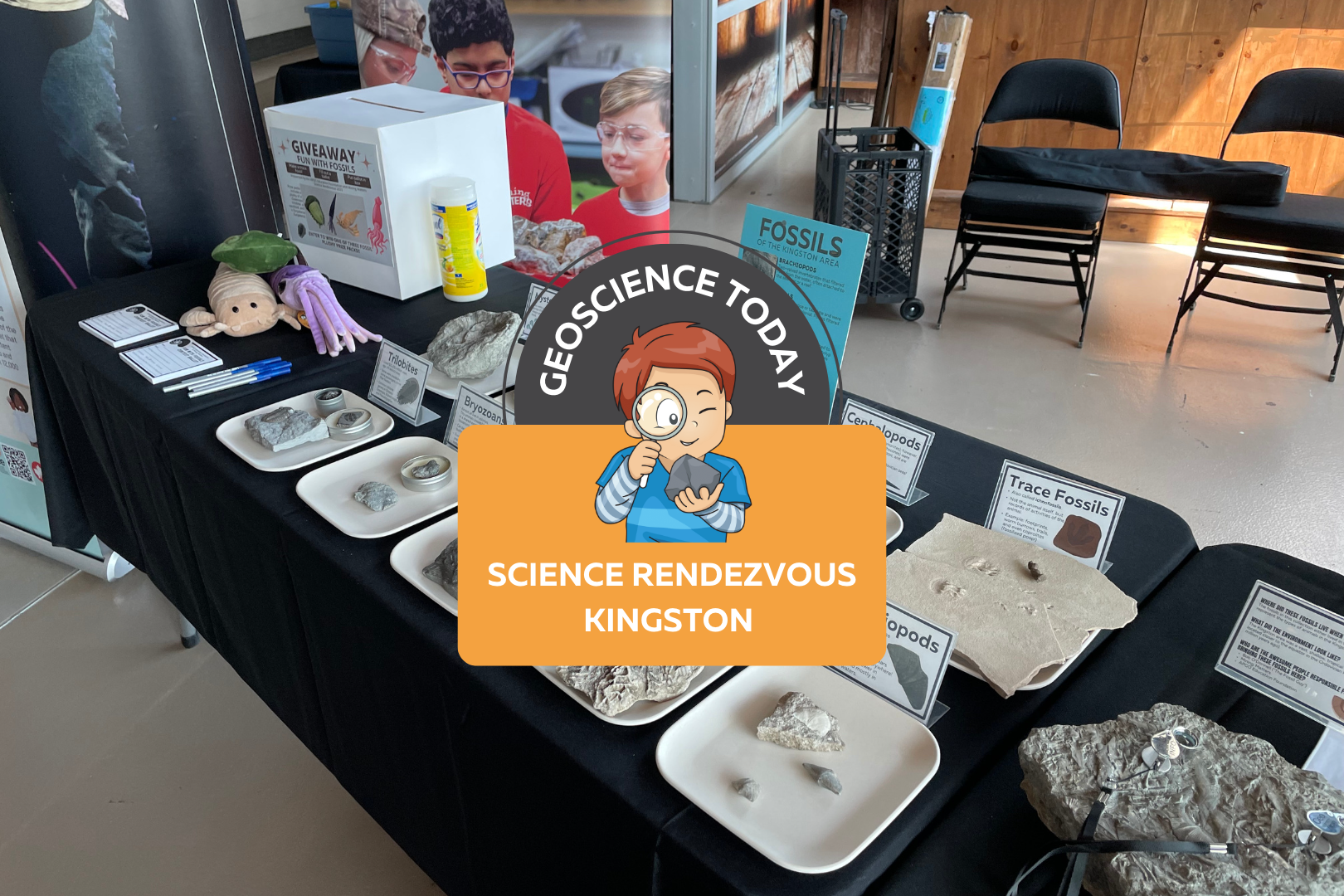
The APGOEF table at Science Rendezvous with fossils and stuffed animals. On top of the image text reads "Geoscience today: Science Rendezvous Kingston"

AGPOEF at Science Rendezvous Kingston

The APGO Education Foundation was excited to participate in Science Rendezvous in Kingston on May 13th, 2023! APGOEF has attended Science Rendezvous Kingston in previous years, and it has always been an incredible outreach event.  The day started with opening ceremonies where the official town crier announced the decision to make May 13th, 2023, the official “Science Rendezvous Day.” The town crier along with the mayor opened the doors at 10am to allow the crowd of families into the Leon’s Centre on the Tragically Hip Way by Kingston’s waterfront.  APGOEF collaborated with Mining Matters to create a fun table about the fossils of Kingston! Our booth was right next to the entrance to the Leon’s Centre and the crowd was instantly lining up to take a look at our fossils. We had an extensive fossil collection on display; some of which were donated to us by Bob O’Donnell.  We engaged kids by handing out stickers that said “I love fossils.” The kids loved them, putting them on their hands and t-shirts or tucking them away safely into their tote bags provided by Science Rendezvous. We also brought our signature colour-changing pencils, which are always a hit at any event we go to. We showed the children how, if you rub the pencil between your hands, it will change from black to pink or blue! Everyone was obsessed with the pencils and we handed out 500 or more.  We also had an interactive trace fossil activity with Play Doh. We provided an assortment of invertebrate fossils such as brachiopods, bryozoans, and corals, and encouraged people to press the fossils into the Play Doh and lift them out leaving behind a pattern. These patterns are similar to how trace fossils are made when the organism is alive, and sometimes all we have preserved of an organism is records of its behaviour in the sediment and not the animal itself! We also had some fun trace fossils on hand to surprise kids, such as footprints and coprolites (fossilized poop!) Once the kids were finished playing with the fossils and Play Doh, they moved further down the table to take a look at some cool fossil samples that could be found in the Kingston area. We explained how Kingston used to be under a massive shallow sea, and how all the sea creatures we see fossilized here used to live in the sea. We encouraged kids and parents to look around the limestones of Kingston to see some of the same fossils that were displayed here. At the end of the table we held a giveaway for three really cute fossil plushies as well as a copy of Four Billion Years and Counting, the beautifully illustrated geology textbook. We had families fill out a slip of paper answering questions about the fossils they interacted with in order to enter the giveaway. We picked three winners from the ballots the following day and mailed them their prizes. Approximately 1,300 people visited our booth during the 5 hour event. We really enjoyed talking to parents, kids, and individuals about the fossils of Kingston. A lot of the children expressed interest in fossils and some said that they had some fossils or rocks at home already. One child mentioned that he found a fossil on the way to school recently, and a few kids said that they loved dinosaurs. Although we didn’t have any dinosaurs at our table (you won’t find any dinosaur fossils in Kingston, or Ontario generally), we were still excited to connect with the kids about their passions.  The other organizations at Science Rendezvous all had incredible booths! We did not have much of a chance to walk around and see the other exhibits because we were so busy, but the whole event looked like a big success.  We would like to thank Science Rendezvous Kingston for having us again this year and for hosting such an incredible event. We also want to thank Bob O’Donnell for donating some of the beautiful fossils that really made our table a hit. We look forward to doing this again in the future!     Veronica Klassen is the Manager of the Foundation’s blog – Beneath Your Feet: A Geoscience Blog. She studied Arts and Science at McMaster University with a minor in Earth Science and has a Master’s in Science Communication from Laurentian University. She is passionate about making science accessible and engaging to the public.

Read More »