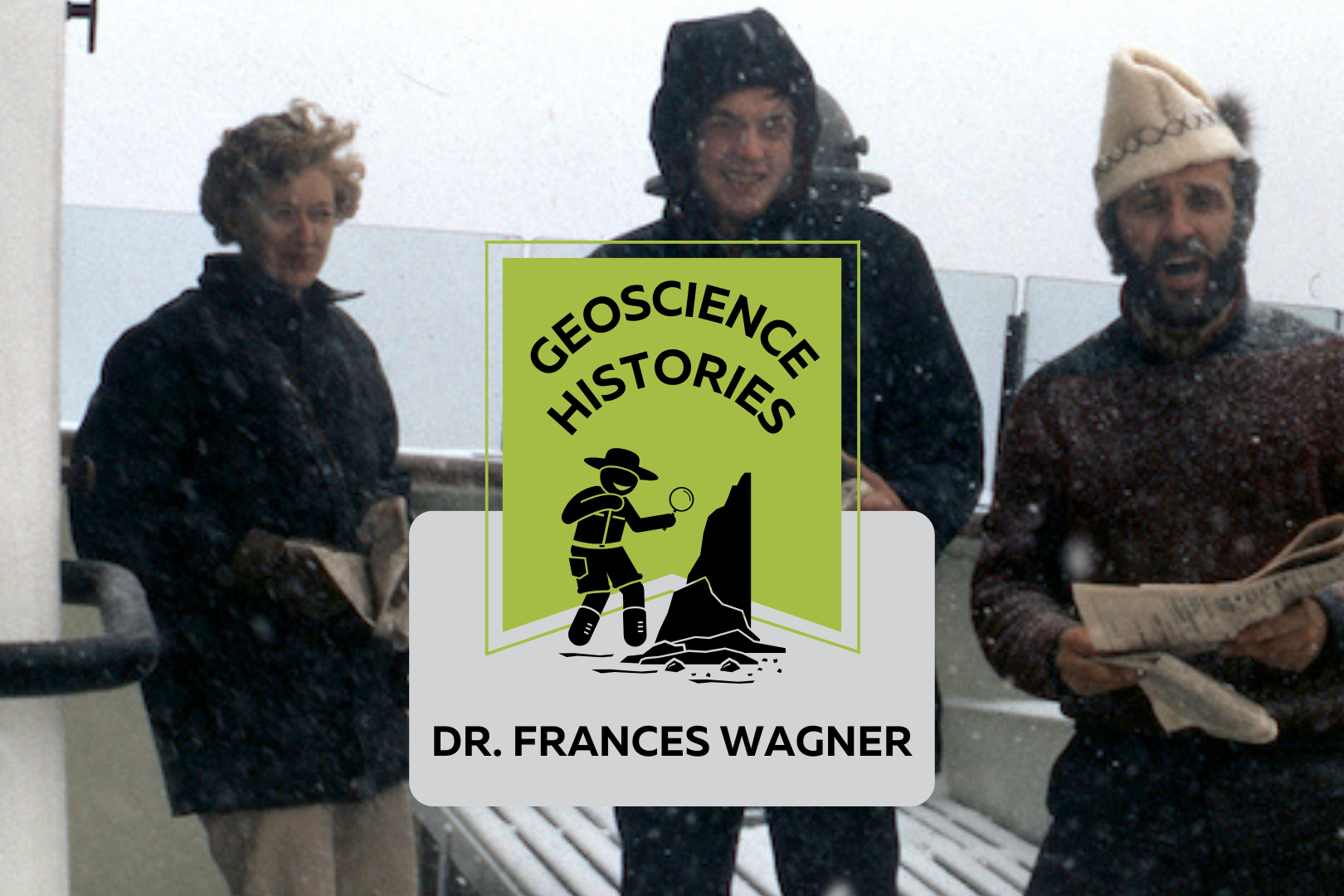
Three people standing on the deck of a boat with snow falling. Text on top of the photo reads: "Geoscience Histories, Frances Wagner"

Geoscience Histories: Dr. Frances Wagner

Frances Wagner was one of Canada’s first female geologists. Her studies in micropaleontology and mapping of Canada’s microscopic fossils were groundbreaking to our understanding of the geology of the continental shelves around Canada, especially the Arctic.  Frances was born in May of 1927 and grew up in Hamilton, Ontario, spending summers enjoying nature at her family’s cottage on Mary Lake. She and her brother would identify the lichens on the Canadian Shield rocks and go canoeing and exploring.  Wagner studied paleontology at the University of Toronto for her undergrad and went on to complete a Master’s degree in invertebrate paleontology at UofT. She researched Ordovician fossils near Ottawa under Dr. Alice Wilson (see our blog post on Dr. Wilson). The summer before she completed her Master’s degree she was hired by the Geological Survey of Canada (GSC) to catalogue fossil samples from the Victoria Museum in Ottawa. She was only the third woman to work at the GSC, in a time where women were considered too weak to do field work. Frances Wagner and her colleague Dr. Helen Belyea were some of the first women to work in the field at the GSC in the summer of 1950 with the support of Dr. Alice Wilson. Wagner went on to complete her PhD in micropaleontology at Stanford University in California. Her thesis was supervised by another groundbreaking female geoscientist Dr. Myra Keen. Her thesis was on marine Pleistocene deposits in southwestern British Columbia. She studied with a Geological Survey of Canada work party on the coast of British Columbia and shipped 350 pounds of samples from British Columbia to California to complete her studies. Her PhD allowed her to pioneer the study of marine micropaleontology. In 1954 Wagner returned to Ottawa to work full time at the GSC and complete her thesis at the same time. In order to complete her PhD she travelled three days by train to Stanford and three days back for her oral exam. In 1964, Wagner’s colleague Charlotte Keen was the first woman to travel on a research ship. The next summer, Dr. Wagner joined Keen and a few other women on the CSS Hudson to map the floor of Hudson’s Bay. The CSS Hudson was the first ship to circumnavigate North America. Wagner joined the ship as it traversed the dangerous Northwest Passage. This was a particularly perlious journey, and they concluded that the Northwest Passage was unsafe for travel. Chief Scientist Dr. Bernard Pelletier wrote in the ship report that at one point, “[the ship] rode up onto a particularly hard floe and slid off one side thereby heeling to port so abruptly and steeply that her guardrail almost touched the broken sea ice.” This is just a taste of the danger that Dr. Pelletier wrote in the report. While on the CSS Hudson, Dr. Wagner studied the ecological history of the Beaufort Sea and published groundbreaking work on the topic. In 1967, Dr. Wagner moved to Nova Scotia to work for the Bedford Institute of Oceanography. She used her experience in marine micropaleontology to study the microbiota of the Arctic and Atlantic continental shelves. In 1973 Dr. Wagner was elected as a Fellow of the Royal Canadian Geographical Society. In 1979 she co-authored a second paper on the Beaufort Shelf, this one focusing on the effects of disturbances, such as hydrocarbon drilling, on the marine ecology of the area. Outside of her career, Frances was an avid horsewoman. She owned two registered Morgan horses, Belle and Jay. She raised Jay from 5 months old and rode him for 24 years. She helped found the Nova Scotia Historical Riding Society and learned to ride sidesaddle in order to do demonstrations of traditional riding techniques at different Museum sites in Nova Scotia. She also researched and sewed traditional clothing for the Uniacke Heritage Society. Wagner was also a dog breeder. She had a kennel called Thicketwood where she bred Shetland Sheepdogs. She helped save the rare Norwegian Lundehund from extinction, importing them to Canada and breeding and showing them. Once she retired in 1984, she focused more of her time and attention on her dog breeding and horseback riding. She always had a love for the outdoors, and was an accomplished canoeist and long distance swimmer.  Wagner never married or had kids. When asked about it she said, “I was a career girl.” In Wagner’s day there was a lot of prejudice against women in the workplace getting married or having families. In Canada there was a law in place that allowed employers to fire female employees if they married. This legislation was only repealed in 1955, when Wagner was already 28 years old. Dr. Wagner had an immense influence on the field of micropaleontology in Canada. You can read one of Dr. Wagner’s publications, “Fossils of Ontario: Part 2: Macroinvertebrates and vertebrates of the Champlain Sea,” published by the Royal Ontario museum. Along with her female colleagues, she defied expectations and made major contributions to her field doing work that was previously considered improper or too difficult for women. Sources:  Science.ca Scientist Profile Frances Wagner Trowelblazers Frances Wagner NecroCanada Obituaries Frances Wagner Ada Lovelace Day Dr Frances Wagner Paleontology and stratigraphy of the marine Pleistocene deposits of Southwestern British Columbia. Fossils of Ontario: Part 2: Macroinvertebrates and vertebrates of the Champlain Sea Author Veronica Klassen is the Manager of the Foundation’s blog – Beneath Your Feet: A Geoscience Blog. She studied Arts and Science at McMaster University with a minor in Earth Science and has a masters in Science Communication from Laurentian University. She is passionate about making science accessible and engaging to the public.
Read More »
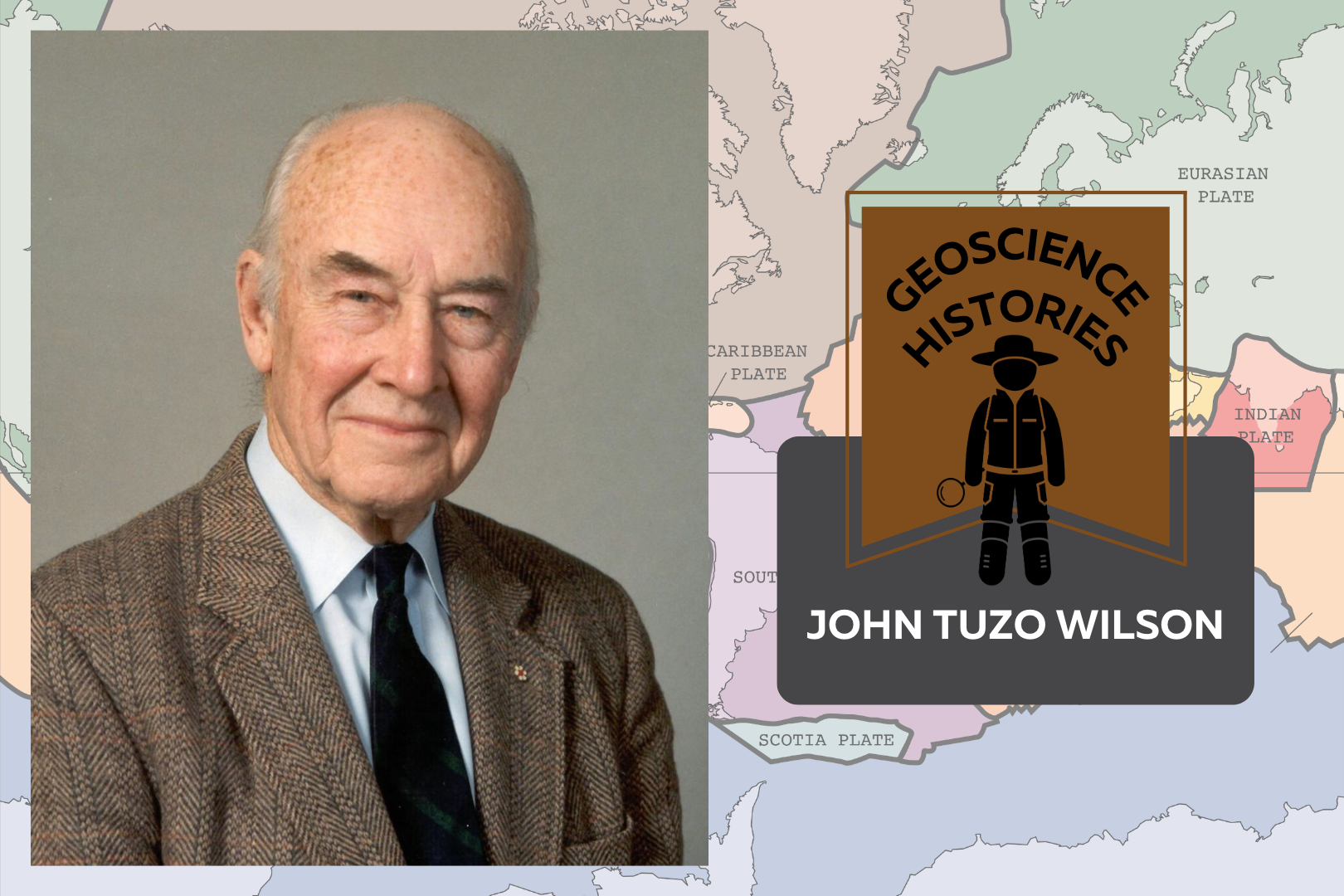
Headshot of John Tuzo Wilson beside text saying: Geoscience Histories: John Tuzo Wilson. In the background there is a colourful map of the world with the tectonic plates outlined

Geoscience Histories: John Tuzo Wilson

Canada’s history is full of geoscientists who have made important discoveries in the field of geoscience. Geoscientists work to help advance technology, solve problems, preserve the environment, and understand Earth’s processes. One important geologist in Canada’s history is John Tuzo Wilson, known for his contributions to the field of plate tectonics.  John was born in Ottawa, in 1908, to Robert Wilson and Annie Tuzo. His father worked for the Canadian government as an engineer and his mother was an adventurous mountain-climber. Annie had a mountain peak named after her, Mount Tuzo, after she and her guide, Christian Bohren, were the first people to ascend the peak. John’s interest in geology began when he was quite young, and he used to collect rocks and fossils on family trips growing up. John studied physics and geology in his undergrad at the University of Toronto (U of T), graduating in 1930. At the time there was no geophysics program at U of T, however, John found instruction wherever he could and did a joint degree instead. He then moved to England on a Massey Fellowship to study at Cambridge. John moved to Princeton for his Ph.D., completing field work on his own in the Beartooth Mountains in Montana.  After his studies, Tuzo Wilson worked for the Geological Survey of Canada as an Assistant Geologist. In 1938, John married Isabel Dickson in Ottawa. When World War II started, he joined the Royal Canadian Engineers, gaining rank to become a colonel. Isabel followed John to England to be closer to him during the war. They returned to Canada together in 1944 and he started a job as a Professor at the University of Toronto. It was here that John Wilson would spend the bulk of the rest of his career.  John Tuzo Wilson via Smorris123 at English Wikipedia, CC BY-SA 3.0, via Wikimedia Commons John’s research at U of T greatly influenced the field of plate tectonics. At the time, Alfred Wegener’s theory of continental drift was largely disputed. Wegener’s theory, published in the early 1900s, asserted that the continents move in relation to one another over long periods of time. But there were inconsistencies in his theory and a lack of evidence. John initially opposed the theory like most of his colleagues, but reconsidered his position later on. This reconsideration ultimately led to Wilson’s theory of plate tectonics.  One of John’s significant contributions to the theory of plate tectonics was the idea of “hot spots.” He drew inspiration from studying the Hawaiian Islands, theorizing that the islands were created as the Pacific tectonic plate moved northwest, over a magma plume in the mantle. This created the chain of volcanoes decreasing in size and intensity to the southwest. This theory resolved some of the contradictions in Wegener’s continental drift theory. Wegner’s theory asserted that volcanoes form solely as a result of movement at the edges of tectonic plates and so was highly disputed because of the lack of explanation for volcanoes located away from plate boundaries (such as Hawaii). Wilson’s new hot spot theory provided an explanation for why there are volcanoes in other places as well as at plate boundaries.  John’s second major discovery was that of transform faults. A transform fault occurs when two plates move past one another,  sometimes resulting in a build-up of stress (e.g., shear stress). Transform faults may cause landforms to break and move past each other, thereby looking offset from each other in aerial view. This new theory of faults explained the topography of mid-ocean ridges and greatly contributed to the larger theory of plate tectonics.  John continued to teach and research at U of T for many years, but even after he retired from the University, he continued to teach his theories, travelling to over 100 countries. He particularly loved travelling to China, and even wrote a book about his trip to China in 1958 entitled “One Chinese Moon.” He produced the tv series “Planet Earth,” and introduced many episodes, continuing his love for teaching. After Wilson retired, he became the director of the Ontario Science Centre, encouraging exploration and interest in science. He famously posted “please touch” signs on the exhibits. He wanted the centre to be a combination of artefacts and hands-on experiments, and often interacted with visitors and school groups. He also supported the introduction of travelling science exhibits in order to make science accessible to remote Ontario communities. The success of the travelling exhibits contributed to the creation of Science North in Sudbury, which Wilson supported.  John Tuzo Wilson’s many discoveries led to our current theory of plate tectonics. His willingness to test the boundaries of science is what gave him great success. His passion for teaching and love for student exploration has greatly impacted the effectiveness of science centres in Ontario.  Nick Eyles recently published a book about John Tuzo Wilson entitled “Tuzo: the unlikely revolutionary of plate tectonics.” It is an enlightening look at Tuzo’s life and career. APGOEF’s president Dr. Bill Pearson describes the book such: Nick has done a tremendous job pulling together a vast amount of historical information not just on the remarkable life and prodigious achievements of Tuzo Wilson but also documenting in fascinating detail the long and protracted battle between those that believed in a contracting earth versus those that believed in continental drift which eventually evolved into what we now know as plate tectonics…The book wonderfully documents the incredible technical revolution especially following WWII that revolutionized the science of geology and moved it rapidly forward…The account of his WWII service is outstanding, and Nick eloquently outlines how his experiences then gave Tuzo many lifelong skills in communication and leadership that would serve him well in future years…It is a fitting tribute to a remarkable man who is unquestionably Canada’s greatest geoscientist.  Dr. Bill Pearson Check out the book at the University of Toronto Press or Amazon. Sources: Brittanica: J. Tuzo Wilson The Canadian Encyclopedia: John Tuzo Wilson The Canadian Encyclopedia: John Tuzo Wilson’s Theory

Read More »
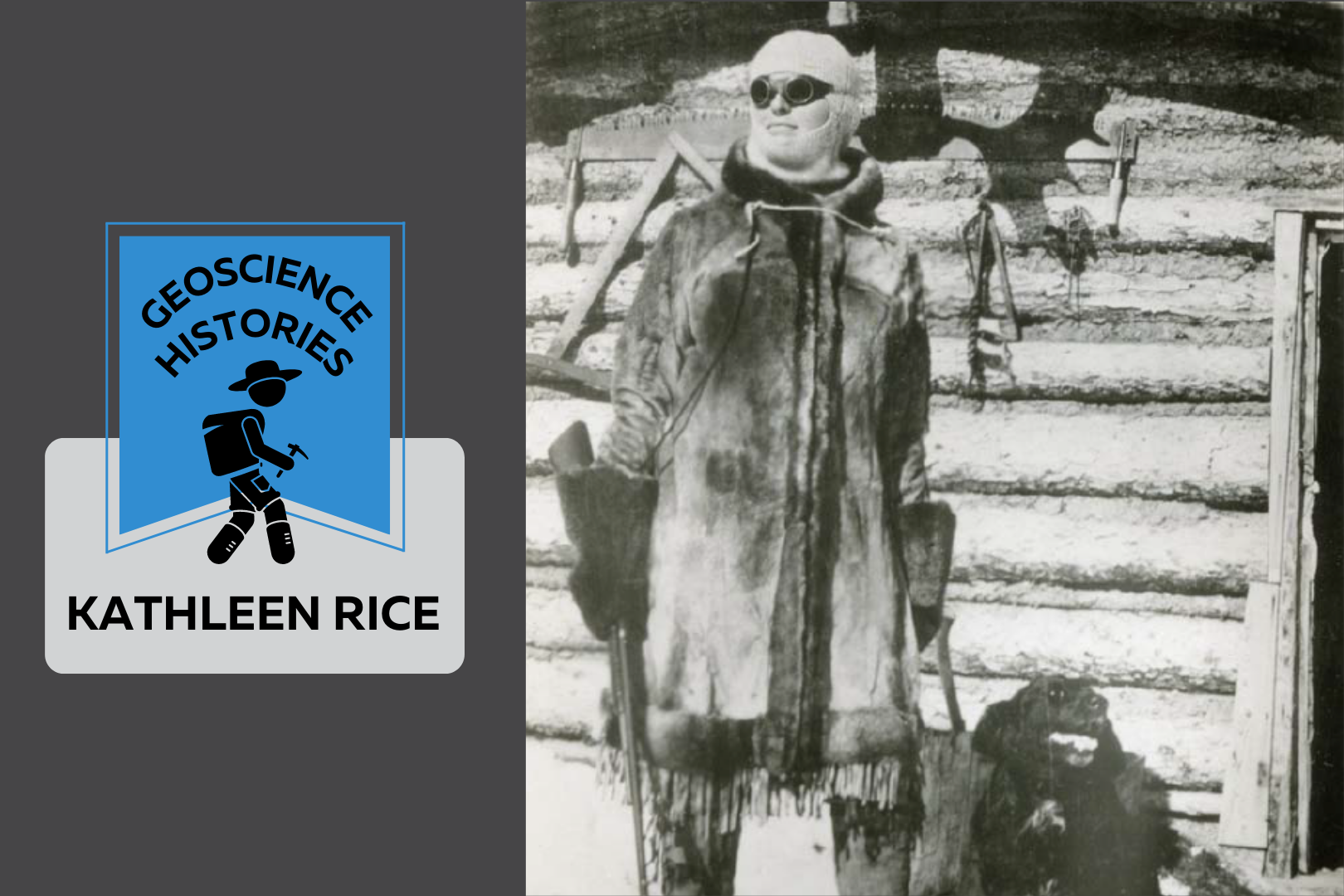
Black and white photo of Kate Rice. She stands looking into the distance dressed in a large coat and dark sunglasses. She is holding a gun and behind her is her log cabin. Beside the photo text reads: Geoscience Histories. Kate Rice.

Geoscience Histories: Kathleen Rice

Kathleen (Kate) Rice, also known as the Lady of the Lake, was an adventurer, prospector, wilderness survivalist, musher, hunter, trapper, and writer—despite living in a time where it was considered improper for middle- and upper-class women to do any of these things. She defied the expectations put on her as a single woman and lived her life in the wilderness of Northern Manitoba. She consistently chose nature over civilization and became proficient in the skills necessary to make a life for herself as a mineral prospector. Born in St. Mary’s Ontario, Kate’s parents taught her a love of nature growing up. Her dad showed her how to canoe and camp and told her stories of pioneering and exploration. Kate’s dad wanted to be an explorer himself, but instead took a more practical job teaching. Her father’s dreams and aspirations were possibly part of the reason that Kate became an explorer herself. Kate Rice studied mathematics, physics and astronomy in the early 1900s at the University of Toronto. She was awarded the prestigious Edward Blake scholarship twice and became a math teacher once she graduated. She was smart and gifted, but it wasn’t all easy going for her. When talking about teaching in a very male-dominated subject, she described that she was “constantly up against a feeling that [she] ought not to be there” (CIM Magazine). Maybe it was this feeling that drove Rice to live alone in the woods, or maybe it was simply the call of nature. In 1911, Rice moved near the Rocky Mountains for a teaching job and decided to take up mountaineering. She explored the Cascade Mountains and joined the Alpine Club of Canada, falling in love with a life outdoors. After only 5 years of teaching, she decided to give up her job and move up North to start a homestead. The Canadian government at the time was encouraging European settlers to explore the “new frontier”—Canada’s North. Of course, northern areas of Canada were not in fact new or unexplored, as Indigenous peoples had lived and travelled there since time immemorial. Kate moved up North as a colonial settler, which makes it difficult to decipher the true nature of Kate’s relationship with Indigenous people. We do know that she forged friendships with local Cree people, learned to speak Cree, and learned many life skills from her friends. However, the colonial nature of Canadian exploration adds complexity to her relationship with the Cree people which we cannot discount. Although the Canadian government wanted settlers to move up North, Kate was not legally allowed to buy land. Women weren’t considered people in Canada until 1929, so she enlisted her brother to buy a piece of land for her in his name. She bought a piece of land north of The Pas in Manitoba and she moved there in 1913. She started gardening, farming, fishing and writing, but there were many skills that she had to learn in order to survive on her own in Northern Manitoba. It was around this time that there was a gold rush near Beaver Lake. Rice decided to teach herself everything she could about geology and prospecting in the hopes of staking a claim for gold. In 1914, she hired a Cree guide to take her by dogsled to Beaver Lake. She continued from there by canoe to Brochet where she tried her hand at prospecting. She found some zinc and vanadium at Reindeer Lake, but she decided not to stake a claim there because it was inaccessible due to the lack of a railway. The following year, she hired “Old Isaac,” a local Cree elder, to take her back to Beaver Lake. She learned from Old Isaac how to shoot, hunt, trap, and mush dogs. It’s said that he called her “Mooniasquao,” or white woman. It was on this trip that she staked her first claims for gold and base metals near Beaver Lake. In 1916, she entered a prospecting partnership with Richard “Dick” Woosey. Dick had moved from England to Canada at age 25 with his wife, but his wife strongly disliked life in the bush and returned to England soon after. Dick and Kate connected and worked as prospectors together. She moved into his cabin on Chisel Lake, but despite rumours that they were romantically involved, Kate always made clear that their relationship was strictly a business partnership and friendship, nothing else. Almost 10 years later, Rice and Woosey built a cabin together on Assessment Island in Wekusko Lake. The island would later get renamed Rice Island for the 16 different prospecting claims that they made there. Woosey and Rice created the Rice Island Nickel Company in 1928 and attempted to sell their claims for $1 million. They were offered $500 000 but held out for a better offer. Instead of getting the payoff they had hoped, Kate and Dick ended up selling the claims to INCO for $20,000 many years later. Although they may not have seen much payment for the claims, Rice and Dick’s discoveries of copper and nickel were the reason that INCO originally came to Northern Manitoba, eventually turning Thompson into an important mining hub. At around 60 years old, Dick Woosey passed away, leaving Kate alone on the island. She continued to write, garden, fish, mush, and trap— taking care of the homestead for another 20 years after his death. She took her small 12ft canoe called “Duckling” on prospecting trips all over Manitoba and beyond. Kate was a skilled musher, becoming known for her ability to raise and train sled dogs, as well as mush without using a whip. She became somewhat of a local celebrity in Toronto where the rest of her family lived. Whenever she came to visit them, she would be hounded by papers wanting to write about her adventures. Although Kate never catered to the journalists, she did write several articles and scientific papers. A main topic for her writing was the Aurora Borealis because, after all, she

Read More »
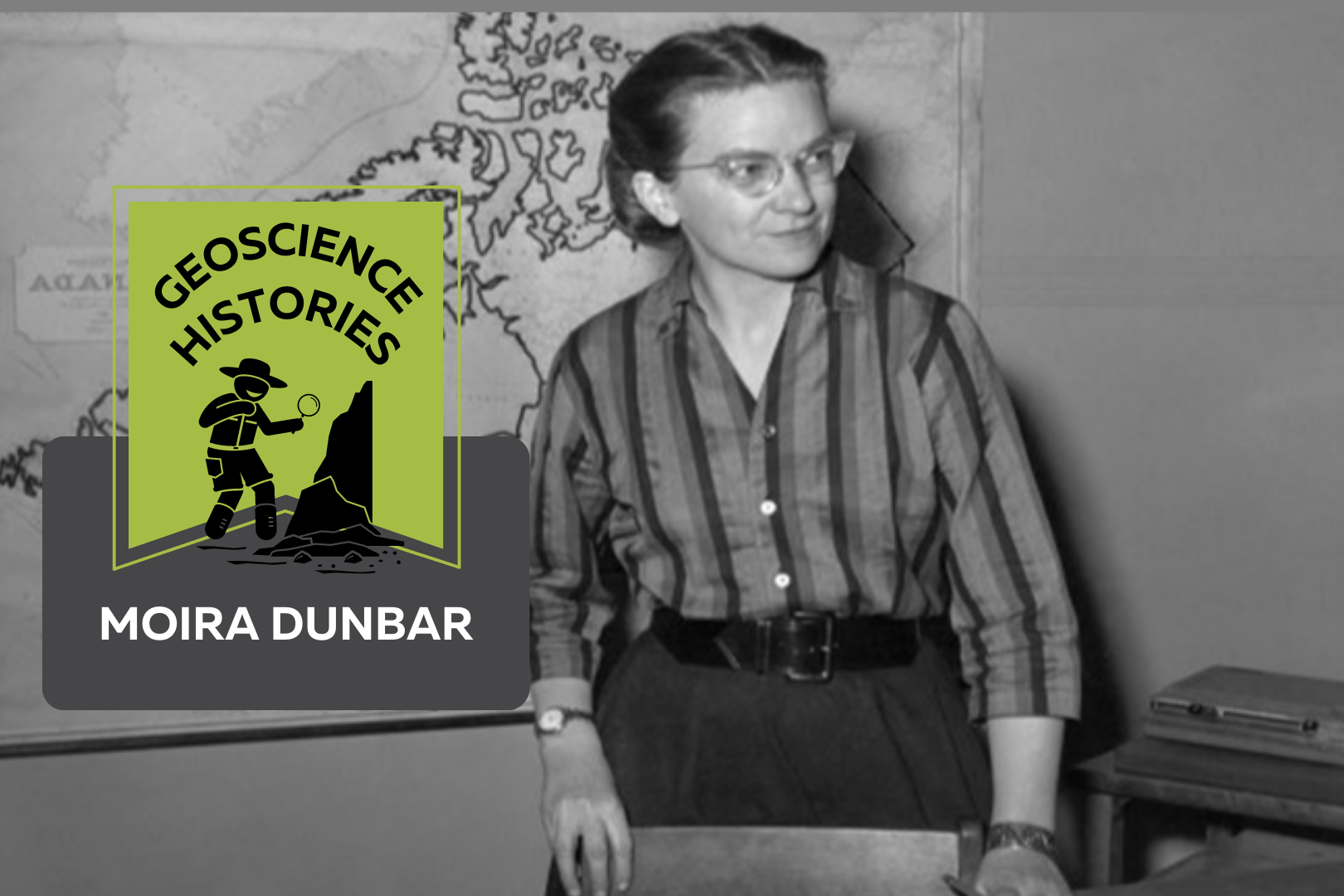
A black and white photograph of a young woman in a striped shirt with glasses. She is standing in front of a desk and there is a map of Canada on the wall behind her. On top of the photo text reads: "Geoscience Histories. Moira Dunbar."

Geoscience Histories: Moira Dunbar

Musician, geographer, actress, and sea ice researcher: Moira Dunbar was a legendary scientist. Born in Edinburgh, Scotland, Moira emigrated to Canada when she was 29 years old and started her career in sea-ice research working for the Government of Canada. She received many awards over her career for her important research and publications on Arctic ice.  Growing up, Moira’s family were academically-inclined. Her brother became a scientist and was made a Fellow of the Royal Society of Canada. Moira studied geography at Oxford University but when she graduated, she didn’t immediately go into research.  During the Second World War, Moira worked as an actress and a stage manager with the English Theatre. She toured Great Britain with the theatre and performed for the armed forces. “I was what is known as a character juvenile,” she said later, “which meant playing a long string of comic maids.” Despite her lacklustre acting career, she also was musically talented, playing the guitar and piano.  In 1947 Dunbar emigrated to Canada. Once there, she became aware that the Canadian government was looking for scientists. She got a job at the Joint Intelligence Bureau of Canada to research the movement of Arctic ice. This was important to the Canadian efforts during the Cold War, since the Canadian and American governments were afraid of nuclear attacks via the Arctic.  In 1952, Dunbar moved from the Intelligence Bureau to the Defense Research Board. Two years later she applied to join a Royal Canadian Navy icebreaker boat taking scientists to the Arctic for research. At this time, naval boats had never taken a woman aboard. Moira recalled that they “expected [her] to go around seducing all the men or something” (The Herald, 1999). She kept applying to go on icebreaker trips and for six months fought against her superiors to be given permission to go. Eventually her request reached the Deputy Minister, who decided that she was, in Moira’s words, “probably harmless.” She was finally allowed to go, but reflected that “they regarded me as some sort of cross between a delicate flower and a dangerous disease” (The Herald, 1999). Over time, however, she was accepted on the team and it was not raised as an issue again.  While on the icebreaker journeys, she analyzed sideways-looking radar in order to determine patterns in the movement of ice. She used photos of sea-ice taken at different times during the day and year to analyze ice conditions and determine the ice’s predicted position at different times of year.  In addition to time spent on icebreakers, she also joined Royal Canadian Air Force flights to study Arctic ice from the air. Dunbar spent nearly 600 hours flying over her career. She was one of the first people to observe and document an Arctic formation called a polynya. This occurs when strong winds flowing south combine with warm upwelling in the sea and melt or thin ice. She worked on standardizing ice terminology and wrote many papers on ice conditions in the Canadian Arctic. In 1956 she published Arctic Canada from the Air, written with Keith Greenaway. This book was a combination of aerial images and descriptions, and introduced many people to Arctic landscapes.  In her studies of Arctic ice, she became aware of the important research happening on the subject in Russia. She studied Russian and became certified as a linguist in Russian. She travelled to the Soviet Union and Finland in 1964 in order to learn from their ice-breaking operations.  In 1958 Dunbar wrote a particularly interesting article for Canadian Art about the Royal Arctic Theatre. Between 1819 and 1876, The Royal Arctic Theatre was a series of theatre productions put on by members of expedition trips to the Arctic during the long winters when the ships were stuck in the ice. Dunbar writes that “surely nowhere have plays been produced in more unlikely surroundings or in more difficult conditions than aboard the ships of British naval expeditions wintering in what is now the Canadian Arctic” (pg 110). Indeed, some of the plays were performed in less than 0 degrees Celsius on scarcely protected ship decks. There were no such equivalent theatre productions on Moira’s icebreaker trips, but being an actress herself, the Royal Arctic Theatre would have held a special appeal to Moira’s interests.  Throughout her career Dunbar received many distinctions for her work, including the Royal Canadian Geographical Society’s Massey Medal and the Centennial Award from the Canadian Meteorological Service. She also became a Fellow of the Royal Society of Canada and an Officer of the Order of Canada. She was a Governor of the Arctic Institute of North America and the Director of the Royal Canadian Geographical Society.  In 1978 Moira Dunbar retired to run a hobby farm and volunteer as a local historian in Ontario. She never married but enjoyed a long and diverse career. From growing up in Scotland, to acting for troops across Europe, to trailblazing on Canadian icebreakers, to flying alongside Air Force pilots over the Arctic; Dunbar’s career was filled with adventures and learning. Her impact in Arctic glaciology and sea-ice research is still felt today.  Sources and Further Reading: Moira’s Legacy of Land, Queen’s University Belfast Women in Geoscience Series, Irish Association for Women in Geosciences Moira Dunbar, The Canadian Encyclopedia Moira Isobel Dunbar, Science.ca Moira Dunbar, The Herald, 1999 A Selection of Moira’s Publications: High Latitude Navigation Flights, The Arctic Circular, pg 88-92, 1951 Ice Islands: Evidence from North Greenland, Arctic Institute of North America, 1953 Thrust Structures in Young Sea Ice, Journal of Glaciology, 1960 Veronica Klassen is the Manager of the Foundation’s blog – Beneath Your Feet: A Geoscience Blog. She studied Arts and Science at McMaster University with a minor in Earth Science and has a Master’s in Science Communication from Laurentian University. She is passionate about making science accessible and engaging to the public.
Read More »
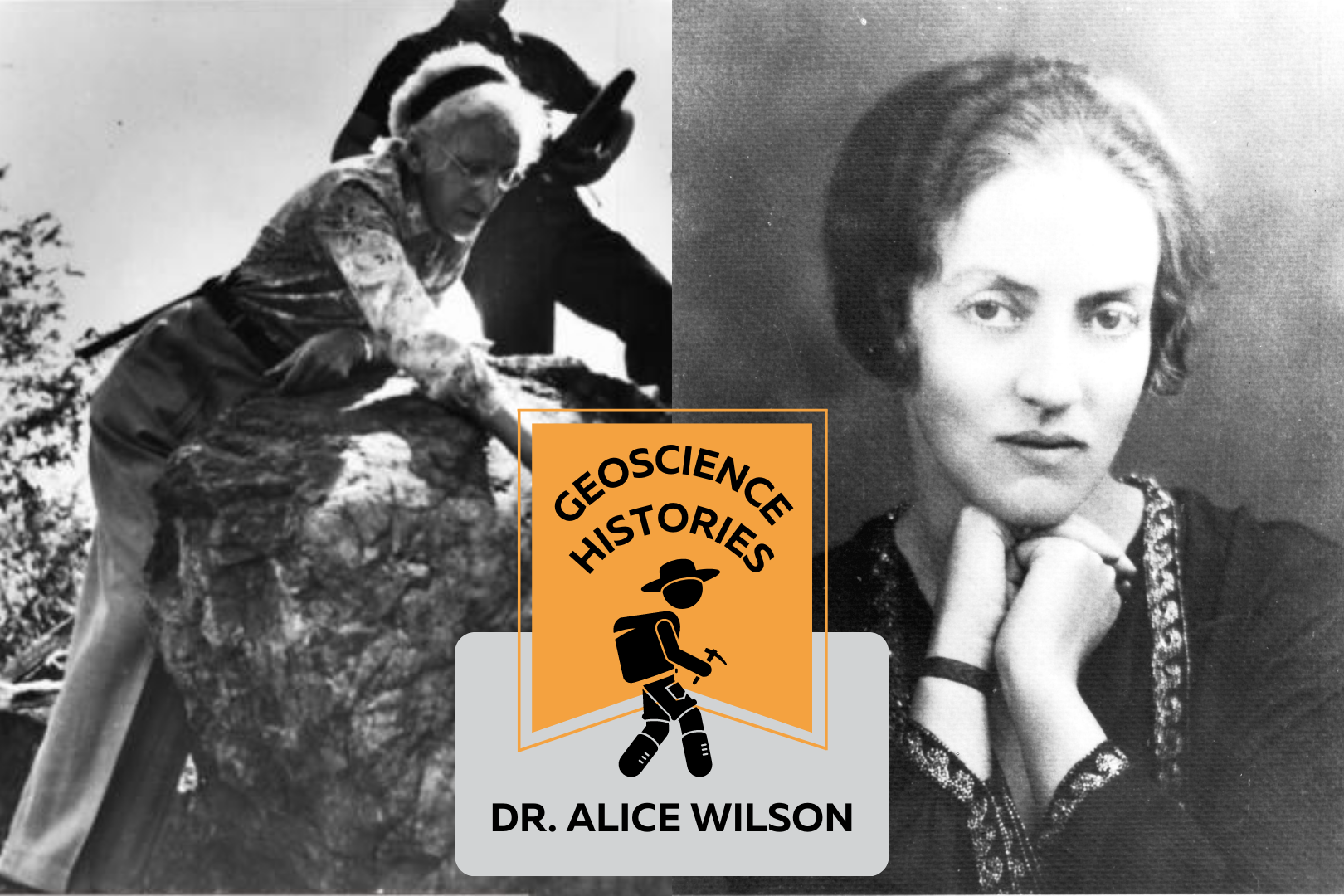
Two black and white images of Alice Wilson side by side. The left image is of Alice bending over a boulder. The right image is a headshot of a young Alice looking at the camera. Over the photos text reads: "Geoscience Histories: Dr. Alice Wilson"

Geoscience Histories: Dr. Alice Wilson

Dr. Alice Wilson, born August 1881, was one of Canada’s first female geologists, and the first female to be hired to work as a geologist at the Geological Survey of Canada. She persevered in the face of many personal and career-related challenges and paved a new path for women in geology in Canada. Alice Wilson grew up in a family that respected and encouraged education and exploration. She spent many summers canoeing, kayaking, and exploring the land and water around her family’s cottage in Ontario. Her father was a professor of Classics at the University of Toronto and both her brothers received PhD’s in their respective fields. When Alice was 20, she decided to study Classics at Victoria College in Toronto, with the goal of becoming a teacher. It’s unclear whether Alice actually wanted to pursue teaching or whether she did this because it was expected of her at the time. According to her friend Winston Sinclair, Alice said that in her youth teaching was the only acceptable field for a young lady. Perhaps this is why she decided to become a teacher. Her career path took a twist in her last year of university when she became very ill with anemia. She was unable to complete her courses and dropped out of school. After a few years in recovery, she started working in 1907 as a clerk at the University of Toronto. She had collected fossils as a child from the Cobourg Limestones near her home and was already passionate about palaeontology. In 1909 she became a museum assistant in the palaeontology department of the Geological Survey of Canada (GSC). In 1911, she finished her degree in Classics and was hired full time at the GSC. During this time, she connected with Percy Raymond who was the Chief Palaeontologist at the GSC. Her knowledge of languages came in handy when Percy needed her to translate a textbook of palaeontology from German to English. Percy connected with Alice and encouraged her to take a leave from the GSC in order to pursue a doctorate degree. Alice applied to take a paid leave in 1915 but she was rejected, despite the fact that other male geologists who applied for the same leave were granted it. Meadowcroft wrote that Alice believed her rejection was based solely on her gender, since the “fundamental reason [for rejection] has been that it would make a woman eligible for the highest positions in the Survey” (Meadowcroft, 1990, p. 208).  While she continued to apply for approval, Alice and Percy published an article on a new species of brachiopod. Unfortunately, when Percy left the GSC, Wilson’s other colleagues were not as eager to include her in their publications, and she was forced to work alone. In 1916, she paid for her own trip to Cold Spring Harbor, Long Island, NY to study comparative anatomy and marine biology for six weeks. When she returned to Canada in 1916, Wilson decided to help in the war effort for World War I. She joined the Canadian Women’s Army Corps (CWAC), an all-female military unit providing aid to the Canadian troops as decoders, drivers, cooks, stenographers, telephone operators and many other positions. The CWAC’s wore uniforms with a badge of three joined maple leaves, and on the collar of every uniform was an image of the helmeted head of Athene– the Goddess of War. As a willing volunteer for the CWAC, it is clear that Wilson didn’t shy away from danger or hard work. Women in the Canadian Women’s Army Corps were often subjected to disdain and discrimination from the Canadian public. General sentiment at the time was that women should be in the home, not in the army, and many people thought that women who joined the CWAC were of low moral standing. Wilson likely had to deal with some of this discrimination while serving with the CWAC.  Once the war was over, Alice Wilson returned to her position at the Geological Survey of Canada and continued to apply for leave to pursue further education. In 1926, she was awarded a scholarship by the Canadian Federation of University Women (CFUW) to fund her education leave. But even with the scholarship, the GSC still denied her leave. The CFUW lobbied for Alice, protesting her denied leave and demanding the GSC let her finish her education. The GSC finally relented and Wilson left to get her doctorate in geology at the University of Chicago. It had taken more than 10 years, but finally she received the education that she wanted.  When she returned to the Geological Survey of Canada, she was required to switch her area of research from Ordovician to Devonian rocks, due to the demand for petroleum in Western Canada. It was the Great Depression, and any research that could help Canada’s economy was prioritized. During this time, Dr. Wilson was responsible for ordering the National Type Collection of fossils, which is still an internationally recognized collection for fossil specimens. As she got older, Alice’s research started gaining recognition. She was the first woman to be elected as a Fellow at the Royal Society of Canada and the second woman to be a Fellow at the Royal Canadian Geographical Society. She received many other notable achievements, one of which was the Order of the British Empire (MBE) in 1935. The GSC, becoming more aware of Wilson’s achievements, promoted her to Assistant Geologist after she received the MBE. This designation should have been automatically given when she received her PhD 7 years earlier. But this wasn’t what Wilson wanted. She requested to be upgraded to Associate Palaeontologist, a title that she was never awarded throughout her career. Additionally, it wasn’t until 1945– nearly 16 years after she received her PhD– that her colleagues finally started referring to her as “Doctor”. During her time at the GSC, it would have been considered very indecent for a woman to join men on field work. So, she did her research by foot and

Read More »