

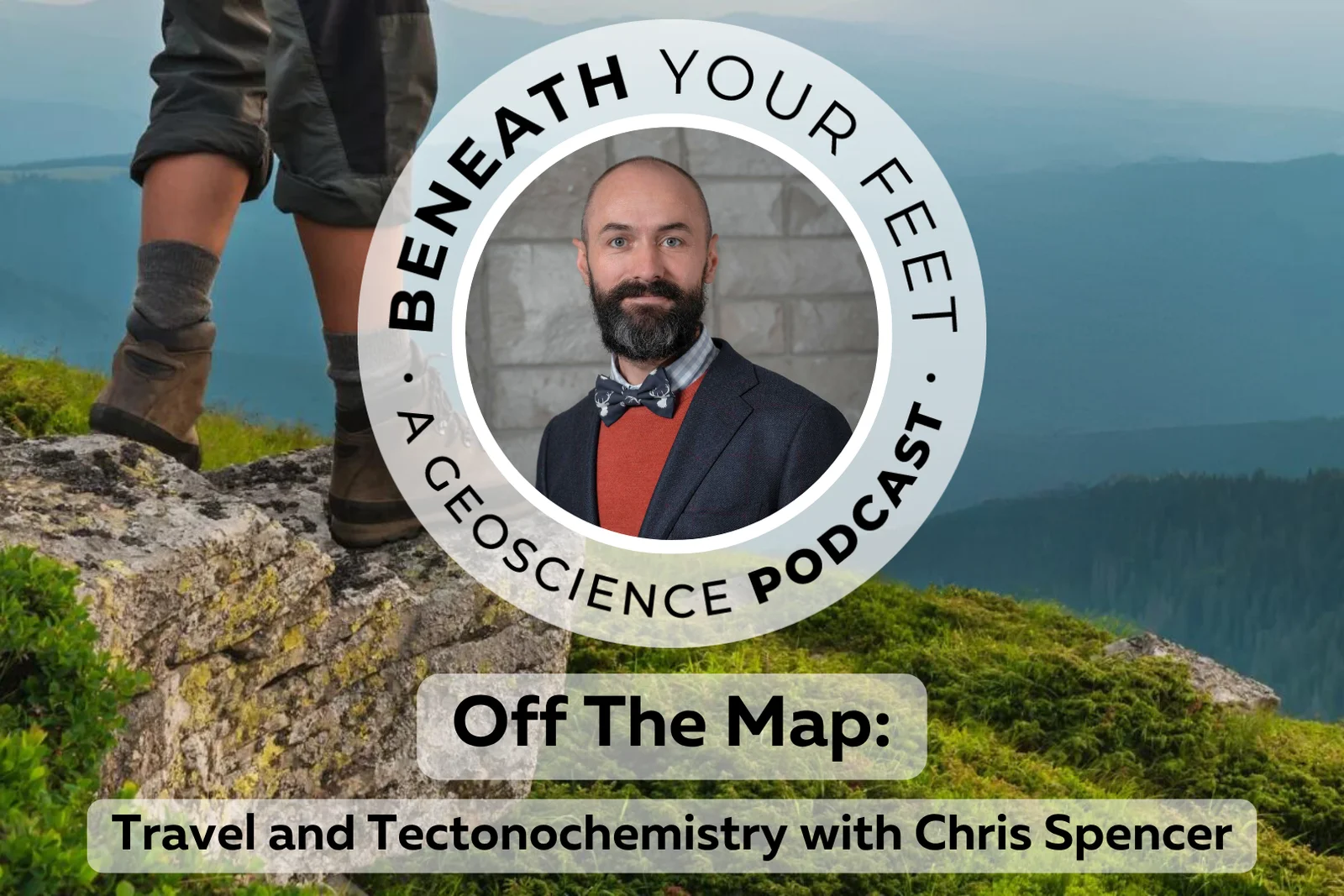
Off The Map: Travel and Tectonochemistry with Chris Spencer
From getting stranded in the middle of the desert and walking two days to the nearest town, to burning the soles of his shoes on two-week old lava, Chris Spencer is truly a well-travelled geologist and adventurer! As a professor at Queens University (the best job in the world according to Chris), he teaches field geology, helps run the geochemical facility, and does research all over the world on tectonochemistry. Listen in to hear his advice for students, fun travel stories, and passion for the earth that shows in every story he tells. Listen now: You can also listen to our podcast on these platforms: Amazon Music Apple Podcasts Spotify Read along with the podcast transcript: Introduction Hello, everyone. Welcome to Beneath Your Feet, a geoscience podcast. I’m Veronica Klassen, science communicator, geology enthusiast and your host. Here at the APGO Education Foundation, our mission is to spark curiosity and passion for the geology of Ontario. Whether you’re a geology nerd, science enthusiast, or nature lover, this podcast is for you. Join us as we geek out over fascinating geology, uncover the hidden storiesand secrets of our extraordinary planet and explore the captivating world beneath your feet. Veronica Klassen Hello, everyone, and welcome to another episode of Beneath Your Feet. Today, our guest is Chris Spencer, who is a researcher at the University of Queen’s in Kingston, Ontario. He studies tectonochemistry, which is something that I am not familiar with so I’m very excited to learn more; with a lot of research rooted in fieldwork, including lots of travel, which I’m also very excited to hear about. So thank you so much for being with me here today. Chris Spencer Happy to be here. Veronica All right. So to get started, just tell us a bit about yourself. Who are you and what do you do? Chris My name is Chris Spencer. I am a professor of geology at Queen’s University. I’m originally from the US, but left the US about 15 years ago and did my Ph.D. and post-doc in the United Kingdom. And then I had a research position at Curtin University in Western Australia and since 2020 I have been a professor at Queen’s. Veronica And what is a day in the life look like for you? Christ Yeah. So I mean, as a professor, I think the most natural thing that I’m doing is teaching students. And so my role in the teaching program at Queen’s is primarily focused in teaching field geology. And so I teach a few different field geology courses to our students at Queen’s, just teaching them how to do things in the field, how to be a field geologist, how to read and interpret maps, how to construct maps, and how to extract information from rocks that become spatially relevant, and then how to collect samples that we can take back to the laboratory to do other tests to, I guess, evaluate the properties of those rocks. So teaching is I guess kind of my my first duty as a professor. But then I also run the geochemical facility at Queen’s with a colleague of mine. And the geochemical facility is where we have lots of different instrumentation that is used specifically to evaluate the composition of various rocks. But in addition to analyzing rocks, we also analyze a lot of biological specimens that have geologic interest. And then we’re able to then use the compositional features of various samples to understand kind of how they formed and how they have evolved through time. And so I do spend a lot of time in the laboratory working with technicians and students for the isotope facility at Queen’s. And then the third part of my job is doing fieldwork for my own research and for the research of my graduate students. I’ve got about a dozen students that are working with me, ranging from undergraduate students all the way through to master’s and PhD students. And their research is happening all over the world. I’ve got a student who’s on a plane right now to China to do some work in China, and then I’ve got students who are working in West Africa, students who are working in Europe and South America. And so I tend to travel around a lot specifically to look at the rocks in different localities and to collect samples and then bring those samples back to my laboratory to see if I can understand better kind of when they form to how they formed and how they fit into a larger system of kind of planetary evolution, how the planet has changed over time. Veronica That’s so interesting. And can you explain a little bit like what actually is tectonochemistry? Chris Yeah, So tectonochemistry is a silly word that I that I made up to describe the research that I do because I am very interested, as I said, in the evolution of our planet and specifically the tectonic evolution. So plate tectonics is kind of what is a dominant feature that’s happening on the surface of the earth, where we have tectonic plates that are kind of floating around on the mantle. And the interactions at plate boundaries are what leads to things like volcanoes and metamorphism and earthquakes. And today we have kind of a very clear understanding of those tectonic processes. However, it is unclear how those tectonic processes have evolved over time. We think that the Earth’s mantle today is much cooler than it was billions of years ago. And so you can imagine in the same way as if you’re cooking a pot of oatmeal, if you turn the stove very high, that oatmeal is going to cook differently than if you have the stove on very low. And so my research is trying to understand how plate tectonics have evolved over time as the Earth is slowly cooling. And this also has implications for other planetary bodies like Venus and