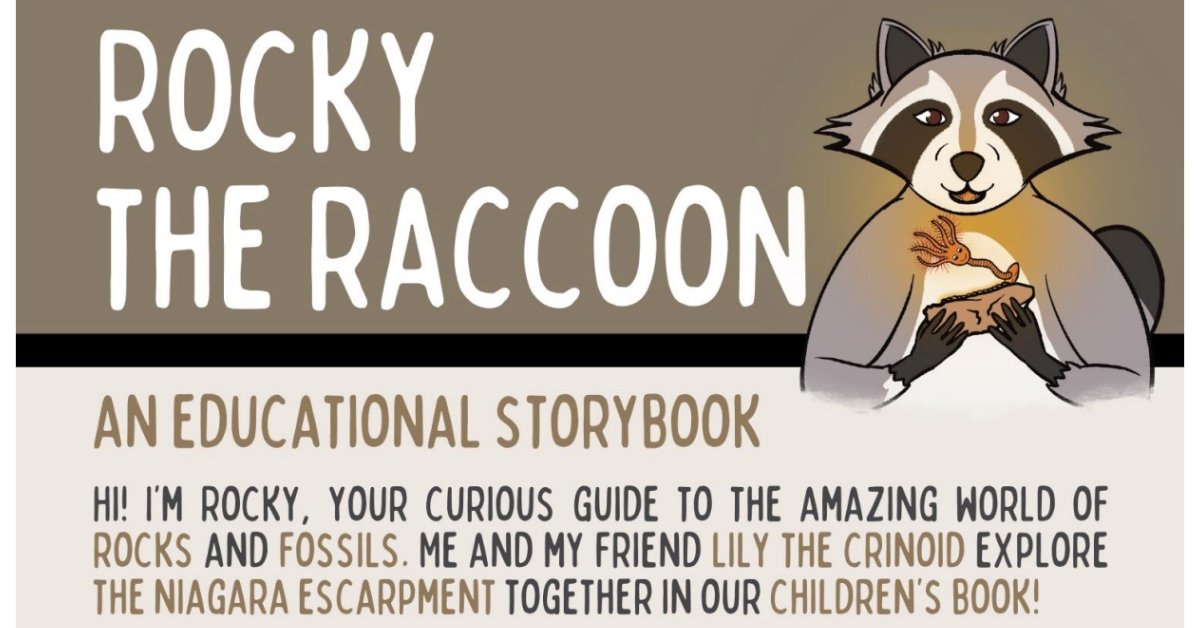
APGO Education Foundation Releases New Children’s Book
Book and accompanying teacher’s guide for Grade 4 can be viewed digitally for free on our new “Kid’s Zone” on GeoscienceINFO.com and purchased in paperback on Amazon.


Book and accompanying teacher’s guide for Grade 4 can be viewed digitally for free on our new “Kid’s Zone” on GeoscienceINFO.com and purchased in paperback on Amazon.
In this episode, I sit down with author Katie Maloney and illustrator Alex Young to talk about their brand-new children’s book Rocky the Raccoon Explores the Niagara Escarpment, which is directly aligned with the Grade 4 Ontario science curriculum. We dive into the art of science communication—how to take complex ideas and transform them into fun, accessible stories that spark curiosity. Katie and Alex share what it was like to bring Rocky to life, from the creative process of writing and illustrating to the challenges of making geology engaging for kids. We also discuss why it’s vital for scientists to share their work with the public, and how teachers can use Rocky the Raccoon as a classroom resource. Listen now: You can also listen to our podcast on these platforms: Audible Apple Podcasts Spotify Read along with the podcast transcript: Introduction Hello, everyone. Welcome to Beneath Your Feet, a geoscience podcast. I’m Veronica Klassen, science communicator, geology enthusiast and your host. Here at the APGO Education Foundation, our mission is to spark curiosity and passion for the geology of Ontario. Whether you’re a geology nerd, science enthusiast, or nature lover, this podcast is for you. Join us as we geek out over fascinating geology, uncover the hidden storiesand secrets of our extraordinary planet and explore the captivating world beneath your feet. Veronica Klassen Hello, everyone, and welcome to another episode of Beneath Your Feet. Today I’m going to be talking to Katie Maloney and Alex Young, who’ve been writing and illustrating a children’s book about the geology of the Niagara Escarpment. Rocky The Raccoon, which is out now, is a story about a raccoon exploring the Niagara Escarpment, learning about geology and the environment. The goal of the book is to educate, inspire kids to get outside and explore the natural environment. So thank you guys so much for joining me. Why don’t you start by telling me a bit about yourselves? Who are you and what do you do? Katie Maloney So I’m Katie Maloney. I am a paleontologist and I’m currently a Rebanks fellow at the Royal Ontario Museum, so studying some of the fossils in their collection. I did my Ph.D. and Master’s at University of Toronto and my undergrad at McMaster, and then I did a short post-doc at McMaster, kind of working on this project and another postdoc at McGill University, working up in the Arctic on some older fossils that are about a billion years old. And I’ll be starting at Michigan State this August. Alexander Young And my name is Alex Young. I’m a biomedical communicator and freelance medical illustrator, which doesn’t necessarily mean a ton, we’ll get into what those mean probably later on in the podcast. But broadly, I would consider myself a scientific communicator that focuses on visuals. And so Katie asked if I could help illustrate this book, bring Rocky to life. And given the fact that I can draw most of the time, and also I am able to relatively accurately convey that science because of my background, that’s why I got brought onto the project. And why I can do the things accurately? Well, I did my Master’s at UofT in medical illustration and science communication, and prior to that I did my undergrad at Mac in Integrated Science, which is actually where I met Katie and Carolyn, the other co-author on the book. So, yeah. Veronica Perfect. Thanks so much, guys. So I am so excited to hear about this book that you are working on. So how did this project come about? Where did the idea originally start? Katie So the idea for the book originally started when I was a Mitacs postdoctoral fellow at McMaster University, and so we had a project working on geoscience communication, trying to sort out how we could have people be more engaged with the Niagara Escarpment, since it affects everyone’s everyday lives throughout the Hamilton Niagara area. And so the project originally started with several undergraduate students who were supposed to work in a lab during COVID. And then when the COVID pandemic hit, they were not allowed in the lab space at McMaster University. So instead what they did is they rode their bikes along the Niagara Escarpment and picked out different areas of interest. So the project was in motion long before I joined. But when I joined in 2022, it was a lot of putting the data that these students had gathered over several years together and making it accessible for the public. And then Deana, who works for the APGO Education Foundation, puts all this fantastic information and data into these story maps that people can access online and use to have a virtual guide to these trails. Veronica Okay, awesome. And how did you get connected to this Alex? Alex So I got brought in as an illustrator once they got sort of some funding and the project evolved into, you know, how can we make this a more engaging experience to introduce the topics and the subject matter to the school system as well. And sort of with a focus on, you know, local schools that are adjacent to the Niagara Escarpment, but beyond that, as well what would be useful for Ontario students given the curriculum and what they’re taught about earth sciences at the elementary school level. And once they realized that they wanted to do an illustrated book that could connect to elementary school students, then Katie and Carolyn co-author got in touch. They knew that I had been in ISci with both of them, Carolyn was our prof, and then I had sort of moved into this capacity as a medical illustrator and they thought that it would be a good fit for the book. And then it became a very fun mash up of like personal, because obviously I have so much respect for Katie and Caroline and being able to work with them again is