

Grey and red stones. Text overlay reads "Geo Careers. Sisyphus Mountain, A career reflection by Melanie Siewert, President of PGO"

Sisyphus Mountain: A Career Reflection by Melanie Siewert, President of PGO

In ancient Greek mythology, Sisyphus is known as the guy destined to push a rock up a mountain for all of eternity, with the rock rolling back to the bottom of the hill each time. For those that do not know the rest of the story, King Sisyphus was a mortal man, known for his arrogance. He made demands of the gods, claiming that his feats as a mortal made him worthy of becoming a god. He claimed he deserved, even demanded, that the gods grant him immortality. The Greek gods were ever obliging but in their twisted way, their gifts were rarely without a price. It is thought that the gods responded to King Sisyphus’ arrogance by rewarding him with a lesson in humility. This story of incessant effort with no reward is often used as a metaphor for our daily slog –  wake up, go to work, put in your hours, come home, go to sleep and do it all over again tomorrow. If this is what you are doing, you are not living a fulfilling career. You are merely collecting a pay cheque. It shouldn’t be that way! After over twenty years practicing as a geoscientist, I often get questions about what I like about my profession and what keeps me engaged. Indefinitely, my answer revolves around lifelong learning. I’ve seen a lot of change in the industry over my time. When I started in the industry, I thought it was about soil, rocks, water and their interactions with contaminants. Since that time, I’ve learned that a career in environmental consulting is about much more than the physical matrices we assess. I’ve learned about various site characterization and remediation technologies, human health and ecological risk assessment, ecological considerations, environmental liability and legal considerations. I’ve seen regulation changes that made previously ‘clean’ sites contaminated once more. I’ve even seen the evolution of methods to deal with contaminants of concern that had not even been identified when I first started practicing. Over the years, I’ve learned invaluable lessons about health and safety, professional ethics, client satisfaction and staff motivation. Some lessons were not necessarily by choice, like experiencing the look of disdain on the face of a driller’s helper that I sent home because he showed up at the drill site in running shoes or experiencing the gut-wrenching feeling of shutting down a job site after hitting a buried line after the public utility locator rushed and missed a traffic line. Other lessons are earned, like the understanding of how different contaminant plumes migrate and the telling evidence to suggest a commingled plume. And some lessons come from investing 10,000 hours in listening to client needs and learning how to tailor the products we provide to satisfy project specific objectives.  One of the most fulfilling aspects of my profession is passing those lessons on to the next generation of professionals: explaining the importance of listening to clients and hearing what drives their decisions. Is it fear of a health and safety incident or fear of a financial audit? Or is their priority protecting site aesthetics like a showcased tulip garden at a public park or avoiding disruptions to site operations like a profitable coffee drive through at a gas station. Or teaching reporting staff that how we present results can be as important as the actual results. I had a tough lesson very early in my career that always stuck with me. A reporter from a small town newspaper took a sentence from my publicly accessible environmental report and presented it out of context. It left me keenly aware of the importance of making every sentence count. I am immensely proud to know that young professionals that I have mentored over my career are now found throughout our industry in regulatory positions.  In my career, I’ve been blessed with daily challenges and opportunities for problem solving. I once visited a job site to perform a safety observation on field staff. Instead, we spent most of our time troubleshooting our drilling location as site logistics wouldn’t allow us to place the borehole where we needed to characterize soil contamination. Sitting in the van after finding a workable solution, he asked me “Have you ever had a job run exactly as planned?” I searched my memory bank and came up with nothing. Consulting is an industry of thinking on our feet and managing change. That same individual from the van left me thoroughly impressed when he applied his determination to a monitoring site where we had “lost” a well for several monitoring events. Other monitoring teams had been to the site and reported back that they couldn’t find the well based on the measurements provided. I remember the look on that determined individual’s face when he said “I saw that well before. I know I can find it.”  And he did! It had incorrectly been recorded relative to two adjacent survey pins; when he shifted his search to the next set of pins, the well was at the exact measurements provided on the figure. I find I have met the most interesting people over the years because consulting attracts people that thrive in an environment of discovery and change. For my part, I have never shied away from accepting those opportunities.  I’ve learned that geoscience is more than geology. You need to be part historian and part detective to piece together a complete conceptual site model. You need to be part interpreter and part politician to bring the right group of technical experts to the table to collaborate on multidisciplinary projects. Any environmental consultant will tell you that there is never a dull moment. We are masters in logistics and contingency planning. If your day to day feels like you are merely punching a time clock, perhaps you are not listening to what the universe is offering.  So back to the guy with the rock. There is an alternate theory to explain the lesson the Greek gods had for King Sissyphus. In
Read More »
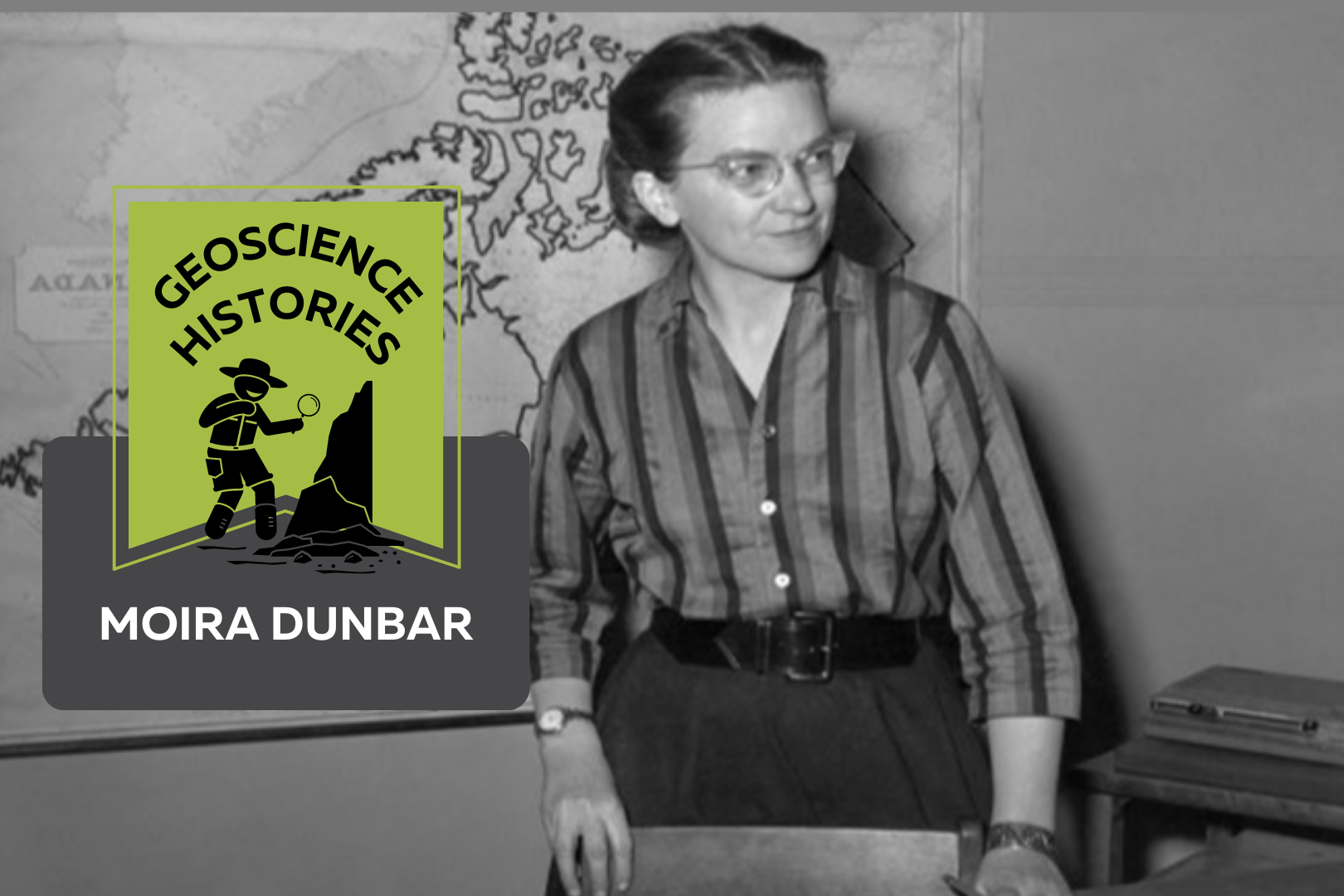
A black and white photograph of a young woman in a striped shirt with glasses. She is standing in front of a desk and there is a map of Canada on the wall behind her. On top of the photo text reads: "Geoscience Histories. Moira Dunbar."

Geoscience Histories: Moira Dunbar

Musician, geographer, actress, and sea ice researcher: Moira Dunbar was a legendary scientist. Born in Edinburgh, Scotland, Moira emigrated to Canada when she was 29 years old and started her career in sea-ice research working for the Government of Canada. She received many awards over her career for her important research and publications on Arctic ice.  Growing up, Moira’s family were academically-inclined. Her brother became a scientist and was made a Fellow of the Royal Society of Canada. Moira studied geography at Oxford University but when she graduated, she didn’t immediately go into research.  During the Second World War, Moira worked as an actress and a stage manager with the English Theatre. She toured Great Britain with the theatre and performed for the armed forces. “I was what is known as a character juvenile,” she said later, “which meant playing a long string of comic maids.” Despite her lacklustre acting career, she also was musically talented, playing the guitar and piano.  In 1947 Dunbar emigrated to Canada. Once there, she became aware that the Canadian government was looking for scientists. She got a job at the Joint Intelligence Bureau of Canada to research the movement of Arctic ice. This was important to the Canadian efforts during the Cold War, since the Canadian and American governments were afraid of nuclear attacks via the Arctic.  In 1952, Dunbar moved from the Intelligence Bureau to the Defense Research Board. Two years later she applied to join a Royal Canadian Navy icebreaker boat taking scientists to the Arctic for research. At this time, naval boats had never taken a woman aboard. Moira recalled that they “expected [her] to go around seducing all the men or something” (The Herald, 1999). She kept applying to go on icebreaker trips and for six months fought against her superiors to be given permission to go. Eventually her request reached the Deputy Minister, who decided that she was, in Moira’s words, “probably harmless.” She was finally allowed to go, but reflected that “they regarded me as some sort of cross between a delicate flower and a dangerous disease” (The Herald, 1999). Over time, however, she was accepted on the team and it was not raised as an issue again.  While on the icebreaker journeys, she analyzed sideways-looking radar in order to determine patterns in the movement of ice. She used photos of sea-ice taken at different times during the day and year to analyze ice conditions and determine the ice’s predicted position at different times of year.  In addition to time spent on icebreakers, she also joined Royal Canadian Air Force flights to study Arctic ice from the air. Dunbar spent nearly 600 hours flying over her career. She was one of the first people to observe and document an Arctic formation called a polynya. This occurs when strong winds flowing south combine with warm upwelling in the sea and melt or thin ice. She worked on standardizing ice terminology and wrote many papers on ice conditions in the Canadian Arctic. In 1956 she published Arctic Canada from the Air, written with Keith Greenaway. This book was a combination of aerial images and descriptions, and introduced many people to Arctic landscapes.  In her studies of Arctic ice, she became aware of the important research happening on the subject in Russia. She studied Russian and became certified as a linguist in Russian. She travelled to the Soviet Union and Finland in 1964 in order to learn from their ice-breaking operations.  In 1958 Dunbar wrote a particularly interesting article for Canadian Art about the Royal Arctic Theatre. Between 1819 and 1876, The Royal Arctic Theatre was a series of theatre productions put on by members of expedition trips to the Arctic during the long winters when the ships were stuck in the ice. Dunbar writes that “surely nowhere have plays been produced in more unlikely surroundings or in more difficult conditions than aboard the ships of British naval expeditions wintering in what is now the Canadian Arctic” (pg 110). Indeed, some of the plays were performed in less than 0 degrees Celsius on scarcely protected ship decks. There were no such equivalent theatre productions on Moira’s icebreaker trips, but being an actress herself, the Royal Arctic Theatre would have held a special appeal to Moira’s interests.  Throughout her career Dunbar received many distinctions for her work, including the Royal Canadian Geographical Society’s Massey Medal and the Centennial Award from the Canadian Meteorological Service. She also became a Fellow of the Royal Society of Canada and an Officer of the Order of Canada. She was a Governor of the Arctic Institute of North America and the Director of the Royal Canadian Geographical Society.  In 1978 Moira Dunbar retired to run a hobby farm and volunteer as a local historian in Ontario. She never married but enjoyed a long and diverse career. From growing up in Scotland, to acting for troops across Europe, to trailblazing on Canadian icebreakers, to flying alongside Air Force pilots over the Arctic; Dunbar’s career was filled with adventures and learning. Her impact in Arctic glaciology and sea-ice research is still felt today.  Sources and Further Reading: Moira’s Legacy of Land, Queen’s University Belfast Women in Geoscience Series, Irish Association for Women in Geosciences Moira Dunbar, The Canadian Encyclopedia Moira Isobel Dunbar, Science.ca Moira Dunbar, The Herald, 1999 A Selection of Moira’s Publications: High Latitude Navigation Flights, The Arctic Circular, pg 88-92, 1951 Ice Islands: Evidence from North Greenland, Arctic Institute of North America, 1953 Thrust Structures in Young Sea Ice, Journal of Glaciology, 1960 Veronica Klassen is the Manager of the Foundation’s blog – Beneath Your Feet: A Geoscience Blog. She studied Arts and Science at McMaster University with a minor in Earth Science and has a Master’s in Science Communication from Laurentian University. She is passionate about making science accessible and engaging to the public.

Read More »