Headshot of Joanna Northover over image of a hikers boots and mountain landscape. Text reads: Beneath Your Feet. A Geoscience Podcast. FossilTok with Joannasaurus.

FossilTok with Joannasaurus

In our latest episode, we speak with @Joannasaurus — a paleontologist and science communicator who’s using TikTok to make fossils fascinating for everyone. Joanna talks about what it takes to make complex science accessible, the role of humour in online storytelling, and her roundabout journey to paleontology! Listen now: You can also listen to our podcast on these platforms: Amazon Music Apple Podcasts Spotify Read along with the podcast transcript: Introduction Hello, everyone. Welcome to Beneath Your Feet, a geoscience podcast. I’m Veronica Klassen, science communicator, geology enthusiast and your host. Here at the APGO Education Foundation, our mission is to spark curiosity and passion for the geology of Ontario. Whether you’re a geology nerd, science enthusiast, or nature lover, this podcast is for you. Join us as we geek out over fascinating geology, uncover the hidden storiesand secrets of our extraordinary planet and explore the captivating world beneath your feet. Veronica KlassenWell, welcome, everyone, to another episode of Beneath Your Feet. Today, I’m going to be talking to Joanna Northover, who is a science communicator on TikTok. We’re going to be talking about science communication, we’re going to talk about her career in geoscience, we’re going to talk about advice for students and all kinds of exciting things. So thanks so much for joining me, Joanna. JoannaNo problem. It’s my pleasure. It’s going to be a lot of fun. VeronicaAmazing. I’m very excited. All right. So why don’t we just start. Tell me a bit about yourself. Who are you and what do you do? JoannaAll right. Well, as you said, my name is Joanna Northover, but on TikTok, Instagram and YouTube, I go by Joannasaurus and I am a science communicator. But I started out interested in paleontology. So my science communication really centers around paleontology. So fossils, dinosaurs, things like that. And I have loved paleontology for as long as I can remember. And so it was sort of, I had a few stumbles along the way. We’ll probably talk about that later on. But I did do a master’s degree and an undergraduate degree in paleontology. But then I fell in love with science communication, and the rest, as they say, is history. VeronicaThat’s awesome. So yeah, so going a bit back, how did you originally become interested in paleontology and how has that journey sort of changed for you over time? JoannaAll right. So I guess a lot of people go through a dinosaur phase when they’re kids, and I was no exception. My was quite early. I really loved dinosaurs, even at a very young age and as young as the age of four, I declared that I was going to become a paleontologist. And that was a dream that I held for a very, very long time until I hit my teens. And, you know, I kind of got a little discouraged. I thought maybe this wasn’t a practical career, you know, And I thought, oh, well, maybe I’ll be a teacher instead, because I also really loved teaching. Even from a young age. I used to pretend to teach my little brother, you know, with a pointing stick and some little diagrams and stuff. And so when I was in high school, you know, I kind of pivoted a bit and I thought, Oh, I’ll do a degree, and then I’ll go to Teachers College. And I had really good marks in history and chemistry. So that’s what I applied to. I did actually apply to paleontology as well, and I got in at UofT, but I was too nervous to move all the way there because at the time I was one of the first years to do that double cohort thing where, you know, in Ontario we went from having grade 13 to going to grade 12. And so I was 17 when I graduated. I wasn’t even a legal adult, and I just felt like really nervous about going too far away from home all by myself. VeronicaCause where is home for you, sorry? JoannaOttawa. I grew up in Ottawa and that’s where I live now, so I didn’t want to go too far away from home. So I decided I would go to university at Ottawa U. And I decided to go into history and I did my first year of history and I dropped both of my history courses. So I was like, Wow, wow, this isn’t the right major. And I was like, well, maybe I made a mistake here, so that’s not a good sign. So I had done actually a first year geology course as one of my breadth courses when I was at Ottawa U. I’d also taken a lot of philosophy and I almost switched to a major in philosophy. My mom actually, of all people, said, Did you know that Carleton has just started a vertebrate paleontology concentration from the Earth Science Department? And so I applied right away. I switched over. I thought, you know what? I knew more when I was four than I know now. I just I’ll go to school and I’ll figure it out after. I’ll just, I have to study something I love or else this is going to be a disaster. And so I transferred over to Carleton and I started in the Earth Science department there doing my vertebrate paleontology concentration. And it was just magical. Suddenly it was easy to go to school. I wasn’t dropping my courses. I had so much fun. The department there was great, really supportive, and I liked it so much that after I did my bachelor’s degree, I ended up deciding to stay and do a graduate degree. I did a master’s degree also at Carleton. But while I was doing my bachelor’s and master’s, I started working in the summers at the Royal Tyrrell Museum of Paleontology, where I was working in the Science Education Department. And also I did some science education sort
Read More »
A hiker stands on the top of an outcrop looking over a distant mountain scene. Text reads: "Beneath Your Feet. A geoscience podcast."

PODCAST EPISODE #6: From Extraction to Innovation with Mary-Anne Hildebrandt

Summary In episode 6 of Beneath Your Feet, A Geoscience Podcast, host Veronica Klassen interviews resource geologist Mary-Anne Hildebrandt. Mary-Anne discusses her roundabout path to geoscience, unique career journey, and focus on sustainability throughout her career. Mary-Anne and Veronica discuss the perception of geoscience as a ‘fluffy’ science and how including geoscientists in conversation can benefit organizations. Mary-Anne provides insight into the role of geoscience in moving from a linear to a circular economy and how understanding the energy and value of a consumable good can help us to waste less. Listen now: You can also listen to our podcast on these platforms: Spotify Audible Apple Podcasts Read along with the podcast transcript: Introduction Hello, everyone. Welcome to Beneath Your Feet, a geoscience podcast. I’m Veronica Klassen, science communicator, geology enthusiast and your host. Here at the APGO Education Foundation, our mission is to spark curiosity and passion for the geology of Ontario. Whether you’re a geology nerd, science enthusiast, or nature lover, this podcast is for you. Join us as we geek out over fascinating geology, uncover the hidden storiesand secrets of our extraordinary planet and explore the captivating world beneath your feet. Veronica Klassen: Hello everyone and welcome to another episode! Today I’m going to be talking to Mary-Anne Hildebrandt, a resource geologist and past president of PGO. Mary-Anne has a BSc in Geological and Earth Sciences, a BA in Political Studies, and a Master of Earth and Energy Resource Leadership, where she did her thesis in waste and the circular economy. So we’ll be discussing the perception of geoscience in society, advice for young students, how to choose what to study, and the role of geoscience in moving away from increasing waste and towards a circular economy. Welcome Mary-Anne. Thanks so much for being with me. Why don’t you start by telling us a bit about yourself? Mary-Anne Hildebrandt: So, Veronica, it’s so great to be here today. I’m a resource geology manager at Stellar Gold. And what that means is that we’re creating the three dimensional models and estimates that will be used for potentially the development into a mining project down the road. We’re a junior exploration company. A bit about myself I studied at Queen’s quite a long time ago now. I’ve been in the industry for, I guess, 17 years, it seems like it’s gone by in a flash, but it’s been a lot of different fun opportunities over the course of that time. So you know, I started in exploration, was in production, mining, environment for quite a number of years, almost ten years. And I’m back at exploration again. Veronica: Amazing. Thanks so much. You’ve been doing so many different things. I think that’s that’s awesome. So with that, if you’re talking to students who are maybe considering going into geoscience or who are just deciding what they do want to study or what they want to go into and consider as their career options. What would be the best piece of advice you would have for students trying to figure out what they want to do? Mary-Anne: I think with geoscience, like there’s so many different pathways to doing because geoscience is used in in many ways people don’t even realize. Right? Field based part is probably the most visible. But then there’s also the regulatory space with geoscientists working within government and other conservation authorities that are doing work to protect the public. And then there’s the Bay Street Geoscientists, and they could be analysts that are giving advice to investors. Right. And same on the security side, geoscientists that sit within securities, again, a city based position that is that’s creating protection for investors on the stock market. And there’s just so many different ways you can do geoscience. And it’s it’s incredible really, how many opportunities there are. If that answers your question. Veronica: Yes, no it does. And I think that there are so many different ways that you can do geoscience and people might not consider that as students. I guess as like as student would you recommend them like looking into like a wide variety of options or just like starting kind of with the basics and going from there, or how would you recommend them sort of like approaching that? Mary-Anne: I think as students, you know, there are sort of two ways to go about being a student, right? You’re either a student that knows exactly where they’re going, and I don’t know how many students really are those people. And then there’s the students that, you know, might start their university career in one direction and choose something else. I’m one of those students myself. I actually started my first degree, my first major was in political science. It wasn’t in geoscience. And it’s not because I didn’t appreciate geoscience. I didn’t really know much about it where I came from. You’re either a doctor or a lawyer or a teacher or a nurse. That was the things that are my career counselors talked to our high school students about. And I happened to have been always curious about rocks and nature and whatnot and, and the intersection of society and, you know, the natural environment. And because of that, I had more and more of my projects in my first major were geared with an underlying sort of conversation around society’s obligations regarding the natural environment. And, you know, I had been chatting with my closer friends and they were like, why don’t you take a geoscience course as an elective? And that’s what I did. And it was out of that elective that I realized I really liked that discipline. I felt like I was home. And it was the professor of that course that contacted me amongst a group of other folks over the summertime and said, why don’t you come back to the university and do a degree in geoscience? That was Dr Jean Hutchinson that did

Read More »
A hiker stands on the top of an outcrop looking over a distant mountain scene. Text reads: "Beneath Your Feet. A geoscience podcast."

PODCAST EPISODE #5: From Stars to Stones with Cate Larsen

Summary: In episode 5 of Beneath Your Feet, A Geoscience Podcast, host Veronica Klassen interviews geoscience communicator Cate Larsen. Cate discusses her non traditional route from astronomy to geology and her passion for making geoscience accessible and engaging through social media platforms like TikTok and Twitch. She emphasizes the importance of dispelling misconceptions about geology, highlighting that it’s more than just the study of rocks. Cate also shares insights into her daily activities, including content creation, scripting, and planning educational content. Throughout the conversation, she underscores the value of face-to-face interactions and creative approaches in effectively communicating complex scientific concepts to the public. Listen now: You can also listen to our podcast on these platforms: Audible Apple Podcasts Spotify Read along with the podcast transcript: Introduction Hello, everyone. Welcome to Beneath Your Feet, a geoscience podcast. I’m Veronica Klassen, science communicator, geology enthusiast and your host. Here at the APGO Education Foundation, our mission is to spark curiosity and passion for the geology of Ontario. Whether you’re a geology nerd, science enthusiast, or nature lover, this podcast is for you. Join us as we geek out over fascinating geology, uncover the hidden stories and secrets of our extraordinary planet and explore the captivating world beneath your feet. Veronica Klassen: All right, well, welcome. Thank you so much for joining me today. I’m here with Cate Larsen, who’s a geoscience communicator, so both in person doing workshops, conferences, things like that, and through your really cool social media accounts and podcast as well. I found Cate through your TikTok account where you talk about what it’s like to be a geoscientist and what your life is like as a geoscience communicator. So thanks so much for being here with me. Cate Larsen: Thank you for having me. This is so fun to talk about this stuff with a fellow scientist person who are interested in sciences. It is so fun to just geek out about this stuff and kind of talk about our experiences. Veronica: Yeah, I’m super excited. All right. Do you want to start just by telling us about yourself? Who are you and what do you do? Cate: Well, my name is Cate. I talk about rocks for a living. That’s a very simplified version of it. That’s what it says on my business card. I definitely feel like there’s so much more to geology than just rocks, but, and I’m, I mean, I keep it simple for the for the business card and for my quick intro pitches. But in in all I love to teach about geology and geoscience being more than just rocks because it is. And there’s such a huge misconception that it’s a boring science. It’s not a real science. It’s it’s just rocks. Who cares? We don’t need to be studying this. So I go out there and I go on social media, and I make these fun educational videos to kind of teach about geology in all these different ways that people I teach it in interesting, creative ways. But I’m also teaching interesting and creative stuff that people don’t know about. That’s what I mean to say. Veronica: Yeah, yeah. It keeps people’s interest when you’re talking about something that, yeah, they might have no experience with. All right. So as a geoscience communicator, what does a day in the life look like for you? Is there a lot of variety or are you kind of doing the same things. What’s that like? Cate: Well, today happens to be a day that I have just a lot of meetings. This is one of my meetings. I’ve got two more today. I definitely like to connect with people. That’s my whole thing. I love connectivity and just like personal conversation, I feel like that’s one of the best ways to, you know, effectively communicate stuff is face to face, and that’s why I spend so much time with my social media, because I know that that face to face you know, showing I’m explaining something and my face is here, I’m talking to you. I’m making it sort of casual, conversational, almost. So I’ve got meetings today. I’m going to hopefully try to work on I’m going to finish up a script that I’m doing for a new YouTube video. And hopefully be able to record that before I lose daylight. Also this week I’ll be working on some itinerary plans for a field expedition that me and some people are doing next month in March. But we have to prepare for it way ahead of time. Veronica: Where are you guys going? Cate: Oh, we’re going to Southern California to make a bunch of educational content, in person with the geology hands on. So it’s a really cool opportunity to get out there and not just have to use green screen to teach about stuff that we’re pointing to. I feel like that’ll really show people that geology is is very hands on. It’s really interesting. And you can learn so much just from going in person. I’m also looking forward to just, bothering random passersby. I love grabbing hikers and being like, hey, do you want to learn something cool about these rocks? I love doing that. That’s going to be really, really fun. Veronica: That sounds so cool. How did you hear about that opportunity? Or is this something that you guys are making for yourselves? Cate: We created this. So me and my friends are a bunch of other geoscience communicators. If you are on YouTube, you probably have heard of Geo Girl. That’s that’s our wonderful, wonderful friend Rachel. She is a postdoc, and she’s doing her postdoc on geoscience communication. So she had written into her new grants like, hey, we can go do this, and we will track the data on these posts and the performances and show how effective it is to get out in the fields and do this stuff and

Read More »
A hiker stands on the top of an outcrop looking over a distant mountain scene. Text reads: "Beneath Your Feet. A geoscience podcast."

PODCAST EPISODE #4: Reefs and Reels: Evolution and Communication with Charlotte Spruzen

Summary In this episode of Beneath Your Feet, A Geoscience Podcast, host Veronica Klassen interviews Charlotte Spruzen about her research on ancient reef systems in the Yukon and their role in the evolution of complex life. Charlotte explains how these ancient ecosystems provide clues about early animal life and Earth’s changing environments. Beyond her fieldwork, she shares insights on geoscience communication, including her experiences making educational TikTok videos and the challenges of debunking misinformation online. The conversation highlights the importance of making science accessible, engaging, and accurate in a digital age where myths can spread quickly. Listen now: You can also listen to our podcast on these platforms: Spotify Apple Podcasts Amazon Music Audible Read along with the podcast transcript: Introduction Hello, everyone. Welcome to Beneath Your Feet, A Geoscience Podcast. I’m Veronica Klassen, science communicator, geology enthusiast and your host. Here at the APGO Education Foundation, our mission is to spark curiosity and passion for the geology of Ontario. Whether you’re a geology nerd, science enthusiast, or nature lover, this podcast is for you. Join us as we geek out over fascinating geology, uncover the hidden stories and secrets of our extraordinary planet and explore the captivating world beneath your feet. Veronica Klassen Welcome. Thanks so much for being with me here today. Today I’m going to be talking to Charlotte Spruzen, who is a PhD candidate at McGill University, studying the evolution of complex life. So, thanks for being with me here today. Charlotte Spruzen Thank you for inviting me, I’m so excited to be here. Veronica So, yeah, why don’t we just start with, tell us a little bit about yourself, who are you and what do you do? Charlotte Yeah. So I’m Charlotte. My pronouns are she/ her. I came to Canada three years ago, so I’ve been in Montreal since then, working at McGill University. I’m a PhD candidate in sedimentology and stratigraphy. So that’s basically looking at sedimentary rocks and seeing how they change as a function of distance from the shoreline and how sea level changes as well. And before that, I was in the UK, as you can probably tell from the accent. I love it, I love Canada, I love being here. I am really into my research and yep, that’s a little bit about me. Veronica Amazing. Thanks so much. Yeah. And I found you via your TikTok channel, which is really fun. And so you also do a little bit of science communication there, which is also a really cool part of what you do. Charlotte Yeah. I keep forgetting to plug that. Yeah. So I do a bit of science communication under the username @charbonate. And I do that on Instagram and TikTok it’s the same content on both and I make videos about mostly sedimentary rocks but I’m moving a little bit more into climate change just because I feel that’s important in the current political landscape. Veronica Yeah, that is definitely very important. All right. So with your studies, what what is it day in life look like for you both when you’re out doing research in the field or when you’re at home at the university? Charlotte So my time, as you kind of alluded to, is split between fieldwork, which is maybe like 1 or 2 months per year and office work. So when I’m in the field, it sort of depends on where we are. But most of my fieldwork has been in Yukon, so that’s helicopter fieldwork out in the Ogilvie Mountains just north of Dawson City. It’s an absolutely beautiful part of the world and I’m so lucky to work there. And a day in the life there, we’ll be staying in like individual tents. So we will have slept in the tent overnight. You wake up, you go into a group tent, you make coffee, you make breakfast, which is normally just oatmeal with just the same thing every single day. It gets pretty boring. And then we leave at, you know, between 8 and 9 a.m. and we go out into the field and we do between an eight and a ten hour day. And we’re walking off to the outcrops and we’re studying the rocks, mostly taking what are called stratigraphic logs. So that’s when you walk up a hill and you’re measuring how the rocks change through time. Well, how the rocks change up the hill, which means how they’re changing through time. And then we come back, we make our dinner, which again, is pretty much the same thing every day. It’s just a dehydrated meal and you add hot water. And so we have that. We have maybe some like, fun snacks and then we go to bed. So, yeah, it’s very much the same routine, but different rocks every day, which is pretty cool. Veronica Hm, that’s awesome, yeah. Charlotte And then when I’m in the office, again, there’s like a lot of, so I guess kind of the opposite of the fieldwork where there’s a lot of variety. I’m kind of doing something different every day. So sometimes I might be doing some lab work measuring the geochemical composition of things. Sometimes I might be writing or maybe doing some coding, figure plotting, basically preparing things for manuscripts or for my thesis. And then other days I’d say most days right now I’m doing microscope work. So my main area of interest is looking at really thin slices of carbonate rocks and trying to figure out if they’re getting more complex through time. So I’m just spending hours staring down the microscope looking at these tiny little like micron scale features, which I love, but it does give you a headache after a little bit. Veronica I believe it. Okay, awesome. That’s super cool. I love that, there’s so much variety in what you do. I think that’s really fun. How did you get where you are? Like, how were you originally

Read More »
A hiker stands on the top of an outcrop looking over a distant mountain scene. Text reads: "Beneath Your Feet. A geoscience podcast."

PODCAST EPISODE 3: From Books to Bedrock: Student life with Keira Hum

In this episode, we sit down with Keira Hum, a passionate Integrated Science student at McMaster University, to explore the ins and outs of student life in the world of Earth Sciences. Keira shares her journey from the classroom to the field, offering invaluable advice for balancing academics, personal growth, and career aspirations. Whether it’s navigating coursework, finding opportunities in the geoscience community, or preparing for a future in the field, Keira’s relatable stories and practical tips are sure to inspire students and geoscience enthusiasts alike. Tune in for a fun and insightful conversation packed with guidance for thriving in geoscience studies! 🌍🎙️ Listen now: You can also listen to our podcast on these platforms: Audible Apple Podcasts Spotify Read along with the podcast transcript: Introduction Hello, everyone. Welcome to Beneath Your Feet, a geoscience podcast. I’m Veronica Klassen, science communicator, geology enthusiast and your host. Here at the APGO Education Foundation, our mission is to spark curiosity and passion for the geology of Ontario. Whether you’re a geology nerd, science enthusiast, or nature lover, this podcast is for you. Join us as we geek out over fascinating geology, uncover the hidden storiesand secrets of our extraordinary planet and explore the captivating world beneath your feet. Veronica Klassen Thanks so much for joining me. Today I’m here with Keira Hum, a third year university student at McMaster. We’re going to be talking about some tips and ideas for being in school, studying geology,all those sorts of things. And I think it’ll be a really good conversation. I’m really excited to talk with you. Keira Hum I’m really excited to talk to you, too, Veronica. I’m excited to kind of talk about my job and experience going through a geoscience program. VeronicaYeah, for sure. All right, so why don’t you just start by introducing yourself? Who are you? What do you do? KeiraSo, yeah, my name is Keria Hum. I go to McMaster, and I’m in the Integrated Science program. I’m going into my fourth year of study and I have a concentration in Earth and Environmental Science. So I do a lot of, like, scientific research and take a lot of environmental electives. VeronicaAwesome. How does it feel being almost done? KeiraPretty good. I know I’m going to miss my friends a lot so that I’ll be going over my mind throughout the year and kind of thinking about master’s programs too, right now. So that’s been what I’ve been doing. VeronicaYeah. And how did you get where you are now? So how did you originally become interested in geoscience and what was that journey like for you? KeiraSo in my first year of undergrad in my Integrated Science program, we did have an introductory lecture and course in Earth and Environmental Science, and I really enjoyed that compared to like all the other courses that we had to take. And I just thought the Earth Science course was so much more fun and so much more interactive. And I also took an intro to Environment, Climate and Water, and I thought that was really interesting too. And I had a bunch of field events, which was really fun, and I thought, you know, can’t hurt to try going into that concentration. And I’m so glad that I did. VeronicaYeah, that’s awesome. And I think I remember you saying that you were not imagining that you would do Earth Science before university. You had a different track in mind. Is that the case? KeiraYeah. I was thinking I would go into biology. That’s kind of what I was interested in during high school. But getting introduced to the course at a university level and the concepts I thought was really interesting. I really like the idea of sitting in the classroom, learning about the concepts and then doing labs outside and in the field. That was really interesting to me and I learn so much better in those kind of environments. So it was kind of perfect for me. Yeah, and I just thought, it’s so applicable to so many different types of disciplines, like I could do biology and geoscience if I wanted, or earth and environmental science and biology. And I really liked how the discipline can, kind of, interact with so many other ones. VeronicaYeah, definitely. That’s one of the things that I also love about geology is just like how universal is and like it relates to so many different scientific and also nonscientific areas of study. KeiraYeah, for sure. VeronicaAnd you also said that you decided to try to get your PGO certification. So could you tell us a bit about how that process has been for you? KeiraYeah. So I first got introduced to what PGO is and the importance of it in my first year of study. So I was kind of thinking about it and trying to plan my courses for the PGO and because I’m in ISci, it’s hard to manage my electives just because I have limited space every year. So I had to do a lot of planning field courses and extra courses during the summer and spring terms just so I can make up all the knowledge requirements to get the PGO certificate. So it’s been a lot of planning and stress, but I know it’ll be worth it in the end. Yeah, I love the courses that I’m taking anyway that are required for the PGO knowledge requirements, so I find it, you know, not too difficult and pretty enjoyable because I’m getting more exposure to courses I might not have noticed or taken if it wasn’t for the PGO requirement list and seeing the course offerings on that document. VeronicaRight? Yeah, it’s different things that necessarily you would always get to get to explore. So that’s cool. On that note, do you have any other piece of advice that you would give for younger students who are maybe considering PGO or geoscience in general? What

Read More »
Text reads: Geoscience Today. Pukaskwa National Park: A geological gem in the northern ontario landscape.

Pukaskwa National Park: A Geological Gem in the Northern Ontario Landscape

Author: Cyndy Broughton, Minerals Engineering Technologist The APGO Education Foundation is pleased to support the Geologist-in-Residence program at Pukaskwa National Park. Gazing out over the calm waters of Hattie Cove near the visitor centre at Pukaskwa National Park, I realized the allure of the park. Many of the people that I had recently met during my walks around the park were repeat visitors, coming back year after year to experience the wonders of nature. Some visitors travelled thousands of kilometers each year to experience the solitude and beauty that the park has to offer. Some came to relax and enjoy family time; others came to paddle the waters of Lake Superior or hike the many trails in the park. My goal that day was to help park visitors view the vistas of Pukaskwa through the lens of geology. In August 2024, I had the opportunity of being the Geologist-in-Residence at this beautiful national park located on the shores of Lake Superior near the community of Marathon, Ontario. My last visit to Pukaskwa National Park was in 1984 as a young geological technologist enjoying a day off from work and taking the opportunity to swim in the clear waters of Lake Superior. Now I was returning at the invitation of the Canadian Federation of Earth Sciences and Parks Canada near the end of a career spent mostly in geological education. The role of the Geologist-in-Residence (GIR) program is to highlight the significant geological evidence and history on display within the park and increase public awareness and appreciation of geoscience. The mandate of Parks Canada is to protect and present nationally significant examples of Canada’s natural heritage. Parks Canada’s goal, written in its vision statement, is to make Canada’s treasured natural and historic places a living legacy, connecting hearts and minds to a stronger, deeper understanding of the very essence of Canada. Two of the guiding principles that govern the system of national parks are Education and Presentation and Human-Environment Relationship. Successful natural interpretive programs allow park visitors to discover and learn about ecosystems. Sharing knowledge about sustainability and the connections between people and our environment are important tools in ensuring that our efforts to protect our natural heritage are successful. When we provide the opportunity to experience nature and we share knowledge of ecosystems, we can foster the desire in citizens to protect and appreciate the world around us. To understand the very essence of Canada, we need to share geoscience knowledge, as well as knowledge of wildlife and botany. The geology of our country is literally the ground beneath our feet. Knowledge of geology can help make connections to soil formation, biodiversity, water quality, mineral resources, energy resources, and so much more. The Geologist-in-Residence program is an important program that helps to develop interpretive geology hikes and drop-in sessions where visitors to the park are invited to engage in interactive, hands-on programs. Programming is developed by geoscience educators to help park staff share the geological wonders of the park. This year’s guided hike to Pukaskwa National Parks North Beach helped visitors travel back through geological time to explore the formation of the 2.7-billion-year-old rocks. We discussed the formation of the Lake Superior basin through mid-continent rifting 1 billion years ago and ended our hike examining the impact that glaciation had on the rocks and sand deposits along the coast. During drop-in sessions, we tested the chemistry of Lake Superior waters and connected our results to the geology of the Canadian Shield. Children had the chance to learn basic rock and mineral identification skills and were able to apply those skills when they explored the rocks on the hike. With the assistance of Parks Canada Interpretation Officer and Coordinator Carly Robillard, the support of the Canadian Federation of Earth Sciences (CFES), and the financial support of the APGO Education Foundation, my time spent at Pukaskwa National Park was a rewarding experience that offered me the opportunity to showcase the geological wonders of the park and help visitors make those important connections between geology and world around us. Cyndy Broughton is a Minerals Engineering Technologist and a Professor with 36 years of experience teaching geology and environmental science at Fleming College. She encourages everyone, young and old, to head outside and discover the connections between geology and the living world.

Read More »
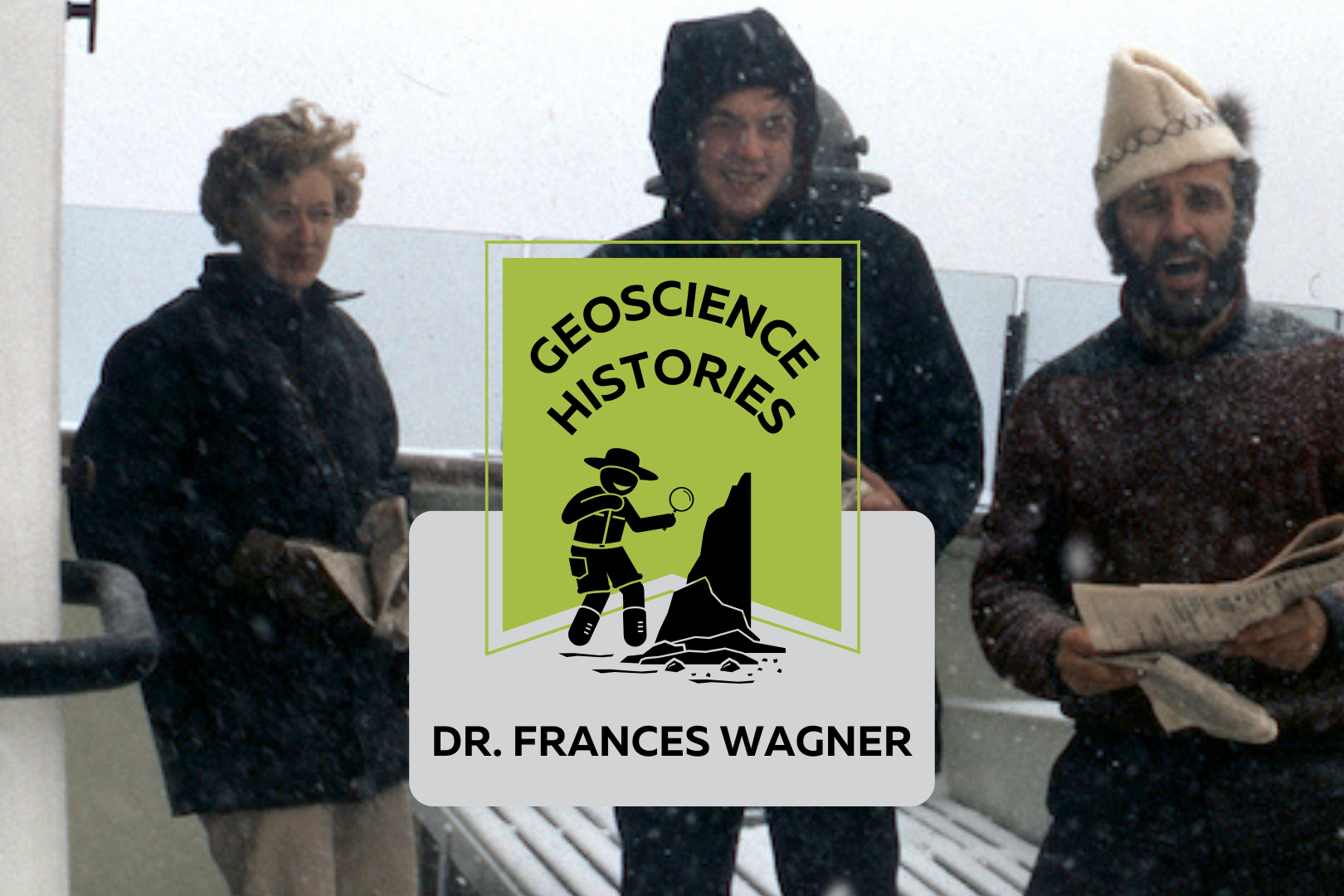
Three people standing on the deck of a boat with snow falling. Text on top of the photo reads: "Geoscience Histories, Frances Wagner"

Geoscience Histories: Dr. Frances Wagner

Frances Wagner was one of Canada’s first female geologists. Her studies in micropaleontology and mapping of Canada’s microscopic fossils were groundbreaking to our understanding of the geology of the continental shelves around Canada, especially the Arctic.  Frances was born in May of 1927 and grew up in Hamilton, Ontario, spending summers enjoying nature at her family’s cottage on Mary Lake. She and her brother would identify the lichens on the Canadian Shield rocks and go canoeing and exploring.  Wagner studied paleontology at the University of Toronto for her undergrad and went on to complete a Master’s degree in invertebrate paleontology at UofT. She researched Ordovician fossils near Ottawa under Dr. Alice Wilson (see our blog post on Dr. Wilson). The summer before she completed her Master’s degree she was hired by the Geological Survey of Canada (GSC) to catalogue fossil samples from the Victoria Museum in Ottawa. She was only the third woman to work at the GSC, in a time where women were considered too weak to do field work. Frances Wagner and her colleague Dr. Helen Belyea were some of the first women to work in the field at the GSC in the summer of 1950 with the support of Dr. Alice Wilson. Wagner went on to complete her PhD in micropaleontology at Stanford University in California. Her thesis was supervised by another groundbreaking female geoscientist Dr. Myra Keen. Her thesis was on marine Pleistocene deposits in southwestern British Columbia. She studied with a Geological Survey of Canada work party on the coast of British Columbia and shipped 350 pounds of samples from British Columbia to California to complete her studies. Her PhD allowed her to pioneer the study of marine micropaleontology. In 1954 Wagner returned to Ottawa to work full time at the GSC and complete her thesis at the same time. In order to complete her PhD she travelled three days by train to Stanford and three days back for her oral exam. In 1964, Wagner’s colleague Charlotte Keen was the first woman to travel on a research ship. The next summer, Dr. Wagner joined Keen and a few other women on the CSS Hudson to map the floor of Hudson’s Bay. The CSS Hudson was the first ship to circumnavigate North America. Wagner joined the ship as it traversed the dangerous Northwest Passage. This was a particularly perlious journey, and they concluded that the Northwest Passage was unsafe for travel. Chief Scientist Dr. Bernard Pelletier wrote in the ship report that at one point, “[the ship] rode up onto a particularly hard floe and slid off one side thereby heeling to port so abruptly and steeply that her guardrail almost touched the broken sea ice.” This is just a taste of the danger that Dr. Pelletier wrote in the report. While on the CSS Hudson, Dr. Wagner studied the ecological history of the Beaufort Sea and published groundbreaking work on the topic. In 1967, Dr. Wagner moved to Nova Scotia to work for the Bedford Institute of Oceanography. She used her experience in marine micropaleontology to study the microbiota of the Arctic and Atlantic continental shelves. In 1973 Dr. Wagner was elected as a Fellow of the Royal Canadian Geographical Society. In 1979 she co-authored a second paper on the Beaufort Shelf, this one focusing on the effects of disturbances, such as hydrocarbon drilling, on the marine ecology of the area. Outside of her career, Frances was an avid horsewoman. She owned two registered Morgan horses, Belle and Jay. She raised Jay from 5 months old and rode him for 24 years. She helped found the Nova Scotia Historical Riding Society and learned to ride sidesaddle in order to do demonstrations of traditional riding techniques at different Museum sites in Nova Scotia. She also researched and sewed traditional clothing for the Uniacke Heritage Society. Wagner was also a dog breeder. She had a kennel called Thicketwood where she bred Shetland Sheepdogs. She helped save the rare Norwegian Lundehund from extinction, importing them to Canada and breeding and showing them. Once she retired in 1984, she focused more of her time and attention on her dog breeding and horseback riding. She always had a love for the outdoors, and was an accomplished canoeist and long distance swimmer.  Wagner never married or had kids. When asked about it she said, “I was a career girl.” In Wagner’s day there was a lot of prejudice against women in the workplace getting married or having families. In Canada there was a law in place that allowed employers to fire female employees if they married. This legislation was only repealed in 1955, when Wagner was already 28 years old. Dr. Wagner had an immense influence on the field of micropaleontology in Canada. You can read one of Dr. Wagner’s publications, “Fossils of Ontario: Part 2: Macroinvertebrates and vertebrates of the Champlain Sea,” published by the Royal Ontario museum. Along with her female colleagues, she defied expectations and made major contributions to her field doing work that was previously considered improper or too difficult for women. Sources:  Science.ca Scientist Profile Frances Wagner Trowelblazers Frances Wagner NecroCanada Obituaries Frances Wagner Ada Lovelace Day Dr Frances Wagner Paleontology and stratigraphy of the marine Pleistocene deposits of Southwestern British Columbia. Fossils of Ontario: Part 2: Macroinvertebrates and vertebrates of the Champlain Sea Author Veronica Klassen is the Manager of the Foundation’s blog – Beneath Your Feet: A Geoscience Blog. She studied Arts and Science at McMaster University with a minor in Earth Science and has a masters in Science Communication from Laurentian University. She is passionate about making science accessible and engaging to the public.

Read More »
Aerial view of a landscape with rolling hills, a valley, and a river. On top of the photo text reads: "Geo Careers. Mary-Anne Hildebrandt." with the icon of a pickaxe hitting a rock.

Geo Careers: Mary-Anne Hildebrandt

What is a career? Merriam-Webster defines career as “a profession for which one trains, and which is undertaken as a permanent calling.” With more workplaces embracing the idea of flexibility, the weight of words like “permanent” and “calling” evoke something else entirely. Career originates from the Latin carrus, as in a wheeled cart, which some interpret to mean chariot (Online Etymology Dictionary, n.d.). It sounds a great deal more epic than logging into a laptop for another Zoom call. Imagine you and your coworkers embarking on a journey in chariots each day. Surely, with that as your vision, nothing is out of reach. So, what do you do for a living? It’s a common question for any social gathering, and yet, my answer is met with surprise. People are surprised to learn that I am not a teacher or nurse or some other career that matches their perception of who I am. No one has ever guessed that I am a geoscientist. Why? Do I not look or sound like a geologist? This encounter is not exclusive to the public. In truth, I’ve even been mistaken for an administrative assistant when standing in my office wearing head to toe safety gear surrounded by rock samples, and that’s not to say administration staff don’t do field work. They most certainly can and do! It’s that everyone carries bias, and when no other information is available, we fill in the missing data with assumptions based on our own perceptions of the world. Even recently at PDAC, I was asked if I was there as a member of the media, and not a geologist. Who knew that you could work in an industry for 17 years and still feel at times that you don’t quite fit other people’s perceptions of your job title. Every day there are lessons, and some are only learned much later.  When I left university for my first summer field position in 2006, I intended to return for a Master of Science, but looming student debt and other family obligations drove me to stay in the industry. I dreamed about continuing to hone my skills in the areas of geoscience that I enjoyed. Early on, I had a conversation with a manager of a team I wanted to join about my career aspirations, and he tried to put an end to those dreams. He explained that no company would invest their finite resources to support my development in this field because I was a woman, and at the age of 25, I was too old. In his experience, it wouldn’t be long before I would marry, have children, and pursue a different career. I left that conversation feeling devastated because this manager was someone that I truly respected. At the time, I didn’t know how to challenge the underlying beliefs and assumptions that he had conveyed about me. I questioned whether saying anything at all would make a difference. Who was he to decide what my future would hold? That evening, I resolved to not let his ignorance define me.   Did you stay in Geoscience? I have had the good fortune to have worked in the field of geoscience since graduating and successfully achieved my designation as a Professional Geoscientist (P.Geo.) in 2017. Drilling, sampling, mapping, and modelling led me to a deeper understanding of the influence of geological processes, sample bias, and error within spatial models and mineral estimates. In addition, the depth and breadth of the technical projects I have been able to work on has increased not only my technical skills but also my leadership skills. After working for several years as the person performing the annual reconciliation for Mineral Resources and co-authoring the technical report on the resource, I was appointed to carry out the duties of Competent Person (as defined in the SAMREC and the JORC codes) for the deposit I had spent years mapping and modelling. A Competent Person is responsible for preparing the technical report used for public disclosure of a Mineral Resource and Reserve. In the Canadian context, a CP would be similar to a Qualified Person or QP under the National Instrument 43-101 Standard. CPs, like QPs, are considered to be competent to sign-off because they meet or exceed the knowledge requirements and have enough time working in a particular commodity, like gold. There are other requirements, and for those working in the industry, it is best to be well-versed in the governing code or standard for your jurisdiction. It’s an incredibly important responsibility that cannot be taken lightly, and I was honoured to know that those in power trusted my capabilities to appoint me into that role. Although I enjoy the technical aspects of my work, I have found mentoring and coaching others to be equally, if not more, rewarding. My career has carried me to remote areas across Canada and even overseas to Botswana and South Africa. I am forever grateful to have been mentored and supervised by professionals who are highly respected in their field. These are the people who saw the value I could add to a team and a project, and they were instrumental in why I stayed the course. I found professionals from all disciplines were always there to lend a hand or an ear to help find a solution to the latest problem.  One project that I had been assigned was to create a spatial estimate for a stockpile. This was not the norm and fell outside of our regular workflow. A stockpile is not an in-situ deposit. To use it in a business plan, my work still needed to answer similar questions that would be asked during mineral classification of an in-situ deposit. There are a number of factors involved in this work, but to keep this brief, these are the types of questions that needed to be considered: How did the mining team place the rock? Do we have confidence in the volume of the stockpile? How was the volume measured? At what frequency was the volume measured? Do

Read More »
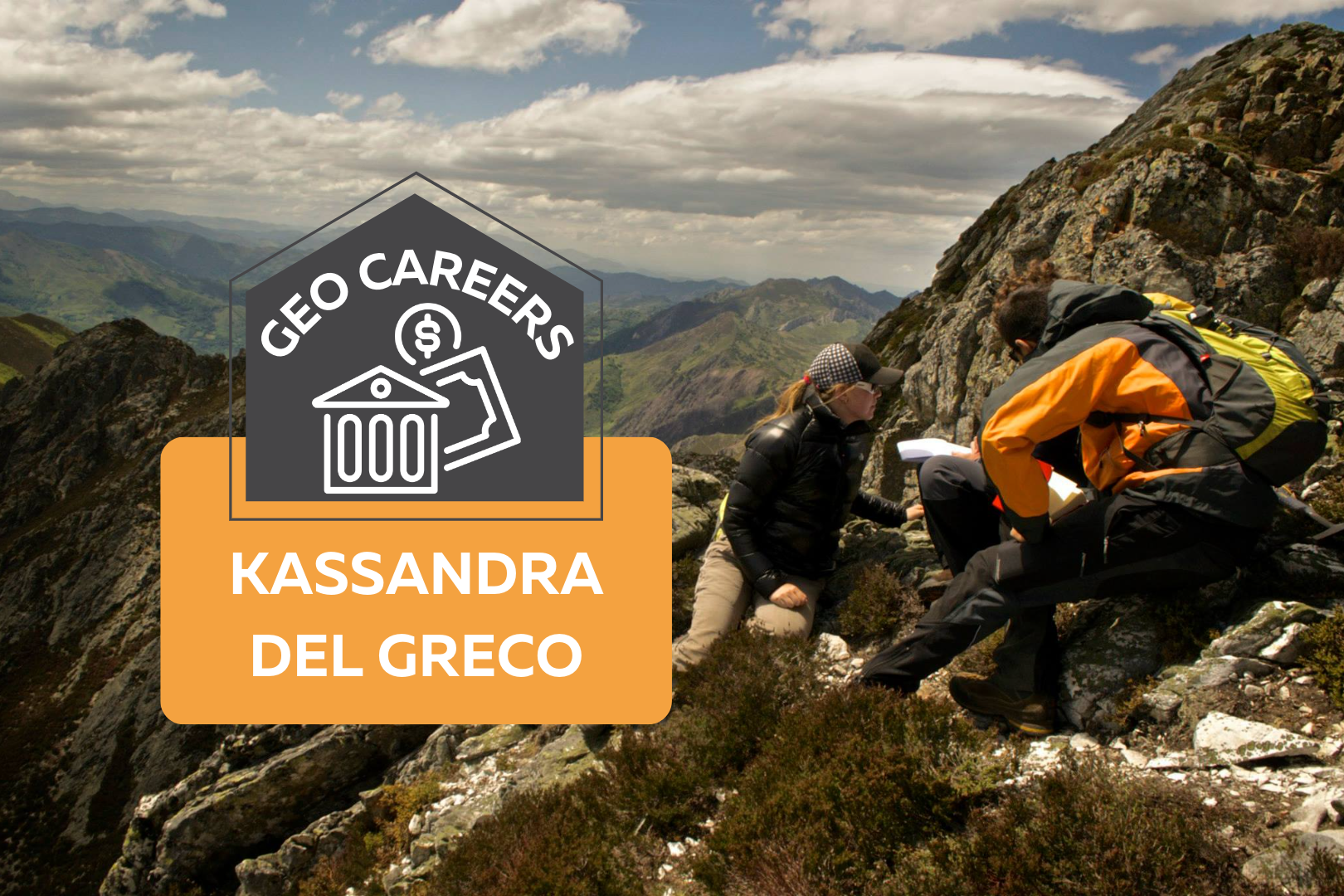
Photo of two people climbing a mountain range. On top of the photo text reads: "Geo Careers: Kassandra Del Greco."

GeoCareers: Kassandra Del Greco

When asked if I could write a little something about my career in geoscience, my gut response was, “I’m not sure I’m qualified to write something.” However, with a little reflection and persuasion, I thought it might be beneficial for others to read about how far an education in geosciences might actually take you. My initial interest in geology came out of my decision to take a “bird” course in CEGEP (Collège d’Enseignement General Et Professionnel), a type of junior college that encompasses the equivalent of grade 12 and the first year of university, to alleviate the heavy math and physics schedule I had lined up for one term. I signed up with a friend, thinking “Won’t it be nice to take a really easy class this semester” and soon found myself completely enthralled with learning about Earth’s history and systems. When university applications came around later that year, I began to consider that the career as a mathematician I had envisioned for myself didn’t quite make sense and I soon found myself wandering over to the geology, mining engineering, and geophysics booths at the McGill University open house. I was reminded during my visit to McGill that I knew two women who had graduated from McGill’s geology program. Two young women from my community, who I knew from extracurricular activities, had graduated with McGill geology degrees a few years prior and from what I could see on Facebook, were living adventure-filled lives working as exploration geologists in places like Australia and Africa. Growing up I had limited travel opportunities; it suddenly occurred to me that there are literally rocks all over the planet and that in theory, I could work anywhere in the world as a geologist, and with a career as a geologist, I might have the opportunity to visit places I’d never dreamed of before. What really sealed the deal was when I heard about the famous “Willy Trips” at McGill’s geology department, where Dr. Anthony Williams-Jones travelled to different destinations with a class of students every year to explore and learn about the geology of a new country. I was hooked. I went through university taking every opportunity to attend as many field trips as I could, and visited places like Chile, Tanzania, Columbia and the Southwest United States during my studies alone. I was so excited to begin my career as an exploration geologist and visit places like the remote Canadian North, Australia, Africa, South America…you name it. Everything was on track until 2012, the year I finally graduated. I entered the job market, top of my class, ready to begin working as an exploration geologist in mid-2012. Little did I know that 2012 would mark the beginning of one of the longest commodity and mining market downturns in history. It was difficult to find a job as an experienced geologist, let alone a freshly graduated geologist with just a summer’s worth of experience. I hustled as much as anyone, applying to literally any job I could find in the industry, but like many of the peers I graduated with, had no luck. It was disheartening, to say the least. After about 8 months of unemployment, I began looking at graduate studies opportunities. I thought that maybe I could either pursue a career in academia, or at the very least, hide out during a Masters degree and hope that within a couple of years the industry would turn and entry level jobs would begin to reappear. During my Masters degree at the University of Victoria I studied the structural geology and tectonics of the Cantabrian mountains in Northern Spain and was fortunate enough to spend a summer in Spain doing field work and attending conferences with geologists from the University of Salamanca. I finished my M.Sc. in mid-2016 and two hours after submitting my final thesis I was called by my first ever boss in the Quebec mining industry who I worked for a summer prospecting. He asked me if I was looking for work (I was) and told me about an opportunity for field work that summer (Holy cr*p, my plan worked!). I had my boots on the ground in Northern Quebec about two weeks later and was thrilled to, four years later, be starting my career as an exploration geologist. It was about 18 months of bliss, working multiple consecutive contracts in exploration for multiple gold exploration companies in Quebec. I was working on rotations that were 21 days on, 10 days off, or 14 days on, 14 days off. Of course, I took every opportunity to travel on my time off, living out of a duffle bag for months on end, visiting places like Portugal, Nicaragua, Costa Rica, and Italy. Essentially, I would go anywhere I could get to for a reasonable price and with less than 7 hours of flight time. However, it was about two years later when I started to feel the pains of the job. It turned out that as much as I loved learning about geology in school, I didn’t exactly love the work. I wasn’t totally enthused by core logging, learning to create geological models, or even spending time in the field. I was beginning to feel worn down by the swamps, the bugs, the heavy bags full of rocks, and spending whole days in the bush soaking wet. On top of this, I started to become acutely aware of the fact that I had no community. Over nearly two years, I had barely spent any time at home, causing me to feel disconnected from friends, unable to get involved in any type of club or activities at home, and forget dating, it was impossible! I began to reflect on whether this was the career for me. Sure, I loved learning about geology, and I loved travelling, but I didn’t really enjoy the work or the life I had built for myself anymore. I began searching for a mentor (I found a great one). I started writing

Read More »