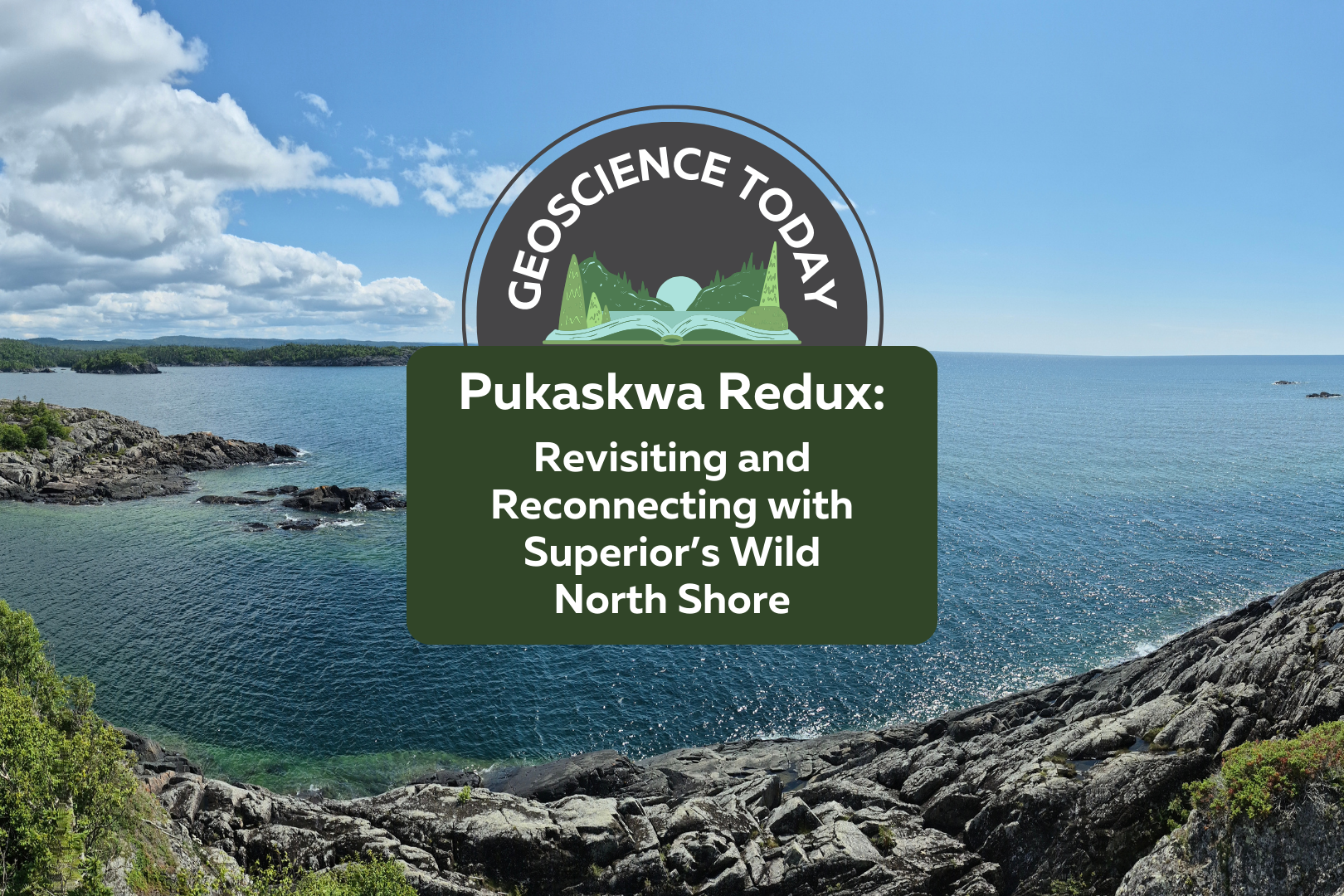
Pukaskwa Redux: Revisiting and Reconnecting with Superior’s Wild North Shore
Mark Smyk, M.Sc., P. Geo. From August 11-24, 2025 I had the pleasure of serving as the Canadian Federation of Earth Sciences (CFES) and Parks Canada’s fourth Geologist-in-Residence (GIR) at Pukaskwa National Park. I worked closely with Carly Robillard, Pukaskwa’s Interpretation Officer and Coordinator to deliver geology-based educational experiences to Park visitors and Parks Canada staff. I was encouraged to apply for Pukaskwa’s GIR Program when a number of my friends and colleagues on Facebook forwarded me the Call for Applications. It would provide me with an opportunity to revisit and reconnect with the Park and that stretch of Lake Superior shoreline where I had worked for over three decades. It had been almost twenty years since my last visit to the Park – a field trip that Tom Muir and I co-led for fellow Ontario Geological Survey (OGS) geologists. (Tom had mapped this area for the OGS in 1977.) I had first worked in the area in 1983 (the same year that Pukaskwa officially opened), based in a tent camp 3 km east of the Visitor Centre, a young geologist employed to look for gold during the height of the Hemlo rush. A few years later, I began my career with the OGS and had the good fortune of visiting the new Park and marveling at its geology. You could argue that the Park’s geology isn’t unique – similar rocks occur elsewhere along the North Shore – but they are rarely exposed as well as they are in Pukaskwa. With that in mind, I began to prepare for my long-overdue return to Pukaskwa, eager to share my passion for the local geology. I was eager to revisit spots I had fondly remembered from my earlier visits. I hiked the four front-country trails (Beach, Southern Headland, Manito Miikana and Bimose Kinoomagewnan) and walked the main access road, describing, photographing, and geo-referencing geologic features. Some of these sites would later be featured on subsequent Guided Hikes/Walks on the Southern Headland and North Beach trails. I hope to compile all of the collected site descriptions to form the basis of a self-guided, geology field trip guidebook that could be provided to future GIRs, Park staff and visitors. It was a busy two weeks at Pukaskwa! My visitor-based activities included: While these formal activities involved over 200 participants in total, I had many other informal conversations as I hiked throughout the Park, with both new and returning visitors. Fellow geologists, professional photographers and educators were among those I met who came to hike, camp and enjoy all that the Park has to offer. The Drop-In sessions invited visitors to try a variety of activities that demonstrated the properties of minerals and rocks, and how those properties help us to identify them and utilize them in everyday life. There was much interest in “Yooperlites”, fluorescent sodalite-bearing syenites from near Marathon that are found as beach pebbles in Ontario and Upper Michigan. Interest in these rocks has not waned since they started making headlines in the United States almost ten years ago. I collected some of this syenite from a rock cut on Highway 17 and gave some keen visitors pieces to take home. Drop-In Session near Visitor Centre, showing table with rock and mineral samples, books and maps, as well as a gold panning station One of the many pleasant surprises during the Drop-In sessions was the visit of Robin Heron, Pukaskwa’s former Park Manager, with whom I had worked on a regional steering committee in the 1990’s. It was great to reconnect with her after 30 years and reminisce about our time together back then! I also saw a few familiar faces on my last Walk and Talk. Friends from Thunder Bay and Terrace Bay made the trip to Pukaskwa just to take part in this event. Two members of Science North’s “Bluecoats” visiting outreach team also took part and shared enthusiastic messages and photos with other members of their team while they were on the walk! I had the good fortune to connect with Park Guardian, Binaeshee-Quae, and seven other community members from nearby Biigtigong Nishnaabeg First Nation who had questions about Grandfather Stones and selecting locally sourced stones to be used in sweat lodges. The conversation was fluid, touching upon local geology, mining history and other subjects. I let them know that they could contact me should they have any follow-up questions or require any information in the future. Photos taken by members of the Science North’s Bluecoats during the Walk and Talk on North Beach (photos courtesy of Emily Kerton, Science North) My time as Pukaskwa’s GIR was thoroughly rewarding for a number of reasons. It allowed me, after a great many years, to revisit an area that I had always enjoyed exploring and working in. I was able to interpret and document the varied Park geology and discover new things along the way. It gave me the opportunity to share my passion for geology with a wider audience and reconnect with friends and former colleagues. I was also able to introduce Pukaskwa to my family, who want to return in the near future. I hope that everyone that was involved in the 2025 GIR program – organizers, staff and visitors alike – gained something from the experience. I know I did. Thank you, all! Merci! Miigwetch! In closing, I’d like to share a poem I wrote some years ago that was inspired by my time on the North Shore. I think it is a fitting epilogue to my time at Pukaskwa. Our land bears silent witness of all that has come before billions of years of creation and destruction darkness and light ever so slowly, changing still. A fragile crust formed by fire cooled by primordial rains worn away to dust by wind and water and time. Quiet, ancient seas belied the unceasing turmoil below tearing apart this rocky shell leaving ice and the Lake to heal its fiery wound. Water upon rock time and again.