Headshot of Joanna Northover over image of a hikers boots and mountain landscape. Text reads: Beneath Your Feet. A Geoscience Podcast. FossilTok with Joannasaurus.

FossilTok with Joannasaurus

In our latest episode, we speak with @Joannasaurus — a paleontologist and science communicator who’s using TikTok to make fossils fascinating for everyone. Joanna talks about what it takes to make complex science accessible, the role of humour in online storytelling, and her roundabout journey to paleontology! Listen now: You can also listen to our podcast on these platforms: Amazon Music Apple Podcasts Spotify Read along with the podcast transcript: Introduction Hello, everyone. Welcome to Beneath Your Feet, a geoscience podcast. I’m Veronica Klassen, science communicator, geology enthusiast and your host. Here at the APGO Education Foundation, our mission is to spark curiosity and passion for the geology of Ontario. Whether you’re a geology nerd, science enthusiast, or nature lover, this podcast is for you. Join us as we geek out over fascinating geology, uncover the hidden storiesand secrets of our extraordinary planet and explore the captivating world beneath your feet. Veronica KlassenWell, welcome, everyone, to another episode of Beneath Your Feet. Today, I’m going to be talking to Joanna Northover, who is a science communicator on TikTok. We’re going to be talking about science communication, we’re going to talk about her career in geoscience, we’re going to talk about advice for students and all kinds of exciting things. So thanks so much for joining me, Joanna. JoannaNo problem. It’s my pleasure. It’s going to be a lot of fun. VeronicaAmazing. I’m very excited. All right. So why don’t we just start. Tell me a bit about yourself. Who are you and what do you do? JoannaAll right. Well, as you said, my name is Joanna Northover, but on TikTok, Instagram and YouTube, I go by Joannasaurus and I am a science communicator. But I started out interested in paleontology. So my science communication really centers around paleontology. So fossils, dinosaurs, things like that. And I have loved paleontology for as long as I can remember. And so it was sort of, I had a few stumbles along the way. We’ll probably talk about that later on. But I did do a master’s degree and an undergraduate degree in paleontology. But then I fell in love with science communication, and the rest, as they say, is history. VeronicaThat’s awesome. So yeah, so going a bit back, how did you originally become interested in paleontology and how has that journey sort of changed for you over time? JoannaAll right. So I guess a lot of people go through a dinosaur phase when they’re kids, and I was no exception. My was quite early. I really loved dinosaurs, even at a very young age and as young as the age of four, I declared that I was going to become a paleontologist. And that was a dream that I held for a very, very long time until I hit my teens. And, you know, I kind of got a little discouraged. I thought maybe this wasn’t a practical career, you know, And I thought, oh, well, maybe I’ll be a teacher instead, because I also really loved teaching. Even from a young age. I used to pretend to teach my little brother, you know, with a pointing stick and some little diagrams and stuff. And so when I was in high school, you know, I kind of pivoted a bit and I thought, Oh, I’ll do a degree, and then I’ll go to Teachers College. And I had really good marks in history and chemistry. So that’s what I applied to. I did actually apply to paleontology as well, and I got in at UofT, but I was too nervous to move all the way there because at the time I was one of the first years to do that double cohort thing where, you know, in Ontario we went from having grade 13 to going to grade 12. And so I was 17 when I graduated. I wasn’t even a legal adult, and I just felt like really nervous about going too far away from home all by myself. VeronicaCause where is home for you, sorry? JoannaOttawa. I grew up in Ottawa and that’s where I live now, so I didn’t want to go too far away from home. So I decided I would go to university at Ottawa U. And I decided to go into history and I did my first year of history and I dropped both of my history courses. So I was like, Wow, wow, this isn’t the right major. And I was like, well, maybe I made a mistake here, so that’s not a good sign. So I had done actually a first year geology course as one of my breadth courses when I was at Ottawa U. I’d also taken a lot of philosophy and I almost switched to a major in philosophy. My mom actually, of all people, said, Did you know that Carleton has just started a vertebrate paleontology concentration from the Earth Science Department? And so I applied right away. I switched over. I thought, you know what? I knew more when I was four than I know now. I just I’ll go to school and I’ll figure it out after. I’ll just, I have to study something I love or else this is going to be a disaster. And so I transferred over to Carleton and I started in the Earth Science department there doing my vertebrate paleontology concentration. And it was just magical. Suddenly it was easy to go to school. I wasn’t dropping my courses. I had so much fun. The department there was great, really supportive, and I liked it so much that after I did my bachelor’s degree, I ended up deciding to stay and do a graduate degree. I did a master’s degree also at Carleton. But while I was doing my bachelor’s and master’s, I started working in the summers at the Royal Tyrrell Museum of Paleontology, where I was working in the Science Education Department. And also I did some science education sort
Read More »
A hiker stands on the top of an outcrop looking over a distant mountain scene. Text reads: "Beneath Your Feet. A geoscience podcast."

PODCAST EPISODE 1: Devonian Discoveries: Fossils at Wainfleet Wetlands with Paleontologist Dr. Daniel Dick

Join podcast host Veronica Klassen and guest paleontologist Dr. Daniel Dick as we delve into the creation of a GeoHike at Wainfleet Wetlands. Discover the unique ecosystem of the middle Devonian period through an array of fascinating features: encounter colonial organisms, massive corals, glacial striations, and pop-up structures. We’ll discuss potentially undiscovered fossils, augmented reality animations to bring fossilized animals to life, and what counting layers on rugose corals can tell us about the speed of the Earth’s rotation in the Devonian. Episode Audio: You can also listen to our podcast on these platforms: Episode Transcript: Dr. Daniel Dick (Dan) It looks like an ecosystem where the water was just drained out of it. It feels alive and it will really help you understand just how different the world used to be. I think that is the main thing that makes paleontology interesting. It just shows you that the world has changed so much, and it will blow your mind. [musical interlude] Veronica Klassen Hello, everyone. Welcome to Beneath Your Feet, a geoscience podcast. I’m Veronica Klassen, science communicator, geology enthusiast and your host. Here at the APGO Education Foundation, our mission is to spark curiosity and passion for the geology of Ontario. Whether you’re a geology nerd, science enthusiast, or nature lover, this podcast is for you. Join us as we geek out over fascinating geology, uncover the hidden stories and secrets of our extraordinary planet, and explore the captivating world beneath your feet. [musical interlude] Veronica All right, let’s get started. Today, I’m going to be talking to Daniel Dick, who is a researcher at McMaster University. Daniel, why don’t you start by telling us a bit about yourself? Dan Yeah, I mean, you covered quite a bit there. I’m Dan. I’m a postdoc at McMaster, primarily working on this public outreach project that we’ve been developing over the last few years. Which, in conjunction with the APGO Education Foundation, is developing this website, GeoscienceINFO, and primarily we are working on the GeoHikes. Research-wise, I’m a paleontologist. I focus primarily on fossils. I work on mass extinction events and trying to understand the dynamics of them, with the end goal of hopefully applying some of the knowledge we might learn from past extinction events to help us understand contemporary extinction dynamics and areas of risk and things like this. Yeah, so, my research sort of takes me all over. It’s primarily focused on Ordovician-Silurian fossils. So that’s a lot of stuff that we find here in Ontario, but also in other parts of Canada and the United States and such. Veronica Amazing. So how did you originally get interested in geoscience? Like, what led you here? Dan I’ve definitely been interested in it for a very long time. I have photos as a kid at the Royal Tyrrell Museum staring at the fossils, and you can sort of see that it’s already something I’m obsessed with at that point. But the beginning of the journey, I think, was in high school because my high school actually had Earth science courses up to grade 12 in B.C., where that’s sort of more standard. And I’d kind of forgotten how much I like geoscience, I think until those late courses. And it reminded me, oh yeah, I forgot that this was a thing. And that was something that I enjoyed and was good at as well, which helped. Veronica So, it was kind of high school, then you decided to study it in university. Did you go straight into geoscience? Dan Yeah, I didn’t actually go straight into it. I went into evolutionary anthropology, so I was focused more on human evolution and human fossils and things like that. But then found myself realizing that the questions and things I was more interested in could more easily be answered by working with non-human fossils, because you need large numbers of things, so you need lots of fossils in order to start to understand things like extinction dynamics and climate change and all that kind of stuff. And so, I switched over to more standard and invertebrate paleontology at that point for my Ph.D., which then looked at those kinds of questions. Veronica So, when you say those kinds of questions, you’re talking about extinction events and how we can learn from that? Is what you mean? Dan Yeah, absolutely. Yeah. Veronica Yeah, for sure. And just for a little bit more context do you want to explain kind of like what the GeoHikes are, what’s like the purpose of the GeoHikes? Dan For sure. So basically, like the GeoHikes are kind of a, they’re sort of a freely accessible trail guide in a literal sense, that’s what they are. They take you along an existing hiking trail that has some sort of geologically interesting features on it, and there’ll be a series of stops which will take you to these different features and will describe for a general audience what’s going on geologically. Occasionally we do other things beyond geology. We also look at ecology, for example, talk about invasive species or we’ll find fossils on some of the hikes, and we’ll talk about ancient ecosystems or mass extinctions or whatever it is we’re doing. And my personal vision for them, is I see them sort of as a living first year Earth science lecture. They’re simple in the sense that they should be understood by anyone. But instead of having a textbook figure or something explaining the process of erosion or soil formation or something, you go to a physical location where this is all on display. And so, the figure that you would normally look at in a textbook is now there in front of you in real life and offers an opportunity to learn this. Ideally, the way I see it is if you do enough of these GeoHikes, you will get all the basic information you would need to understand, you know, the sophistication of

Read More »
Three people standing on the deck of a boat with snow falling. Text on top of the photo reads: "Geoscience Histories, Frances Wagner"

Geoscience Histories: Dr. Frances Wagner

Frances Wagner was one of Canada’s first female geologists. Her studies in micropaleontology and mapping of Canada’s microscopic fossils were groundbreaking to our understanding of the geology of the continental shelves around Canada, especially the Arctic.  Frances was born in May of 1927 and grew up in Hamilton, Ontario, spending summers enjoying nature at her family’s cottage on Mary Lake. She and her brother would identify the lichens on the Canadian Shield rocks and go canoeing and exploring.  Wagner studied paleontology at the University of Toronto for her undergrad and went on to complete a Master’s degree in invertebrate paleontology at UofT. She researched Ordovician fossils near Ottawa under Dr. Alice Wilson (see our blog post on Dr. Wilson). The summer before she completed her Master’s degree she was hired by the Geological Survey of Canada (GSC) to catalogue fossil samples from the Victoria Museum in Ottawa. She was only the third woman to work at the GSC, in a time where women were considered too weak to do field work. Frances Wagner and her colleague Dr. Helen Belyea were some of the first women to work in the field at the GSC in the summer of 1950 with the support of Dr. Alice Wilson. Wagner went on to complete her PhD in micropaleontology at Stanford University in California. Her thesis was supervised by another groundbreaking female geoscientist Dr. Myra Keen. Her thesis was on marine Pleistocene deposits in southwestern British Columbia. She studied with a Geological Survey of Canada work party on the coast of British Columbia and shipped 350 pounds of samples from British Columbia to California to complete her studies. Her PhD allowed her to pioneer the study of marine micropaleontology. In 1954 Wagner returned to Ottawa to work full time at the GSC and complete her thesis at the same time. In order to complete her PhD she travelled three days by train to Stanford and three days back for her oral exam. In 1964, Wagner’s colleague Charlotte Keen was the first woman to travel on a research ship. The next summer, Dr. Wagner joined Keen and a few other women on the CSS Hudson to map the floor of Hudson’s Bay. The CSS Hudson was the first ship to circumnavigate North America. Wagner joined the ship as it traversed the dangerous Northwest Passage. This was a particularly perlious journey, and they concluded that the Northwest Passage was unsafe for travel. Chief Scientist Dr. Bernard Pelletier wrote in the ship report that at one point, “[the ship] rode up onto a particularly hard floe and slid off one side thereby heeling to port so abruptly and steeply that her guardrail almost touched the broken sea ice.” This is just a taste of the danger that Dr. Pelletier wrote in the report. While on the CSS Hudson, Dr. Wagner studied the ecological history of the Beaufort Sea and published groundbreaking work on the topic. In 1967, Dr. Wagner moved to Nova Scotia to work for the Bedford Institute of Oceanography. She used her experience in marine micropaleontology to study the microbiota of the Arctic and Atlantic continental shelves. In 1973 Dr. Wagner was elected as a Fellow of the Royal Canadian Geographical Society. In 1979 she co-authored a second paper on the Beaufort Shelf, this one focusing on the effects of disturbances, such as hydrocarbon drilling, on the marine ecology of the area. Outside of her career, Frances was an avid horsewoman. She owned two registered Morgan horses, Belle and Jay. She raised Jay from 5 months old and rode him for 24 years. She helped found the Nova Scotia Historical Riding Society and learned to ride sidesaddle in order to do demonstrations of traditional riding techniques at different Museum sites in Nova Scotia. She also researched and sewed traditional clothing for the Uniacke Heritage Society. Wagner was also a dog breeder. She had a kennel called Thicketwood where she bred Shetland Sheepdogs. She helped save the rare Norwegian Lundehund from extinction, importing them to Canada and breeding and showing them. Once she retired in 1984, she focused more of her time and attention on her dog breeding and horseback riding. She always had a love for the outdoors, and was an accomplished canoeist and long distance swimmer.  Wagner never married or had kids. When asked about it she said, “I was a career girl.” In Wagner’s day there was a lot of prejudice against women in the workplace getting married or having families. In Canada there was a law in place that allowed employers to fire female employees if they married. This legislation was only repealed in 1955, when Wagner was already 28 years old. Dr. Wagner had an immense influence on the field of micropaleontology in Canada. You can read one of Dr. Wagner’s publications, “Fossils of Ontario: Part 2: Macroinvertebrates and vertebrates of the Champlain Sea,” published by the Royal Ontario museum. Along with her female colleagues, she defied expectations and made major contributions to her field doing work that was previously considered improper or too difficult for women. Sources:  Science.ca Scientist Profile Frances Wagner Trowelblazers Frances Wagner NecroCanada Obituaries Frances Wagner Ada Lovelace Day Dr Frances Wagner Paleontology and stratigraphy of the marine Pleistocene deposits of Southwestern British Columbia. Fossils of Ontario: Part 2: Macroinvertebrates and vertebrates of the Champlain Sea Author Veronica Klassen is the Manager of the Foundation’s blog – Beneath Your Feet: A Geoscience Blog. She studied Arts and Science at McMaster University with a minor in Earth Science and has a masters in Science Communication from Laurentian University. She is passionate about making science accessible and engaging to the public.

Read More »
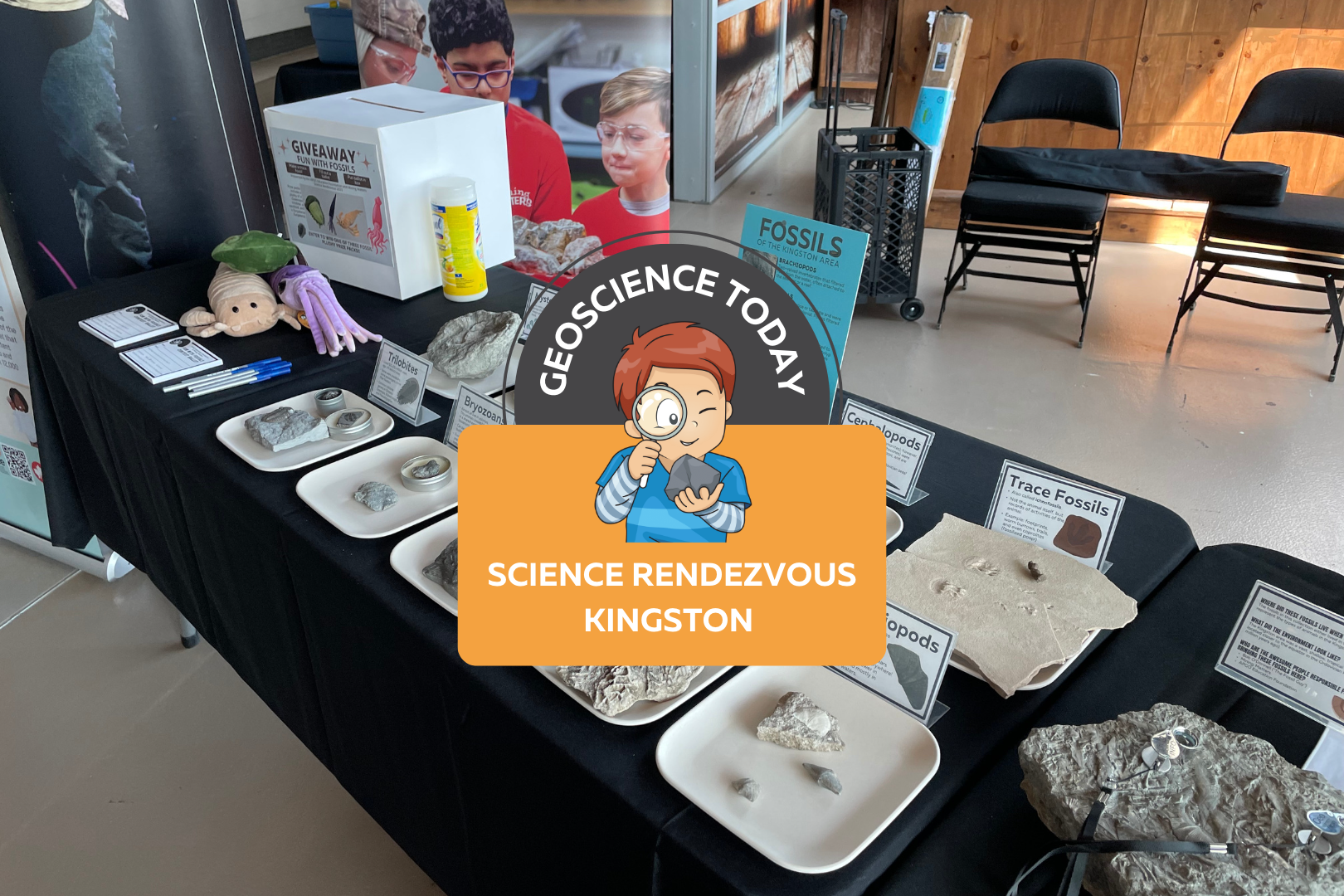
The APGOEF table at Science Rendezvous with fossils and stuffed animals. On top of the image text reads "Geoscience today: Science Rendezvous Kingston"

AGPOEF at Science Rendezvous Kingston

The APGO Education Foundation was excited to participate in Science Rendezvous in Kingston on May 13th, 2023! APGOEF has attended Science Rendezvous Kingston in previous years, and it has always been an incredible outreach event.  The day started with opening ceremonies where the official town crier announced the decision to make May 13th, 2023, the official “Science Rendezvous Day.” The town crier along with the mayor opened the doors at 10am to allow the crowd of families into the Leon’s Centre on the Tragically Hip Way by Kingston’s waterfront.  APGOEF collaborated with Mining Matters to create a fun table about the fossils of Kingston! Our booth was right next to the entrance to the Leon’s Centre and the crowd was instantly lining up to take a look at our fossils. We had an extensive fossil collection on display; some of which were donated to us by Bob O’Donnell.  We engaged kids by handing out stickers that said “I love fossils.” The kids loved them, putting them on their hands and t-shirts or tucking them away safely into their tote bags provided by Science Rendezvous. We also brought our signature colour-changing pencils, which are always a hit at any event we go to. We showed the children how, if you rub the pencil between your hands, it will change from black to pink or blue! Everyone was obsessed with the pencils and we handed out 500 or more.  We also had an interactive trace fossil activity with Play Doh. We provided an assortment of invertebrate fossils such as brachiopods, bryozoans, and corals, and encouraged people to press the fossils into the Play Doh and lift them out leaving behind a pattern. These patterns are similar to how trace fossils are made when the organism is alive, and sometimes all we have preserved of an organism is records of its behaviour in the sediment and not the animal itself! We also had some fun trace fossils on hand to surprise kids, such as footprints and coprolites (fossilized poop!) Once the kids were finished playing with the fossils and Play Doh, they moved further down the table to take a look at some cool fossil samples that could be found in the Kingston area. We explained how Kingston used to be under a massive shallow sea, and how all the sea creatures we see fossilized here used to live in the sea. We encouraged kids and parents to look around the limestones of Kingston to see some of the same fossils that were displayed here. At the end of the table we held a giveaway for three really cute fossil plushies as well as a copy of Four Billion Years and Counting, the beautifully illustrated geology textbook. We had families fill out a slip of paper answering questions about the fossils they interacted with in order to enter the giveaway. We picked three winners from the ballots the following day and mailed them their prizes. Approximately 1,300 people visited our booth during the 5 hour event. We really enjoyed talking to parents, kids, and individuals about the fossils of Kingston. A lot of the children expressed interest in fossils and some said that they had some fossils or rocks at home already. One child mentioned that he found a fossil on the way to school recently, and a few kids said that they loved dinosaurs. Although we didn’t have any dinosaurs at our table (you won’t find any dinosaur fossils in Kingston, or Ontario generally), we were still excited to connect with the kids about their passions.  The other organizations at Science Rendezvous all had incredible booths! We did not have much of a chance to walk around and see the other exhibits because we were so busy, but the whole event looked like a big success.  We would like to thank Science Rendezvous Kingston for having us again this year and for hosting such an incredible event. We also want to thank Bob O’Donnell for donating some of the beautiful fossils that really made our table a hit. We look forward to doing this again in the future!     Veronica Klassen is the Manager of the Foundation’s blog – Beneath Your Feet: A Geoscience Blog. She studied Arts and Science at McMaster University with a minor in Earth Science and has a Master’s in Science Communication from Laurentian University. She is passionate about making science accessible and engaging to the public.

Read More »

Confessions of a Geoscience Educator – How Did I Get Here?

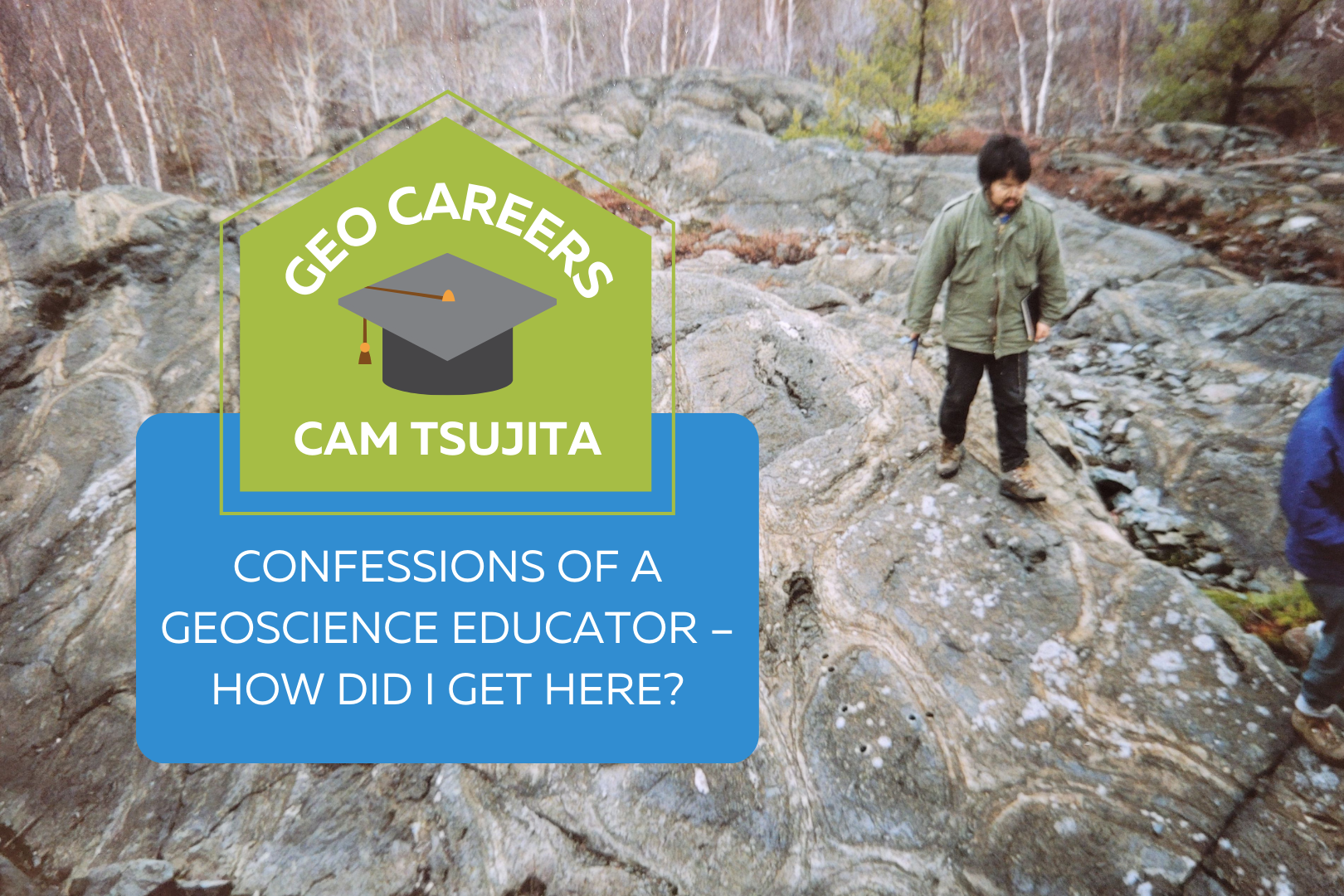
It is common to hear stories of highly gifted individuals pursuing a career path and ultimately landing their dream job after years of climbing the ladder. Sometimes I even tell people that I am very lucky to have landed my dream job. “Lucky” is certainly true, but the fact is, I’m not particularly gifted, nor did I imagine working in the career I have now, that is, being an educator. That sort of happened by accident. My job is amazing, but my work does not quite match what I originally envisioned. Yes, I have always wanted to be a paleontologist, and yes, people call me a paleontologist, but my main passion is teaching geology (and not much of it is actually paleontology). When people asked me what I did for a living, I used to reply that I was a paleontologist. Now, I’m more inclined to say that I’m a university teacher. I guess I am getting to that age where I wake up and think, “Well, how did I get here?”” (and now I’m cursing David Byrne because I know I’ll have that certain song in my head for the rest of the day). I am slightly bothered by the fact that I was born in 1966. This means I’m about as old as the theory of plate tectonics. I have only recently come to fully embrace this without the eye twitch! Plot it on the geologic time scale and it doesn’t look quite so bad. But I digress… I was born in the town of Olds, Alberta. My earliest memory of a rock that interested me was a piece of shale that a friend of the family showed me. It had a trilobite in it. Apparently, I had already shown an interest in rocks at this point, and she thought I might be interested in looking at it. I remember seeing it and thinking that it was the coolest thing I had ever seen. It looked kind of creepy, but beautiful at the same time. And a dead animal in a rock? Sign me up! I’ve noticed that a disproportionate number of photos I have of me as a kid show me looking at the ground for fossils (or rocks). I don’t know exactly what drew me to fossils and rocks. Maybe it has something to do with always having been vertically challenged (and being so close to the ground)? Or maybe it’s an obsession with dead things? I still don’t know exactly what it was… This obsession with fossils got me in trouble at times. I remember my mom being very upset with me for being nearly hit by a train while looking at the stones in the ballast of the train tracks. I was nearly hit by a car once when I was inspecting gravel on the side of the road too. I was developing an interest in dinosaurs as my parents would take me to Drumheller (about an hour and a half drive from Olds) to look for dinosaur fossils (the Royal Tyrrell Museum wasn’t yet constructed). Then my dad (a professor in horticulture) got a job at the University of Guelph. In Ontario. Well, dang – there goes dinosaur hunting.  Fortunately, I found out that there were a lot of old invertebrate fossils to be found in Ontario. I started finding fossils in…driveway gravel (of course). I was very, very fortunate to have parents who were supportive of my strange interests.   My fossil obsession continued through my teen years. I kept it hidden from most others, as I thought most people would think it was a really weird thing (but who are we kidding? Teens think everything is weird). One thing I did discover during high school is I always learned more about something if I had to explain it to someone else. This still holds true for me today. There are a whole lot of things I wouldn’t know now if I didn’t have to teach about them in my courses. The fantasy of becoming a paleontologist sat in the back of my mind for years. But I had always assumed that I would have to be an exceptional student to get into that sort of field. The thing was, I was not an exceptional student. Especially in science. And I was hopeless at math (and I’m still hopeless at math). My teachers in high school (and my guidance counsellor) told me that if I was to go to university after high school, my best bet would be visual art, music or maybe English. I don’t think any of them expected me to go into science. My grades, although definitely not stellar, were good enough to get me into the University of Western Ontario for science, and ultimately into the geology program. By the second year of my undergraduate program, I found my people. I became friends with other students interested in geology and was delighted to learn that a lot of my peers really sucked at math too. One of the most transformative realizations I came to appreciate from the courses I took was that paleontology was part of something much bigger than I formerly realized. Taking courses in a variety of subdisciplines – sedimentology, geochemistry, structural geology, petrology, and many others – made me appreciate the complexity and interconnectedness of natural processes in the Earth system as a whole. The idea that (in conjunction with characteristics of the rocks that contained them) fossils could be used to interpret past environments just blew my mind. And gaining the ability to visualize, in my minds eye, how a given rock formed (something I often to refer to as “looking beyond the rock”) felt like acquiring a superpower. So, while I came to my undergraduate degree wanting to study fossils, I left with a deeper appreciation of rocks – the context for fossils. So, l kept looking down, but my view of the ground became much, much bigger. From my undergraduate degree

Read More »
Graphic with dinosaur footprints and a magnifying glass. Text reads" Geo Q&A: Where are the dinosaurs?" There is a missing poster with a dinosaur on it beside the text.

Where are the dinosaurs?

Dinosaurs were some of the biggest animals to ever roam our planet. This massively large group of reptiles were around from the late Triassic Period (approximately 230 million years ago) until they went extinct at the end of the Cretaceous Period, approximately 65.5 million years ago (not including their flying descendants, which evolved into today’s birds!). For a remarkable 165 million years, they were seemingly ubiquitous; dinosaur fossils have been found on every continent! When dinosaurs first evolved, Earth’s plates were arranged into one large continent called Pangea. This single-continent arrangement no doubt facilitated their migration to all corners of the globe. It should stand to reason therefore that if I start digging in my backyard here in London, Ontario, I should eventually find some kind of dinosaur fossil, should it not? Turns out, the answer is a disappointing no. Only disappointing, though, if dinos are your only area of interest. Don’t get me wrong, I love dinosaurs (although I would not want to meet one in a back alley. Or even a front alley); however, there is still a treasure trove of fossils just waiting to be uncovered here in Ontario. The fossils here are just much, much older than any dinosaur, because the time they lived in and thus the rocks that their remains eventually became fossilized within are much older. The rocks in southwestern Ontario range in age from the late Ordovician Period (about 455 million years) to the Late Devonian Period (about 360 million years). That is roughly 205-130 million years before the first dinosaur strutted on the scene! If there are no dinosaur fossils to be found in southwestern Ontario, does this mean that dinosaurs never lived here at all? Fear not. Ask any paleontologist, and they will all agree that dinosaurs almost certainly did live in what is now Ontario, Canada. The Mesozoic Era, sometimes colloquially called the Age of the Dinosaurs, lasted approximately 165 million years. During such a long geological time span, there were no doubt times of deposition that added to the rock record. Given that there would have been many billions of individual dinosaurs during that time, the remains of many little and big critters would have absolutely been buried in the sediments and later undergone fossilization across Ontario. So, the big question remains: where are the dinosaurs? Up until about 2.5 million years ago, these fossilized dinosaur bones were likely still in the rocks in southern Ontario, just waiting to be discovered by future paleontologists. But then something big happened. Something really big. Things started to get very cold. Global temperatures began to drop significantly, and ice sheets started to grow on the continents. The cause of this change to colder conditions isn’t as clear as you’d think for something that occurred relatively recently (at least in geological terms that is). If you ask three different respected geologists why, you might get three slightly different respectable answers. That doesn’t mean that two of them are wrong, it just means that the cause is likely a result of an interplay of different factors that all contributed to lower global temperatures. The position of Earth’s continental plates no doubt played a big factor in the overall cooling of the planet, as their arrangement greatly affects oceanic and atmospheric circulation patterns. Other variables such as atmospheric CO2 levels and even predictable changes to Earth’s orbit could have facilitated the cooling process.   In North America, the Laurentide ice sheet covered most of Canada and some parts of the United States a number of times, as it advanced and retreated repeatedly in cycles of growth and shrinkage in response to climatic conditions. You can imagine the havoc that a sheet of ice reaching a few kilometres in thickness would have on the ground as it makes its way forward and backward! The ice sheet literally scraped many layers of rock away, turning whatever got in its way into a fine powder called “rock flour”.  All those poor dinosaur fossils that waited so patiently to get their place of honour in a paleontology museum were instead ground up into dust. Far be it from the scientific community to see this as a bad thing. Although glacial activity removed the fascinating rocks layers of the dinosaur-saturated Mesozoic Era here in Ontario, it ended up exposing the just-as-fascinating rock layers of the even older Paleozoic Era! The rocks that lie at or near the surface in southwestern Ontario range in age from the Upper (or late) Ordovician Period (about 455 million years old) around the Belleville to Peterborough area and get progressively younger as you drive southwest towards the Arkona area, where they are late Devonian in age (about 360 million years old). Although the fossils found in these rocks differ among species, there are many common types of fossils found in many of the limestone, dolostone, and shale outcrops throughout southwestern Ontario, from Ordovician to Devonian rock units. Some of the most common types of fossils found in southwestern Ontario are corals. Although they look like plants, corals are actually marine animals that usually lived attached to the seafloor. The fossilized corals here in southwestern Ontario are either tabulate (colonial-type) or rugose (solitary and colonial type) corals, and if you find them, it can tell you quite a bit about what the environment was like when they were alive. Since they thrive in relatively shallow, warm, marine seas, we can reconstruct their living conditions and make some accurate conclusions about the environment when these rock units were deposited. There are also many other fossils to be found in these rocks, such as brachiopods, gastropods, bivalves, crinoid parts, trilobites, bryozoans, and much more. The animation here shows what life could have looked like in the shallow, tropical seas of the Devonian Period, in southwestern Ontario. This is all fine and dandy, but the question still remains: where are the dinosaurs? To find them, you’ll need either a good-working car or a plane ticket; however, you

Read More »