

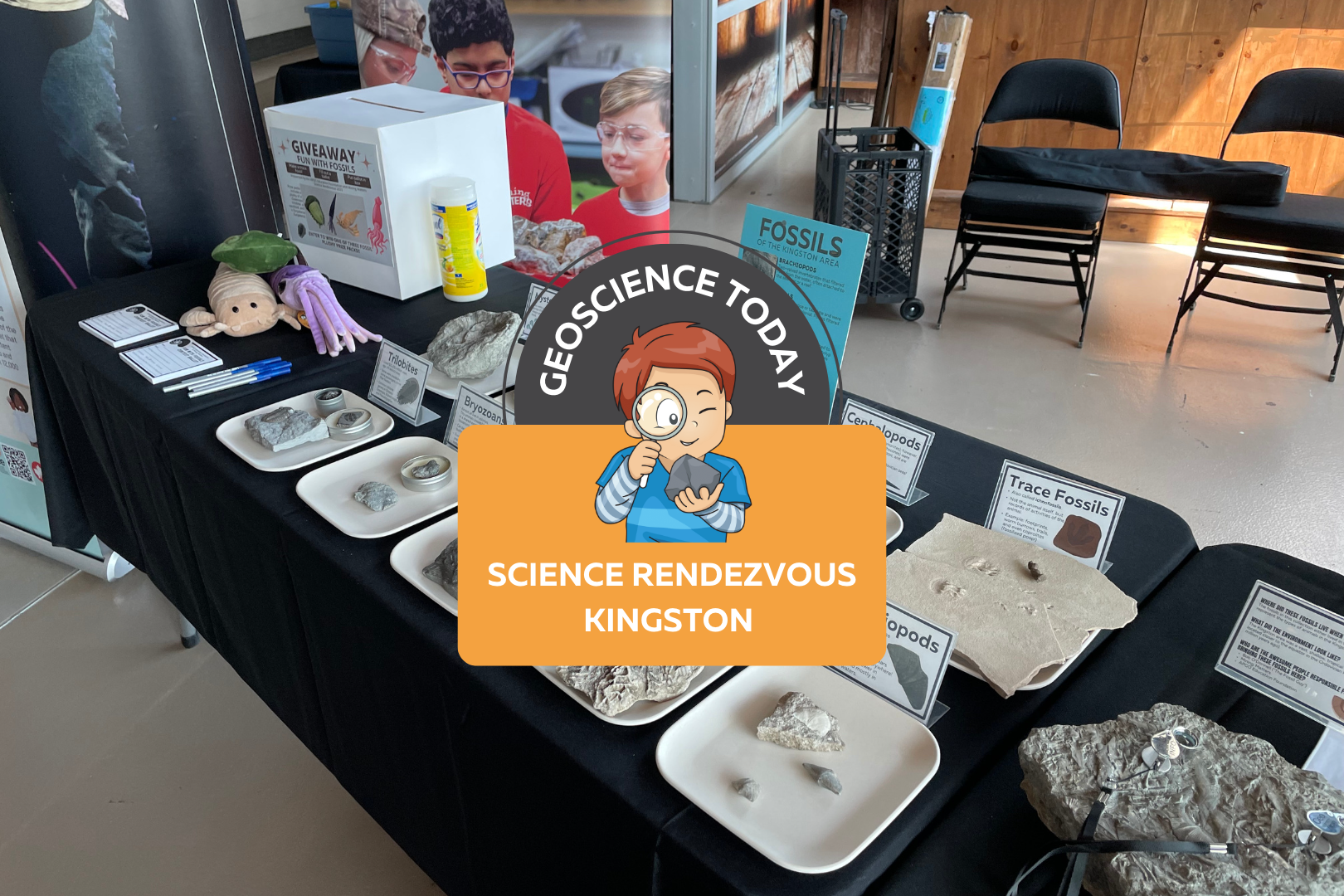
The APGOEF table at Science Rendezvous with fossils and stuffed animals. On top of the image text reads "Geoscience today: Science Rendezvous Kingston"

AGPOEF at Science Rendezvous Kingston

The APGO Education Foundation was excited to participate in Science Rendezvous in Kingston on May 13th, 2023! APGOEF has attended Science Rendezvous Kingston in previous years, and it has always been an incredible outreach event.  The day started with opening ceremonies where the official town crier announced the decision to make May 13th, 2023, the official “Science Rendezvous Day.” The town crier along with the mayor opened the doors at 10am to allow the crowd of families into the Leon’s Centre on the Tragically Hip Way by Kingston’s waterfront.  APGOEF collaborated with Mining Matters to create a fun table about the fossils of Kingston! Our booth was right next to the entrance to the Leon’s Centre and the crowd was instantly lining up to take a look at our fossils. We had an extensive fossil collection on display; some of which were donated to us by Bob O’Donnell.  We engaged kids by handing out stickers that said “I love fossils.” The kids loved them, putting them on their hands and t-shirts or tucking them away safely into their tote bags provided by Science Rendezvous. We also brought our signature colour-changing pencils, which are always a hit at any event we go to. We showed the children how, if you rub the pencil between your hands, it will change from black to pink or blue! Everyone was obsessed with the pencils and we handed out 500 or more.  We also had an interactive trace fossil activity with Play Doh. We provided an assortment of invertebrate fossils such as brachiopods, bryozoans, and corals, and encouraged people to press the fossils into the Play Doh and lift them out leaving behind a pattern. These patterns are similar to how trace fossils are made when the organism is alive, and sometimes all we have preserved of an organism is records of its behaviour in the sediment and not the animal itself! We also had some fun trace fossils on hand to surprise kids, such as footprints and coprolites (fossilized poop!) Once the kids were finished playing with the fossils and Play Doh, they moved further down the table to take a look at some cool fossil samples that could be found in the Kingston area. We explained how Kingston used to be under a massive shallow sea, and how all the sea creatures we see fossilized here used to live in the sea. We encouraged kids and parents to look around the limestones of Kingston to see some of the same fossils that were displayed here. At the end of the table we held a giveaway for three really cute fossil plushies as well as a copy of Four Billion Years and Counting, the beautifully illustrated geology textbook. We had families fill out a slip of paper answering questions about the fossils they interacted with in order to enter the giveaway. We picked three winners from the ballots the following day and mailed them their prizes. Approximately 1,300 people visited our booth during the 5 hour event. We really enjoyed talking to parents, kids, and individuals about the fossils of Kingston. A lot of the children expressed interest in fossils and some said that they had some fossils or rocks at home already. One child mentioned that he found a fossil on the way to school recently, and a few kids said that they loved dinosaurs. Although we didn’t have any dinosaurs at our table (you won’t find any dinosaur fossils in Kingston, or Ontario generally), we were still excited to connect with the kids about their passions.  The other organizations at Science Rendezvous all had incredible booths! We did not have much of a chance to walk around and see the other exhibits because we were so busy, but the whole event looked like a big success.  We would like to thank Science Rendezvous Kingston for having us again this year and for hosting such an incredible event. We also want to thank Bob O’Donnell for donating some of the beautiful fossils that really made our table a hit. We look forward to doing this again in the future!     Veronica Klassen is the Manager of the Foundation’s blog – Beneath Your Feet: A Geoscience Blog. She studied Arts and Science at McMaster University with a minor in Earth Science and has a Master’s in Science Communication from Laurentian University. She is passionate about making science accessible and engaging to the public.
Read More »
Kingston town hall. In front of the photo text reads: "Geoscience Today. A Celebration of Kingston Geology."

A Celebration of Kingston Geology

We at the APGO Education Foundation are always looking for an excuse to celebrate geology. What better way to do that than to sing the geological praises of the Kingston area! On Saturday, May 7, 2022, the APGO Education Foundation and Mining Matters will be hosting a table at the Science Rendezvous event in Kingston, Ontario, at the Leon’s Centre. We hope that you will drop by and talk a bit of shop with us, because we haven’t been able to talk about geology with you in person for so long! This year our theme is “The Geology of Kingston.” From May 7-22, we will be offering a geology themed scavenger hunt where you can earn your digital “Geo-Explorer Badge” of Kingston, and a chance to win one of five cool prizes. Choose from a list of geologically interesting rocks listed on our site, then visit a minimum of six of those rocks located either on Queen’s campus or along the Kingston Waterfront. Take an original photo of the rocks you visit, then submit them to us online. That’s it! If you have visited the correct rocks and submitted an original photo, then you will qualify to win one of five beautiful geology textbooks. Five winners will be randomly selected from qualifying entries. You can also visit us at our booth on May 7th to look at some rock samples of Kingston and talk about how they formed. Did you know that Kingston is also called the Limestone City? People used to build limestone buildings right on top of the limestone they excavated to make them! But limestone isn’t all that Kingston has to offer. Not even a little bit. To say that Kingston has a complicated past would be a big understatement. The area shows evidence of so many geologic events throughout the past billion-plus years that it requires a lot of detective work by geologists to try and piece these events together. Perhaps we’ll never know the full detailed story; however, we can be sure it will give geologists something to think about for centuries to come. To the northeast of Kingston lies a strip of Precambrian rock called the Frontenac Arch. It connects the Precambrian rocks of Algonquin Park to the northwest to those of the Adirondack Mountains to the southeast. The rocks themselves were formed between 1.1 to 1.4 billion years ago, the later stages of which were thought to be a time when there was quite a bit of volcanic activity, resulting in a lot of magma being deposited on the continent1. As if all this magma spewing all over the ground wasn’t enough excitement, the igneous rocks that formed from this magmatism were then deformed due to a process called metamorphism. This metamorphism was a result of an incredibly massive mountain-building event, or what geoscientists call “orogenesis”. This mountain building event is called the Grenville Orogeny, and it lasted until about 980 million years ago. The mountain range itself was massive – it ran from Labrador, Canada, down to Mexico, in a northeast to southwest direction. The mountains formed when at least two continental landmasses collided with Laurentia, the large North American continental landmass at the time. The term “collide” implies an immediate event. But the movement of continental plates is not instantaneous; average plate movement is 10 cm per year. While this rate of movement might seem inconsequential at first, remember that continents are ridiculously massive in size and just because they come in contact with another on-coming continent does not mean they stop moving! Once a continent collides with another continent head-on, the ground starts to buckle and has nowhere to go but up. Think about the last time you shoveled your driveway (brr!). When you put your shovel down, the snow is flat and beautiful, just as it was deposited. When you start to push your shovel though, the snow buckles and builds upwards, forming little mountain-like structures made of snow on your shovel. In orogenesis, instead of snow, the ground itself is pushed upward on a massive scale, forming mountains. Over many millions of years, the Grenville Orogeny was formed in North America, its western edge giving Kingston, Ontario a high five. You might be thinking “Wait, I’ve been to Kingston and there weren’t any mountains there!” You’re right… and you’re wrong. Like all good things, even mountains must come to an end. Once the continents stopped pushing into each other, the ground was no longer being pushed upwards and the mountain building phase ended. With no upward building, the mountainous sediments had nowhere to go but down. Over the next several hundred millions of years, the powerful effects of weathering and erosion wore the mountains down until not much remained but their roots. When you walk over the Frontenac Arch, you are walking on the roots of an ancient mountain! At one point in time, these very rocks were at the bottom of a mountain as tall as the Himalayan Mountains. With that amount of weight sitting on top of you, you can imagine things would get pretty uncomfortable. The rocks found in the roots of a mountain are commonly subjected to metamorphism. Because of the high temperatures and pressures there, they undergo deformation, which alters the original (or “parent”) rock to form a secondary, and ultimately, metamorphic rock. For example, if a granite rock is buried and subjected to high temperatures and pressures, it can turn into the metamorphic rock gneiss. When you stroll over the Frontenac Arch, you see lots of granite and its metamorphic product gneiss. You’ll also see marble, syenite, monzonite, migmatite, gabbro, quartzite and pegmatite2. As millions of years passed, the North American continent moved so that what is now Kingston was positioned near the equator. By the mid Cambrian Period (approximately 520 million years ago) this area became a shallow tropical sea –a stark contrast to its volcanic phase 700 million years before! By this time, life was in full bloom in

Read More »