

A pirate ship sailing into the sunset with a black flag with a photo of the earth on it. Text over the photo read: "Geoscience Today. Pirates and Geoethical privateers."

Pirates and Geo-Ethical Privateers

By Paul Hubley, P.Geo. “True Fact – the lack of pirates is causing global warming” – Forbes (2012) When Forbes Magazine published this graph along with the claim above, it caught my eye. In the graph, the average global temperature is increasing (on the vertical axis) as the number of pirates (on the horizontal axis) is decreasing. The reduction of pirates to “approximately” 17, roughly corresponding to the highest recorded temperature, is an oddly specific measurement (and my favourite part). There is even a handy timestamp along the curve and a familiar but outdated and partially obscured world map background for added authenticity. Taken together, the visual story woven by Forbes cleverly serves to reinforce some of our existing biases and our assumptions – it suggests that we need to pay attention as a society to this global issue of concern, that its all hands on deck concerning the increasing severity of the problem, its based on historical fact … and … global temperature rise is caused by an acute lack of pirates1. Geoscience publications are usually not awash with correlations of Earth systems and the activities of pirates, so this raised a red flag. Though as perhaps you’ve guessed, the graph is “tongue-in-cheek”, challenging those purveyors of “fact” to not confuse simultaneity with causation, in other words, to ensure that we take due care to link measured effects to their causes. It reminds us that we have a collective responsibility to ensure integrity in our data, use applicable scientific methods, and provide unbiased reporting – to stand on our moral and ethical footings.  Broadly, morals are guiding principles, and ethics speaks to rules, behaviours or actions. The graph’s issues of data, methods and communication cause us to drift us into ethical territory. It is reasons such as this that geoscientists (and other professionals) have a Code of Ethics to abide by, usually focused on honesty, integrity in data collection, due consideration of uncertainty using scientific methods and employing unbiased interpretation (etc.). Turns out that there is a Code for pirates too…   Context is Everything! Pirates in the Elizabethan era (the Golden Age of pirates, provided you weren’t Spanish) had codes of conduct to keep harmony on the ship and align the objectives of the crew. Bartholomew Roberts Shipboard Articles of 1721 consisted of a number of agreements between the Captain and crew. The articles were necessary as pirates were not governed by any other rules such as Naval regulations. For some aspects (stealing from each other, gambling, etc.) the rules were very tight, but generally all bets were off once on shore. One of the more interesting elements was Article 9, that is if injury should befall a pirate while on the job, they would be paid a sum commensurate with their injury – in other words, they had a meaningful worker’s compensation program.  Pirate captains were elected and could lose their position for abuse of their authority. However, aside from the agreed articles, there wasn’t much elaboration on what constituted abuse of ethics. Using a modification of Cressey’s Fraud Triangle (Source: David Bailey, 2015 (adapted from Cressey, 1951)), it’s clear that pirates already had the pressure and opportunity to move them into ethical risk territory when a ship was sighted – the promise of riches and glory saw to that. The only thing holding a pirate captain back from ethical shark-infested waters was rationalization2. But rationalization is a fickle passenger. At least, until society gets on board…  Canadian nautical society has a naughty history with piratical negotiations. Pirates receiving a Letter of Marque from the British Admiralty were thus commissioned as Privateers, notably during the War of 1812. These legal pirates were free to conduct their business provided their actions were aligned with the wider interests of society (i.e. the British Crown). One ship owner, Enos Collins, did rather well in 1812, becoming Canada’s wealthiest person; he also co-founded the Halifax Banking Company, a predecessor to the CIBC bank, using the spoils of privateering. If you’re in Halifax you can still see the oft-celebrated results of such shenanigans, starting at the Privateers Wharf (Sources: CIBC and East Coast Heritage. Photo by Thomas Goldsworthy Dutton via Wikimedia Commons). It is social context that allows a scurvy scallywag to turn into a prizewinning Privateer, without fundamentally changing their behaviours. Societal expectations (in the example above, articulated by the Crown) provide the necessary rationalization to justify naughty behaviour.   On the other hand, the inspiration of society can increase the strength of winds in a positive direction, creating neo (new) ethical expectations for the betterment of society – this became evident in the 1970s when the “Blue Marble” was first hoisted3. The Blue Marble Flag of the Earthship You have probably seen the Earth portion of this image without even noticing, as we take images like this for granted today. But it’s one of the most widely distributed print images in history.  It was this NASA photo taken from Apollo 17 in 1972 that became the essential symbol of the public’s collective imagination and expectations. It was widely circulated in the 1970s as a symbol, or flag of the Earth’s fragility, representing vulnerability and isolation in the limitlessness of space, a tiny Earthship alone in the vast ocean. The implied message was, without better care, the Earth would be replaced with a skull and crossbones – society no longer accepted the wanton polluting of the environment, and this trend continues today. This example demonstrates that societal awareness may push to shore as might a sustained wind.  Notably, the photo was not the first of its kind – a few years earlier there were similar photos available from NASA – but earlier photos failed to capture society’s collective imagination like this one, because they were not connected to society’s collective anxieties and will (therefore = shifting winds).  And so for our voyage, it is the 1972 Blue Marble photo that is selected as our Earthship flag.    These days many of us are on
Read More »
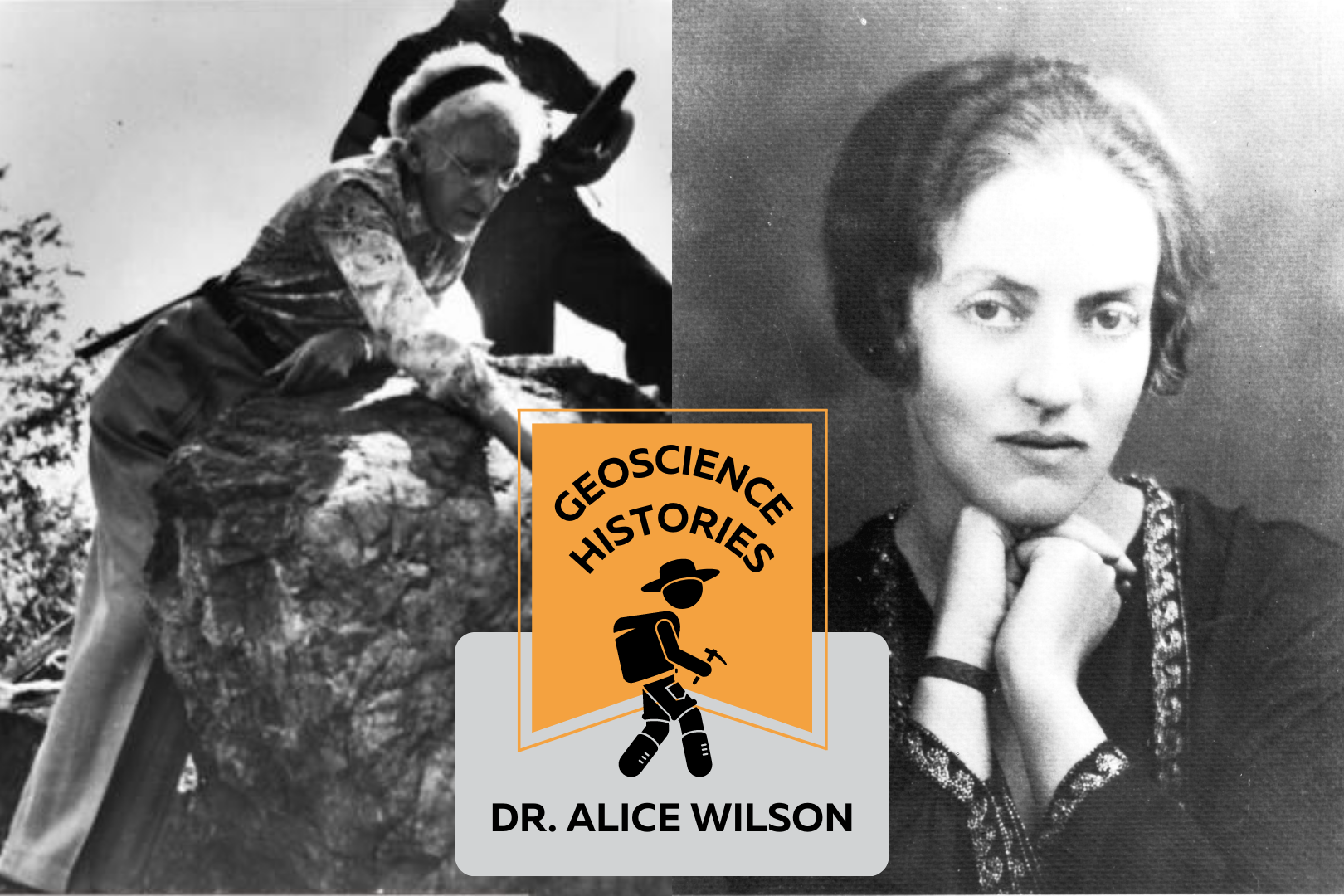
Two black and white images of Alice Wilson side by side. The left image is of Alice bending over a boulder. The right image is a headshot of a young Alice looking at the camera. Over the photos text reads: "Geoscience Histories: Dr. Alice Wilson"

Geoscience Histories: Dr. Alice Wilson

Dr. Alice Wilson, born August 1881, was one of Canada’s first female geologists, and the first female to be hired to work as a geologist at the Geological Survey of Canada. She persevered in the face of many personal and career-related challenges and paved a new path for women in geology in Canada. Alice Wilson grew up in a family that respected and encouraged education and exploration. She spent many summers canoeing, kayaking, and exploring the land and water around her family’s cottage in Ontario. Her father was a professor of Classics at the University of Toronto and both her brothers received PhD’s in their respective fields. When Alice was 20, she decided to study Classics at Victoria College in Toronto, with the goal of becoming a teacher. It’s unclear whether Alice actually wanted to pursue teaching or whether she did this because it was expected of her at the time. According to her friend Winston Sinclair, Alice said that in her youth teaching was the only acceptable field for a young lady. Perhaps this is why she decided to become a teacher. Her career path took a twist in her last year of university when she became very ill with anemia. She was unable to complete her courses and dropped out of school. After a few years in recovery, she started working in 1907 as a clerk at the University of Toronto. She had collected fossils as a child from the Cobourg Limestones near her home and was already passionate about palaeontology. In 1909 she became a museum assistant in the palaeontology department of the Geological Survey of Canada (GSC). In 1911, she finished her degree in Classics and was hired full time at the GSC. During this time, she connected with Percy Raymond who was the Chief Palaeontologist at the GSC. Her knowledge of languages came in handy when Percy needed her to translate a textbook of palaeontology from German to English. Percy connected with Alice and encouraged her to take a leave from the GSC in order to pursue a doctorate degree. Alice applied to take a paid leave in 1915 but she was rejected, despite the fact that other male geologists who applied for the same leave were granted it. Meadowcroft wrote that Alice believed her rejection was based solely on her gender, since the “fundamental reason [for rejection] has been that it would make a woman eligible for the highest positions in the Survey” (Meadowcroft, 1990, p. 208).  While she continued to apply for approval, Alice and Percy published an article on a new species of brachiopod. Unfortunately, when Percy left the GSC, Wilson’s other colleagues were not as eager to include her in their publications, and she was forced to work alone. In 1916, she paid for her own trip to Cold Spring Harbor, Long Island, NY to study comparative anatomy and marine biology for six weeks. When she returned to Canada in 1916, Wilson decided to help in the war effort for World War I. She joined the Canadian Women’s Army Corps (CWAC), an all-female military unit providing aid to the Canadian troops as decoders, drivers, cooks, stenographers, telephone operators and many other positions. The CWAC’s wore uniforms with a badge of three joined maple leaves, and on the collar of every uniform was an image of the helmeted head of Athene– the Goddess of War. As a willing volunteer for the CWAC, it is clear that Wilson didn’t shy away from danger or hard work. Women in the Canadian Women’s Army Corps were often subjected to disdain and discrimination from the Canadian public. General sentiment at the time was that women should be in the home, not in the army, and many people thought that women who joined the CWAC were of low moral standing. Wilson likely had to deal with some of this discrimination while serving with the CWAC.  Once the war was over, Alice Wilson returned to her position at the Geological Survey of Canada and continued to apply for leave to pursue further education. In 1926, she was awarded a scholarship by the Canadian Federation of University Women (CFUW) to fund her education leave. But even with the scholarship, the GSC still denied her leave. The CFUW lobbied for Alice, protesting her denied leave and demanding the GSC let her finish her education. The GSC finally relented and Wilson left to get her doctorate in geology at the University of Chicago. It had taken more than 10 years, but finally she received the education that she wanted.  When she returned to the Geological Survey of Canada, she was required to switch her area of research from Ordovician to Devonian rocks, due to the demand for petroleum in Western Canada. It was the Great Depression, and any research that could help Canada’s economy was prioritized. During this time, Dr. Wilson was responsible for ordering the National Type Collection of fossils, which is still an internationally recognized collection for fossil specimens. As she got older, Alice’s research started gaining recognition. She was the first woman to be elected as a Fellow at the Royal Society of Canada and the second woman to be a Fellow at the Royal Canadian Geographical Society. She received many other notable achievements, one of which was the Order of the British Empire (MBE) in 1935. The GSC, becoming more aware of Wilson’s achievements, promoted her to Assistant Geologist after she received the MBE. This designation should have been automatically given when she received her PhD 7 years earlier. But this wasn’t what Wilson wanted. She requested to be upgraded to Associate Palaeontologist, a title that she was never awarded throughout her career. Additionally, it wasn’t until 1945– nearly 16 years after she received her PhD– that her colleagues finally started referring to her as “Doctor”. During her time at the GSC, it would have been considered very indecent for a woman to join men on field work. So, she did her research by foot and

Read More »