

Artists rendition of the big bang showing a sphere of light with rays of light flowing outward from the center. Text on top of the image reads: Geoscience Today. The great anthropocene explosion

The Great Anthropocene Explosion

Geodiversity Takes Centre Stage Paul Hubley, P.Geo. All the world’s a stage And all the men and women merely players, They have their exits and their entrances, And one man in his time plays many parts, His acts being seven ages… Excerpt from William Shakespeare As You Like It (spoken by Jacques) An explosion of Homeric (epic) proportions, an estimated 13.8 billion years ago, gave rise to everything physical and chemical around us today. The blast was so great that some even postulate that the early moments of our universe even had several additional dimensions compared to those we know now. And it is all still expanding. Physics tells us that explosions result in a release of energy–a reordering of matter. Chemistry tells us that they are the dismantling of something old and creation of something new. Clinical psychologists refer to explosions as a trauma after which a new awareness can be developed over time. Explosions have shaped our consciousness, informed our rituals, politics and religion, and are often expressed in parables or in oral tradition, theatre, poetry and popular culture. One thing is certain–as the curtain lowers in the aftermath of an explosion, things are not the same as they were.  When we examine our world on the backdrop of explosive events, we judge some events to be acceptable or even good, whereas some we reject as bad. Some explosions play a small part in our history while others occupy centre stage. Natural or manmade, terrible or wonderful, detonation or no detonation, explosions have always been a fascination to many, including geoscientists. Whether it be meteorite strikes resulting in extinction events, or tritium detection from atomic bombs being tracked in groundwater for age-dating, some geoscientists dedicate their careers to understanding explosive events.  In an excerpt of As You Like It, Shakespeare introduced seven Acts for seven ages, beginning with the iconic line “All the World’s a Stage.”  Classical Latin explōdō means “to hiss a bad actor off the stage,” or “to drive an actor off the stage by making noise,” from ex- (“out“) + plaudō (“to clap; to applaud“), hence meaning “to drive out” or “to reject.” The modern meaning developed later. In Shakespeare’s time, just as with the ancient Greeks, men were the only ones allowed to be theatre actors–fortunately in theatre we’ve generally developed a more sensible sense of diversity since that time, and benefited greatly from it.  Shakespeare described seven ages of a man’s life, from young to old. Our play also has seven Acts for seven ages on the World stage, but in reverse order, from oldest to youngest, with some key explosive events as the backdrop. It is presented in two parts, converging in Ontario. In Part I we encounter physical-chemical-biological explosions in the abiotic and biotic world. In Part II we implode (focus inward), in hopes of blending our natural world with our community, actions and interactions with others–an implosion of nature and culture, to see what post-play chatter we can initiate.  Now we welcome our principal company of actors: geodiversity, having this basic definition: Geodiversity is the variety of earth materials, forms and processes that constitute and shape the Earth, either the whole or a specific part of it. Relevant materials include minerals, rocks, sediments, fossils, soils and water. Forms may comprise folds, faults, landforms and other expressions of morphology or relations between units of earth material. Any natural process that continues to act upon, maintain or modify either material or form (for example tectonics, sediment transport, pedogenesis) represents another aspect of geodiversity. However geodiversity is not normally defined to include the likes of landscaping, concrete or other significant human influence.  At this point in our story our world is formed and the stage is set. The stage is suspended in the vastness of space. It’s a place of spectacular beauty, with a slow rotation of players. The audience is in a hushed silence, waiting for the first Act in our diversity play, ready if needed to boo bad actors off the stage…  PART I Act I – All the World’s a Stage It took over 9 billion years after the initial explosion, so about 4.6 billion years ago, to get sufficient cosmic dust and rocks to agree with each other enough to form the accretion of a new celestial body, a world we here call Earth (which is one name of many). Here we find the basic building blocks for everything we know and everything we have ever known.   As the world cooled sufficiently, and for billions of years, all the world’s been a stage for a slow but steady rise in geodiversity, with a few exiting the stage, and many others entering. Throughout this time there were numerous explosions, the biggest is believed to be when a Mars-sized planetoid we named Theia crashed into Earth, ejecting the material for the moon. A meteorite is generally considered to be responsible for the Sudbury Nickel Rim–this would have been an explosive event of epic proportions. No doubt there were new minerals formed as a result of these events. But generally speaking, over this vast timescale of billions of years, geodiversity was not particularly explosive. In a series of studies, Hazen et al (2008), Hazen et al (2017) and Hazen and Morrison (2022) describe geodiversity as a function of mineral diversity. The research identifies that the world stage has hosted between 5,000 and 6,000 minerals, much of it believed to be biologically-mediated (formed as a result of biological processes), even in the early days of world history. The research describes a slow increase over deep time, culminating in the Great Oxidation Event, resulting in a groundswell of new minerals due to the availability of oxygen in the atmosphere to react with other elements (relatively speaking, oxygen is highly reactive and found all sorts of ways to combine with rocks and minerals). But despite this reactivity, throughout this deep time period of billions of years there’s nothing even close to being considered an
Read More »
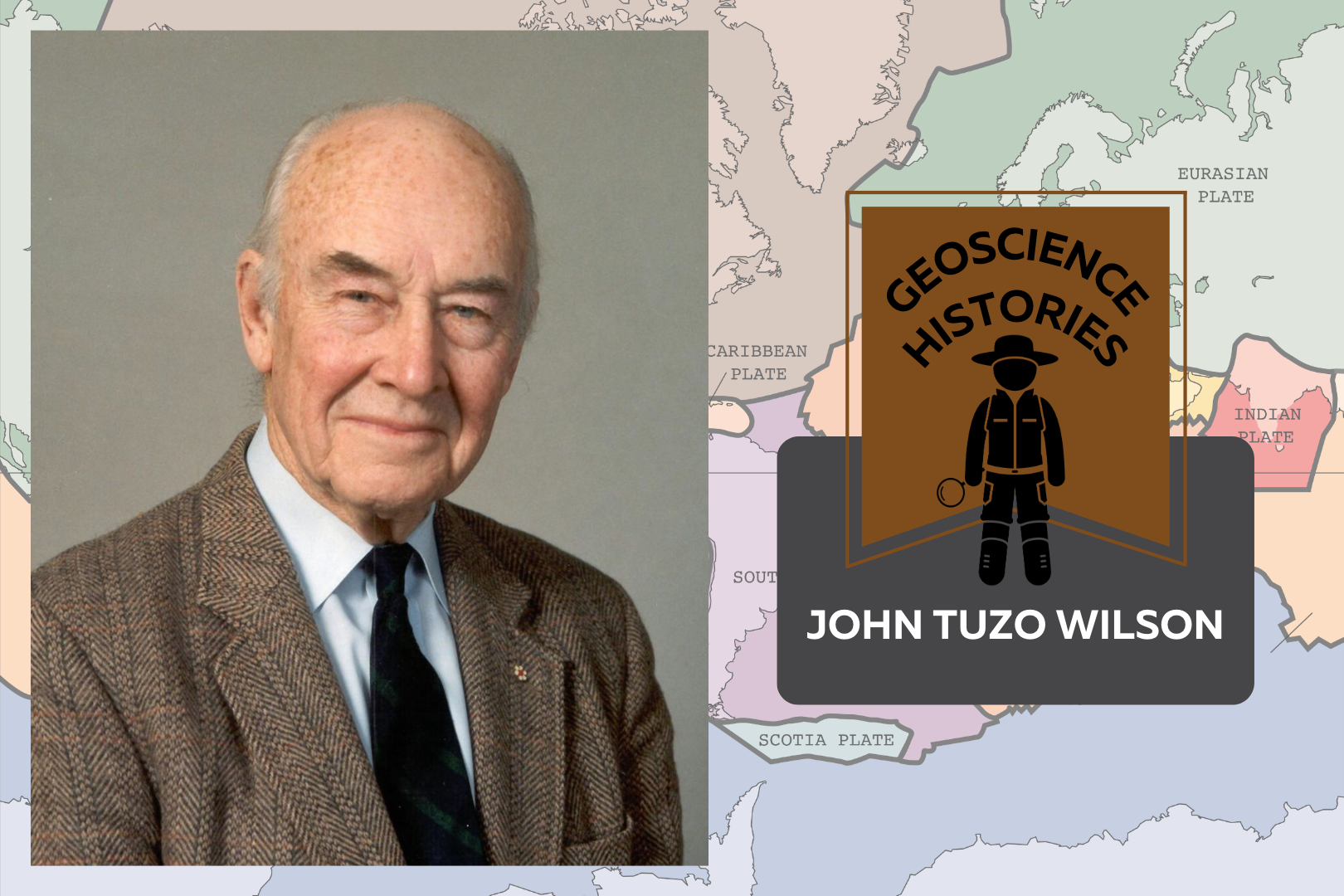
Headshot of John Tuzo Wilson beside text saying: Geoscience Histories: John Tuzo Wilson. In the background there is a colourful map of the world with the tectonic plates outlined

Geoscience Histories: John Tuzo Wilson

Canada’s history is full of geoscientists who have made important discoveries in the field of geoscience. Geoscientists work to help advance technology, solve problems, preserve the environment, and understand Earth’s processes. One important geologist in Canada’s history is John Tuzo Wilson, known for his contributions to the field of plate tectonics.  John was born in Ottawa, in 1908, to Robert Wilson and Annie Tuzo. His father worked for the Canadian government as an engineer and his mother was an adventurous mountain-climber. Annie had a mountain peak named after her, Mount Tuzo, after she and her guide, Christian Bohren, were the first people to ascend the peak. John’s interest in geology began when he was quite young, and he used to collect rocks and fossils on family trips growing up. John studied physics and geology in his undergrad at the University of Toronto (U of T), graduating in 1930. At the time there was no geophysics program at U of T, however, John found instruction wherever he could and did a joint degree instead. He then moved to England on a Massey Fellowship to study at Cambridge. John moved to Princeton for his Ph.D., completing field work on his own in the Beartooth Mountains in Montana.  After his studies, Tuzo Wilson worked for the Geological Survey of Canada as an Assistant Geologist. In 1938, John married Isabel Dickson in Ottawa. When World War II started, he joined the Royal Canadian Engineers, gaining rank to become a colonel. Isabel followed John to England to be closer to him during the war. They returned to Canada together in 1944 and he started a job as a Professor at the University of Toronto. It was here that John Wilson would spend the bulk of the rest of his career.  John Tuzo Wilson via Smorris123 at English Wikipedia, CC BY-SA 3.0, via Wikimedia Commons John’s research at U of T greatly influenced the field of plate tectonics. At the time, Alfred Wegener’s theory of continental drift was largely disputed. Wegener’s theory, published in the early 1900s, asserted that the continents move in relation to one another over long periods of time. But there were inconsistencies in his theory and a lack of evidence. John initially opposed the theory like most of his colleagues, but reconsidered his position later on. This reconsideration ultimately led to Wilson’s theory of plate tectonics.  One of John’s significant contributions to the theory of plate tectonics was the idea of “hot spots.” He drew inspiration from studying the Hawaiian Islands, theorizing that the islands were created as the Pacific tectonic plate moved northwest, over a magma plume in the mantle. This created the chain of volcanoes decreasing in size and intensity to the southwest. This theory resolved some of the contradictions in Wegener’s continental drift theory. Wegner’s theory asserted that volcanoes form solely as a result of movement at the edges of tectonic plates and so was highly disputed because of the lack of explanation for volcanoes located away from plate boundaries (such as Hawaii). Wilson’s new hot spot theory provided an explanation for why there are volcanoes in other places as well as at plate boundaries.  John’s second major discovery was that of transform faults. A transform fault occurs when two plates move past one another,  sometimes resulting in a build-up of stress (e.g., shear stress). Transform faults may cause landforms to break and move past each other, thereby looking offset from each other in aerial view. This new theory of faults explained the topography of mid-ocean ridges and greatly contributed to the larger theory of plate tectonics.  John continued to teach and research at U of T for many years, but even after he retired from the University, he continued to teach his theories, travelling to over 100 countries. He particularly loved travelling to China, and even wrote a book about his trip to China in 1958 entitled “One Chinese Moon.” He produced the tv series “Planet Earth,” and introduced many episodes, continuing his love for teaching. After Wilson retired, he became the director of the Ontario Science Centre, encouraging exploration and interest in science. He famously posted “please touch” signs on the exhibits. He wanted the centre to be a combination of artefacts and hands-on experiments, and often interacted with visitors and school groups. He also supported the introduction of travelling science exhibits in order to make science accessible to remote Ontario communities. The success of the travelling exhibits contributed to the creation of Science North in Sudbury, which Wilson supported.  John Tuzo Wilson’s many discoveries led to our current theory of plate tectonics. His willingness to test the boundaries of science is what gave him great success. His passion for teaching and love for student exploration has greatly impacted the effectiveness of science centres in Ontario.  Nick Eyles recently published a book about John Tuzo Wilson entitled “Tuzo: the unlikely revolutionary of plate tectonics.” It is an enlightening look at Tuzo’s life and career. APGOEF’s president Dr. Bill Pearson describes the book such: Nick has done a tremendous job pulling together a vast amount of historical information not just on the remarkable life and prodigious achievements of Tuzo Wilson but also documenting in fascinating detail the long and protracted battle between those that believed in a contracting earth versus those that believed in continental drift which eventually evolved into what we now know as plate tectonics…The book wonderfully documents the incredible technical revolution especially following WWII that revolutionized the science of geology and moved it rapidly forward…The account of his WWII service is outstanding, and Nick eloquently outlines how his experiences then gave Tuzo many lifelong skills in communication and leadership that would serve him well in future years…It is a fitting tribute to a remarkable man who is unquestionably Canada’s greatest geoscientist.  Dr. Bill Pearson Check out the book at the University of Toronto Press or Amazon. Sources: Brittanica: J. Tuzo Wilson The Canadian Encyclopedia: John Tuzo Wilson The Canadian Encyclopedia: John Tuzo Wilson’s Theory

Read More »