Joana Rodrigues smiles at the camera in front of the ocean. Text reads: From Rocks to Oranges. How to find geology everyday with Joana Rodrigues

From Rocks to Oranges with Joana Rodrigues

Learn how geology is everywhere with Joana Rodrigues! In this episode we talk to Joana Rodrigues, a Portuguese UNESCO expert in geoheritage and geoscience communication. Joana shares her journey from teaching to working in geoparks, where she engages diverse audiences in understanding geodiversity, the non-living elements of nature like rocks, soils, and geological processes. She discusses her PhD research on improving science communication in geoparks, highlighting the need for strategic, audience-focused, and emotionally engaging approaches. Joana emphasizes that geology is deeply connected to everyday life, from food and water to natural hazards, and advocates for shifting public perception to see geoscience as essential for sustainability and environmental solutions.

Read More »
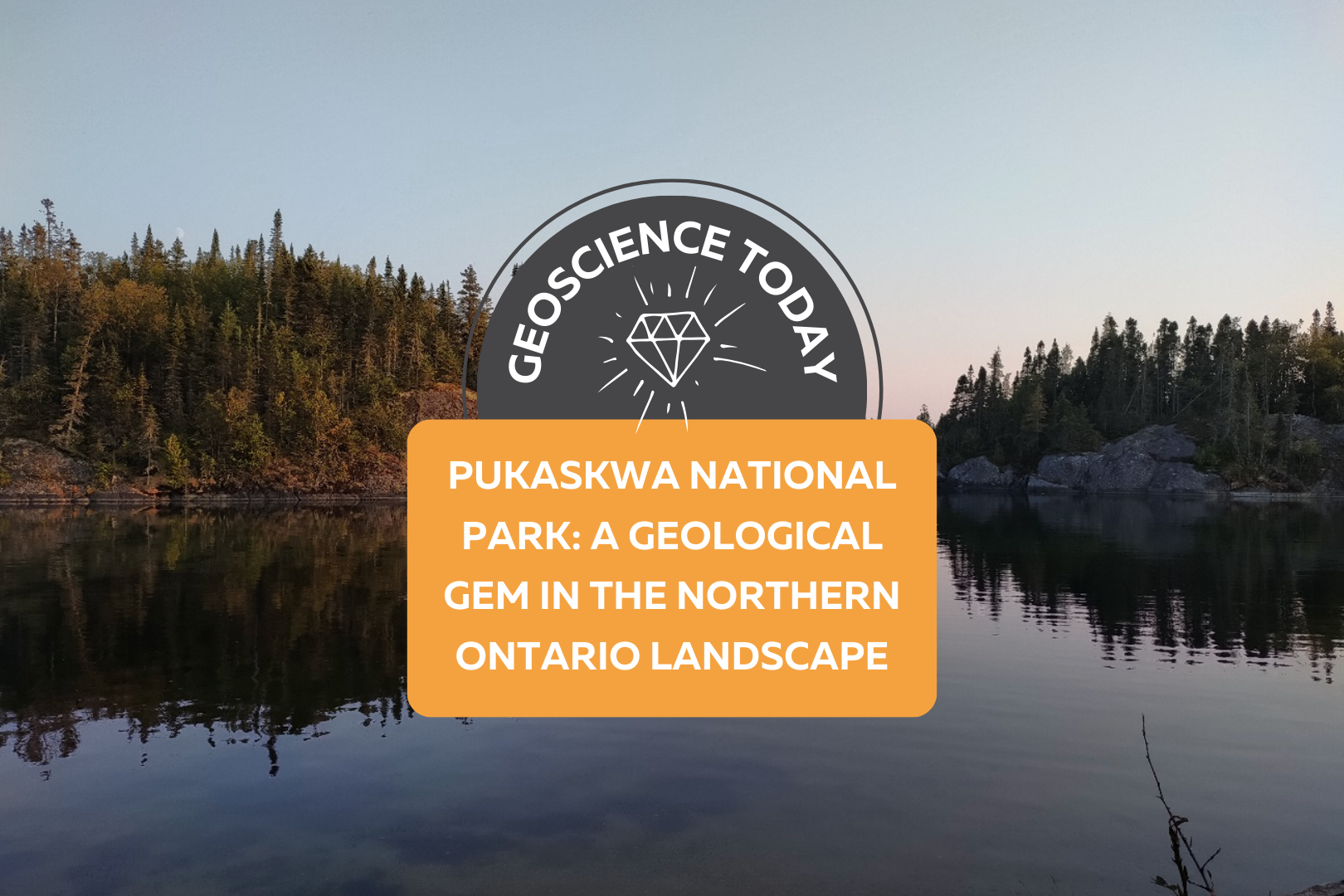
Text reads: Geoscience Today. Pukaskwa National Park: A geological gem in the northern ontario landscape.

Pukaskwa National Park: A Geological Gem in the Northern Ontario Landscape

Author: Cyndy Broughton, Minerals Engineering Technologist The APGO Education Foundation is pleased to support the Geologist-in-Residence program at Pukaskwa National Park. Gazing out over the calm waters of Hattie Cove near the visitor centre at Pukaskwa National Park, I realized the allure of the park. Many of the people that I had recently met during my walks around the park were repeat visitors, coming back year after year to experience the wonders of nature. Some visitors travelled thousands of kilometers each year to experience the solitude and beauty that the park has to offer. Some came to relax and enjoy family time; others came to paddle the waters of Lake Superior or hike the many trails in the park. My goal that day was to help park visitors view the vistas of Pukaskwa through the lens of geology. In August 2024, I had the opportunity of being the Geologist-in-Residence at this beautiful national park located on the shores of Lake Superior near the community of Marathon, Ontario. My last visit to Pukaskwa National Park was in 1984 as a young geological technologist enjoying a day off from work and taking the opportunity to swim in the clear waters of Lake Superior. Now I was returning at the invitation of the Canadian Federation of Earth Sciences and Parks Canada near the end of a career spent mostly in geological education. The role of the Geologist-in-Residence (GIR) program is to highlight the significant geological evidence and history on display within the park and increase public awareness and appreciation of geoscience. The mandate of Parks Canada is to protect and present nationally significant examples of Canada’s natural heritage. Parks Canada’s goal, written in its vision statement, is to make Canada’s treasured natural and historic places a living legacy, connecting hearts and minds to a stronger, deeper understanding of the very essence of Canada. Two of the guiding principles that govern the system of national parks are Education and Presentation and Human-Environment Relationship. Successful natural interpretive programs allow park visitors to discover and learn about ecosystems. Sharing knowledge about sustainability and the connections between people and our environment are important tools in ensuring that our efforts to protect our natural heritage are successful. When we provide the opportunity to experience nature and we share knowledge of ecosystems, we can foster the desire in citizens to protect and appreciate the world around us. To understand the very essence of Canada, we need to share geoscience knowledge, as well as knowledge of wildlife and botany. The geology of our country is literally the ground beneath our feet. Knowledge of geology can help make connections to soil formation, biodiversity, water quality, mineral resources, energy resources, and so much more. The Geologist-in-Residence program is an important program that helps to develop interpretive geology hikes and drop-in sessions where visitors to the park are invited to engage in interactive, hands-on programs. Programming is developed by geoscience educators to help park staff share the geological wonders of the park. This year’s guided hike to Pukaskwa National Parks North Beach helped visitors travel back through geological time to explore the formation of the 2.7-billion-year-old rocks. We discussed the formation of the Lake Superior basin through mid-continent rifting 1 billion years ago and ended our hike examining the impact that glaciation had on the rocks and sand deposits along the coast. During drop-in sessions, we tested the chemistry of Lake Superior waters and connected our results to the geology of the Canadian Shield. Children had the chance to learn basic rock and mineral identification skills and were able to apply those skills when they explored the rocks on the hike. With the assistance of Parks Canada Interpretation Officer and Coordinator Carly Robillard, the support of the Canadian Federation of Earth Sciences (CFES), and the financial support of the APGO Education Foundation, my time spent at Pukaskwa National Park was a rewarding experience that offered me the opportunity to showcase the geological wonders of the park and help visitors make those important connections between geology and world around us. Cyndy Broughton is a Minerals Engineering Technologist and a Professor with 36 years of experience teaching geology and environmental science at Fleming College. She encourages everyone, young and old, to head outside and discover the connections between geology and the living world.

Read More »
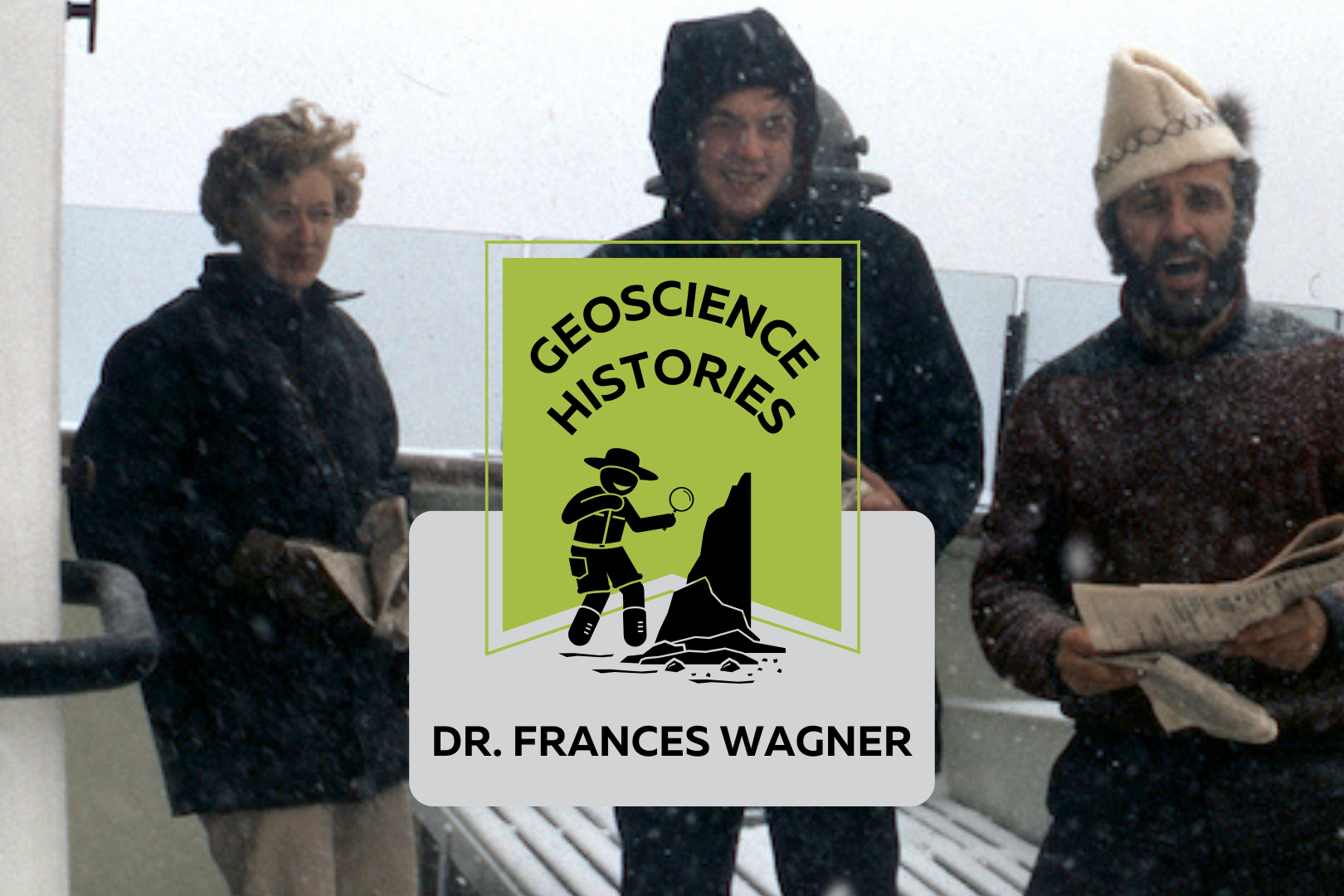
Three people standing on the deck of a boat with snow falling. Text on top of the photo reads: "Geoscience Histories, Frances Wagner"

Geoscience Histories: Dr. Frances Wagner

Frances Wagner was one of Canada’s first female geologists. Her studies in micropaleontology and mapping of Canada’s microscopic fossils were groundbreaking to our understanding of the geology of the continental shelves around Canada, especially the Arctic.  Frances was born in May of 1927 and grew up in Hamilton, Ontario, spending summers enjoying nature at her family’s cottage on Mary Lake. She and her brother would identify the lichens on the Canadian Shield rocks and go canoeing and exploring.  Wagner studied paleontology at the University of Toronto for her undergrad and went on to complete a Master’s degree in invertebrate paleontology at UofT. She researched Ordovician fossils near Ottawa under Dr. Alice Wilson (see our blog post on Dr. Wilson). The summer before she completed her Master’s degree she was hired by the Geological Survey of Canada (GSC) to catalogue fossil samples from the Victoria Museum in Ottawa. She was only the third woman to work at the GSC, in a time where women were considered too weak to do field work. Frances Wagner and her colleague Dr. Helen Belyea were some of the first women to work in the field at the GSC in the summer of 1950 with the support of Dr. Alice Wilson. Wagner went on to complete her PhD in micropaleontology at Stanford University in California. Her thesis was supervised by another groundbreaking female geoscientist Dr. Myra Keen. Her thesis was on marine Pleistocene deposits in southwestern British Columbia. She studied with a Geological Survey of Canada work party on the coast of British Columbia and shipped 350 pounds of samples from British Columbia to California to complete her studies. Her PhD allowed her to pioneer the study of marine micropaleontology. In 1954 Wagner returned to Ottawa to work full time at the GSC and complete her thesis at the same time. In order to complete her PhD she travelled three days by train to Stanford and three days back for her oral exam. In 1964, Wagner’s colleague Charlotte Keen was the first woman to travel on a research ship. The next summer, Dr. Wagner joined Keen and a few other women on the CSS Hudson to map the floor of Hudson’s Bay. The CSS Hudson was the first ship to circumnavigate North America. Wagner joined the ship as it traversed the dangerous Northwest Passage. This was a particularly perlious journey, and they concluded that the Northwest Passage was unsafe for travel. Chief Scientist Dr. Bernard Pelletier wrote in the ship report that at one point, “[the ship] rode up onto a particularly hard floe and slid off one side thereby heeling to port so abruptly and steeply that her guardrail almost touched the broken sea ice.” This is just a taste of the danger that Dr. Pelletier wrote in the report. While on the CSS Hudson, Dr. Wagner studied the ecological history of the Beaufort Sea and published groundbreaking work on the topic. In 1967, Dr. Wagner moved to Nova Scotia to work for the Bedford Institute of Oceanography. She used her experience in marine micropaleontology to study the microbiota of the Arctic and Atlantic continental shelves. In 1973 Dr. Wagner was elected as a Fellow of the Royal Canadian Geographical Society. In 1979 she co-authored a second paper on the Beaufort Shelf, this one focusing on the effects of disturbances, such as hydrocarbon drilling, on the marine ecology of the area. Outside of her career, Frances was an avid horsewoman. She owned two registered Morgan horses, Belle and Jay. She raised Jay from 5 months old and rode him for 24 years. She helped found the Nova Scotia Historical Riding Society and learned to ride sidesaddle in order to do demonstrations of traditional riding techniques at different Museum sites in Nova Scotia. She also researched and sewed traditional clothing for the Uniacke Heritage Society. Wagner was also a dog breeder. She had a kennel called Thicketwood where she bred Shetland Sheepdogs. She helped save the rare Norwegian Lundehund from extinction, importing them to Canada and breeding and showing them. Once she retired in 1984, she focused more of her time and attention on her dog breeding and horseback riding. She always had a love for the outdoors, and was an accomplished canoeist and long distance swimmer.  Wagner never married or had kids. When asked about it she said, “I was a career girl.” In Wagner’s day there was a lot of prejudice against women in the workplace getting married or having families. In Canada there was a law in place that allowed employers to fire female employees if they married. This legislation was only repealed in 1955, when Wagner was already 28 years old. Dr. Wagner had an immense influence on the field of micropaleontology in Canada. You can read one of Dr. Wagner’s publications, “Fossils of Ontario: Part 2: Macroinvertebrates and vertebrates of the Champlain Sea,” published by the Royal Ontario museum. Along with her female colleagues, she defied expectations and made major contributions to her field doing work that was previously considered improper or too difficult for women. Sources:  Science.ca Scientist Profile Frances Wagner Trowelblazers Frances Wagner NecroCanada Obituaries Frances Wagner Ada Lovelace Day Dr Frances Wagner Paleontology and stratigraphy of the marine Pleistocene deposits of Southwestern British Columbia. Fossils of Ontario: Part 2: Macroinvertebrates and vertebrates of the Champlain Sea Author Veronica Klassen is the Manager of the Foundation’s blog – Beneath Your Feet: A Geoscience Blog. She studied Arts and Science at McMaster University with a minor in Earth Science and has a masters in Science Communication from Laurentian University. She is passionate about making science accessible and engaging to the public.

Read More »
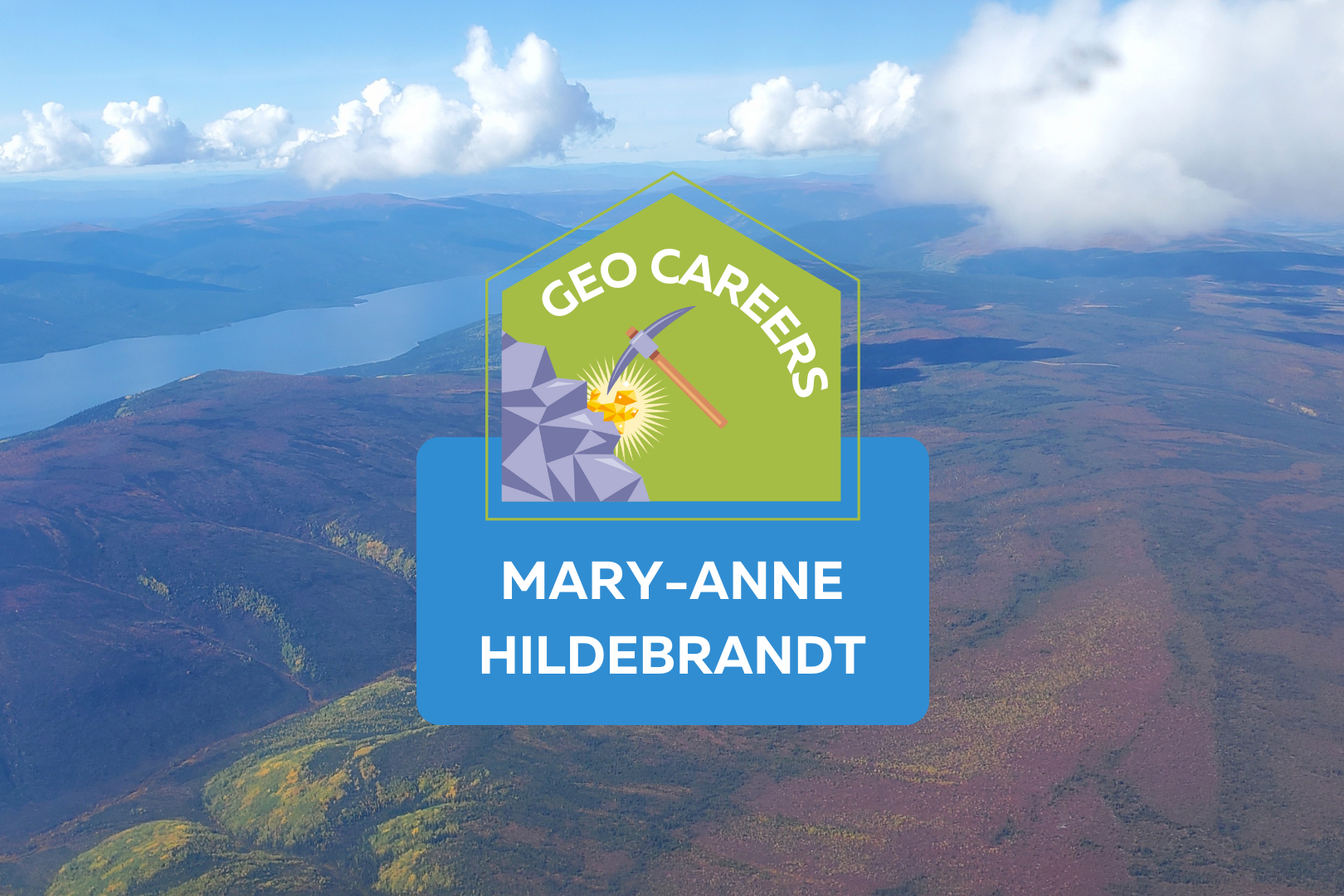
Aerial view of a landscape with rolling hills, a valley, and a river. On top of the photo text reads: "Geo Careers. Mary-Anne Hildebrandt." with the icon of a pickaxe hitting a rock.

Geo Careers: Mary-Anne Hildebrandt

What is a career? Merriam-Webster defines career as “a profession for which one trains, and which is undertaken as a permanent calling.” With more workplaces embracing the idea of flexibility, the weight of words like “permanent” and “calling” evoke something else entirely. Career originates from the Latin carrus, as in a wheeled cart, which some interpret to mean chariot (Online Etymology Dictionary, n.d.). It sounds a great deal more epic than logging into a laptop for another Zoom call. Imagine you and your coworkers embarking on a journey in chariots each day. Surely, with that as your vision, nothing is out of reach. So, what do you do for a living? It’s a common question for any social gathering, and yet, my answer is met with surprise. People are surprised to learn that I am not a teacher or nurse or some other career that matches their perception of who I am. No one has ever guessed that I am a geoscientist. Why? Do I not look or sound like a geologist? This encounter is not exclusive to the public. In truth, I’ve even been mistaken for an administrative assistant when standing in my office wearing head to toe safety gear surrounded by rock samples, and that’s not to say administration staff don’t do field work. They most certainly can and do! It’s that everyone carries bias, and when no other information is available, we fill in the missing data with assumptions based on our own perceptions of the world. Even recently at PDAC, I was asked if I was there as a member of the media, and not a geologist. Who knew that you could work in an industry for 17 years and still feel at times that you don’t quite fit other people’s perceptions of your job title. Every day there are lessons, and some are only learned much later.  When I left university for my first summer field position in 2006, I intended to return for a Master of Science, but looming student debt and other family obligations drove me to stay in the industry. I dreamed about continuing to hone my skills in the areas of geoscience that I enjoyed. Early on, I had a conversation with a manager of a team I wanted to join about my career aspirations, and he tried to put an end to those dreams. He explained that no company would invest their finite resources to support my development in this field because I was a woman, and at the age of 25, I was too old. In his experience, it wouldn’t be long before I would marry, have children, and pursue a different career. I left that conversation feeling devastated because this manager was someone that I truly respected. At the time, I didn’t know how to challenge the underlying beliefs and assumptions that he had conveyed about me. I questioned whether saying anything at all would make a difference. Who was he to decide what my future would hold? That evening, I resolved to not let his ignorance define me.   Did you stay in Geoscience? I have had the good fortune to have worked in the field of geoscience since graduating and successfully achieved my designation as a Professional Geoscientist (P.Geo.) in 2017. Drilling, sampling, mapping, and modelling led me to a deeper understanding of the influence of geological processes, sample bias, and error within spatial models and mineral estimates. In addition, the depth and breadth of the technical projects I have been able to work on has increased not only my technical skills but also my leadership skills. After working for several years as the person performing the annual reconciliation for Mineral Resources and co-authoring the technical report on the resource, I was appointed to carry out the duties of Competent Person (as defined in the SAMREC and the JORC codes) for the deposit I had spent years mapping and modelling. A Competent Person is responsible for preparing the technical report used for public disclosure of a Mineral Resource and Reserve. In the Canadian context, a CP would be similar to a Qualified Person or QP under the National Instrument 43-101 Standard. CPs, like QPs, are considered to be competent to sign-off because they meet or exceed the knowledge requirements and have enough time working in a particular commodity, like gold. There are other requirements, and for those working in the industry, it is best to be well-versed in the governing code or standard for your jurisdiction. It’s an incredibly important responsibility that cannot be taken lightly, and I was honoured to know that those in power trusted my capabilities to appoint me into that role. Although I enjoy the technical aspects of my work, I have found mentoring and coaching others to be equally, if not more, rewarding. My career has carried me to remote areas across Canada and even overseas to Botswana and South Africa. I am forever grateful to have been mentored and supervised by professionals who are highly respected in their field. These are the people who saw the value I could add to a team and a project, and they were instrumental in why I stayed the course. I found professionals from all disciplines were always there to lend a hand or an ear to help find a solution to the latest problem.  One project that I had been assigned was to create a spatial estimate for a stockpile. This was not the norm and fell outside of our regular workflow. A stockpile is not an in-situ deposit. To use it in a business plan, my work still needed to answer similar questions that would be asked during mineral classification of an in-situ deposit. There are a number of factors involved in this work, but to keep this brief, these are the types of questions that needed to be considered: How did the mining team place the rock? Do we have confidence in the volume of the stockpile? How was the volume measured? At what frequency was the volume measured? Do


Read More »