

Aerial view of a landscape with rolling hills, a valley, and a river. On top of the photo text reads: "Geo Careers. Mary-Anne Hildebrandt." with the icon of a pickaxe hitting a rock.

Geo Careers: Mary-Anne Hildebrandt

What is a career? Merriam-Webster defines career as “a profession for which one trains, and which is undertaken as a permanent calling.” With more workplaces embracing the idea of flexibility, the weight of words like “permanent” and “calling” evoke something else entirely. Career originates from the Latin carrus, as in a wheeled cart, which some interpret to mean chariot (Online Etymology Dictionary, n.d.). It sounds a great deal more epic than logging into a laptop for another Zoom call. Imagine you and your coworkers embarking on a journey in chariots each day. Surely, with that as your vision, nothing is out of reach. So, what do you do for a living? It’s a common question for any social gathering, and yet, my answer is met with surprise. People are surprised to learn that I am not a teacher or nurse or some other career that matches their perception of who I am. No one has ever guessed that I am a geoscientist. Why? Do I not look or sound like a geologist? This encounter is not exclusive to the public. In truth, I’ve even been mistaken for an administrative assistant when standing in my office wearing head to toe safety gear surrounded by rock samples, and that’s not to say administration staff don’t do field work. They most certainly can and do! It’s that everyone carries bias, and when no other information is available, we fill in the missing data with assumptions based on our own perceptions of the world. Even recently at PDAC, I was asked if I was there as a member of the media, and not a geologist. Who knew that you could work in an industry for 17 years and still feel at times that you don’t quite fit other people’s perceptions of your job title. Every day there are lessons, and some are only learned much later.  When I left university for my first summer field position in 2006, I intended to return for a Master of Science, but looming student debt and other family obligations drove me to stay in the industry. I dreamed about continuing to hone my skills in the areas of geoscience that I enjoyed. Early on, I had a conversation with a manager of a team I wanted to join about my career aspirations, and he tried to put an end to those dreams. He explained that no company would invest their finite resources to support my development in this field because I was a woman, and at the age of 25, I was too old. In his experience, it wouldn’t be long before I would marry, have children, and pursue a different career. I left that conversation feeling devastated because this manager was someone that I truly respected. At the time, I didn’t know how to challenge the underlying beliefs and assumptions that he had conveyed about me. I questioned whether saying anything at all would make a difference. Who was he to decide what my future would hold? That evening, I resolved to not let his ignorance define me.   Did you stay in Geoscience? I have had the good fortune to have worked in the field of geoscience since graduating and successfully achieved my designation as a Professional Geoscientist (P.Geo.) in 2017. Drilling, sampling, mapping, and modelling led me to a deeper understanding of the influence of geological processes, sample bias, and error within spatial models and mineral estimates. In addition, the depth and breadth of the technical projects I have been able to work on has increased not only my technical skills but also my leadership skills. After working for several years as the person performing the annual reconciliation for Mineral Resources and co-authoring the technical report on the resource, I was appointed to carry out the duties of Competent Person (as defined in the SAMREC and the JORC codes) for the deposit I had spent years mapping and modelling. A Competent Person is responsible for preparing the technical report used for public disclosure of a Mineral Resource and Reserve. In the Canadian context, a CP would be similar to a Qualified Person or QP under the National Instrument 43-101 Standard. CPs, like QPs, are considered to be competent to sign-off because they meet or exceed the knowledge requirements and have enough time working in a particular commodity, like gold. There are other requirements, and for those working in the industry, it is best to be well-versed in the governing code or standard for your jurisdiction. It’s an incredibly important responsibility that cannot be taken lightly, and I was honoured to know that those in power trusted my capabilities to appoint me into that role. Although I enjoy the technical aspects of my work, I have found mentoring and coaching others to be equally, if not more, rewarding. My career has carried me to remote areas across Canada and even overseas to Botswana and South Africa. I am forever grateful to have been mentored and supervised by professionals who are highly respected in their field. These are the people who saw the value I could add to a team and a project, and they were instrumental in why I stayed the course. I found professionals from all disciplines were always there to lend a hand or an ear to help find a solution to the latest problem.  One project that I had been assigned was to create a spatial estimate for a stockpile. This was not the norm and fell outside of our regular workflow. A stockpile is not an in-situ deposit. To use it in a business plan, my work still needed to answer similar questions that would be asked during mineral classification of an in-situ deposit. There are a number of factors involved in this work, but to keep this brief, these are the types of questions that needed to be considered: How did the mining team place the rock? Do we have confidence in the volume of the stockpile? How was the volume measured? At what frequency was the volume measured? Do
Read More »
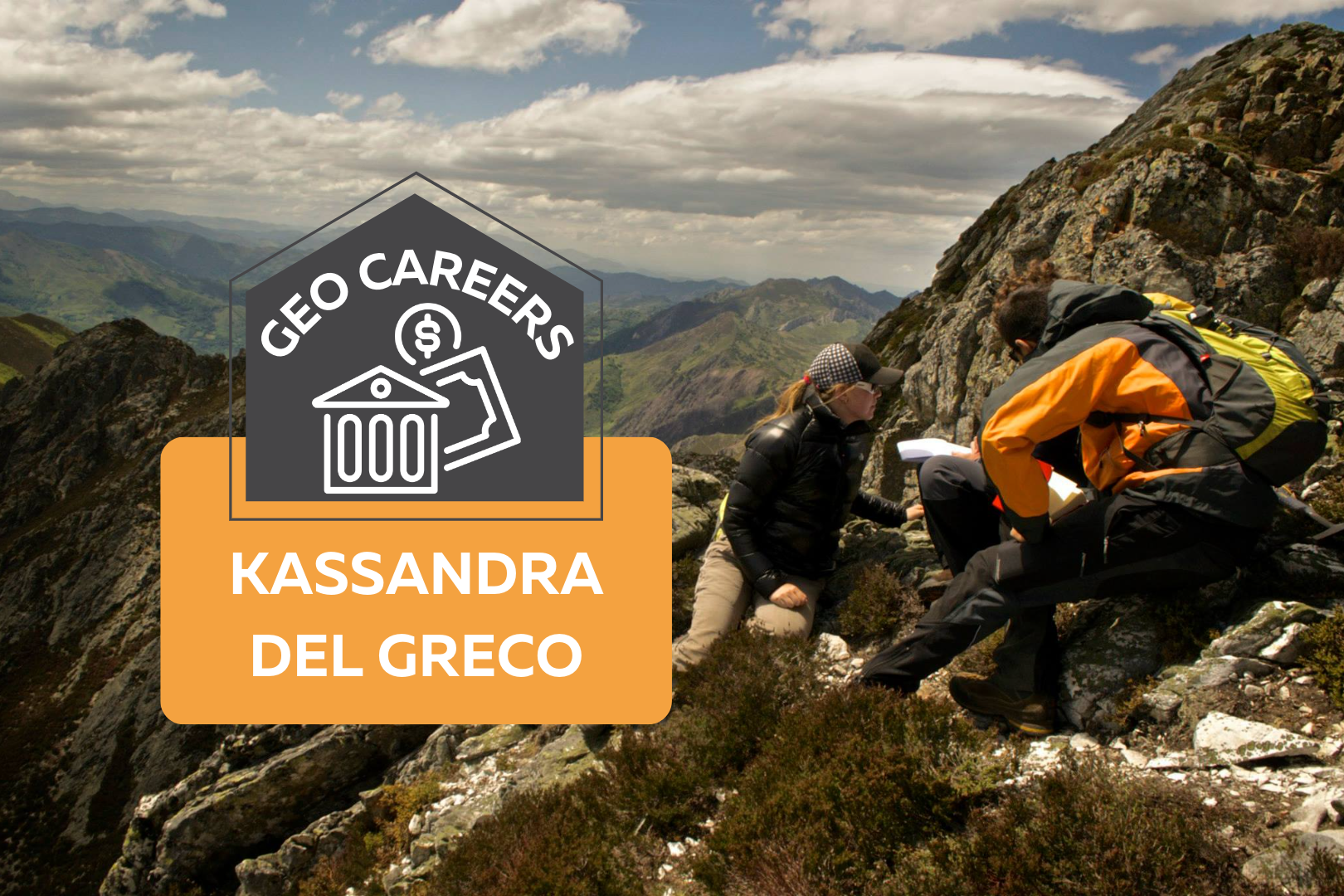
Photo of two people climbing a mountain range. On top of the photo text reads: "Geo Careers: Kassandra Del Greco."

GeoCareers: Kassandra Del Greco

When asked if I could write a little something about my career in geoscience, my gut response was, “I’m not sure I’m qualified to write something.” However, with a little reflection and persuasion, I thought it might be beneficial for others to read about how far an education in geosciences might actually take you. My initial interest in geology came out of my decision to take a “bird” course in CEGEP (Collège d’Enseignement General Et Professionnel), a type of junior college that encompasses the equivalent of grade 12 and the first year of university, to alleviate the heavy math and physics schedule I had lined up for one term. I signed up with a friend, thinking “Won’t it be nice to take a really easy class this semester” and soon found myself completely enthralled with learning about Earth’s history and systems. When university applications came around later that year, I began to consider that the career as a mathematician I had envisioned for myself didn’t quite make sense and I soon found myself wandering over to the geology, mining engineering, and geophysics booths at the McGill University open house. I was reminded during my visit to McGill that I knew two women who had graduated from McGill’s geology program. Two young women from my community, who I knew from extracurricular activities, had graduated with McGill geology degrees a few years prior and from what I could see on Facebook, were living adventure-filled lives working as exploration geologists in places like Australia and Africa. Growing up I had limited travel opportunities; it suddenly occurred to me that there are literally rocks all over the planet and that in theory, I could work anywhere in the world as a geologist, and with a career as a geologist, I might have the opportunity to visit places I’d never dreamed of before. What really sealed the deal was when I heard about the famous “Willy Trips” at McGill’s geology department, where Dr. Anthony Williams-Jones travelled to different destinations with a class of students every year to explore and learn about the geology of a new country. I was hooked. I went through university taking every opportunity to attend as many field trips as I could, and visited places like Chile, Tanzania, Columbia and the Southwest United States during my studies alone. I was so excited to begin my career as an exploration geologist and visit places like the remote Canadian North, Australia, Africa, South America…you name it. Everything was on track until 2012, the year I finally graduated. I entered the job market, top of my class, ready to begin working as an exploration geologist in mid-2012. Little did I know that 2012 would mark the beginning of one of the longest commodity and mining market downturns in history. It was difficult to find a job as an experienced geologist, let alone a freshly graduated geologist with just a summer’s worth of experience. I hustled as much as anyone, applying to literally any job I could find in the industry, but like many of the peers I graduated with, had no luck. It was disheartening, to say the least. After about 8 months of unemployment, I began looking at graduate studies opportunities. I thought that maybe I could either pursue a career in academia, or at the very least, hide out during a Masters degree and hope that within a couple of years the industry would turn and entry level jobs would begin to reappear. During my Masters degree at the University of Victoria I studied the structural geology and tectonics of the Cantabrian mountains in Northern Spain and was fortunate enough to spend a summer in Spain doing field work and attending conferences with geologists from the University of Salamanca. I finished my M.Sc. in mid-2016 and two hours after submitting my final thesis I was called by my first ever boss in the Quebec mining industry who I worked for a summer prospecting. He asked me if I was looking for work (I was) and told me about an opportunity for field work that summer (Holy cr*p, my plan worked!). I had my boots on the ground in Northern Quebec about two weeks later and was thrilled to, four years later, be starting my career as an exploration geologist. It was about 18 months of bliss, working multiple consecutive contracts in exploration for multiple gold exploration companies in Quebec. I was working on rotations that were 21 days on, 10 days off, or 14 days on, 14 days off. Of course, I took every opportunity to travel on my time off, living out of a duffle bag for months on end, visiting places like Portugal, Nicaragua, Costa Rica, and Italy. Essentially, I would go anywhere I could get to for a reasonable price and with less than 7 hours of flight time. However, it was about two years later when I started to feel the pains of the job. It turned out that as much as I loved learning about geology in school, I didn’t exactly love the work. I wasn’t totally enthused by core logging, learning to create geological models, or even spending time in the field. I was beginning to feel worn down by the swamps, the bugs, the heavy bags full of rocks, and spending whole days in the bush soaking wet. On top of this, I started to become acutely aware of the fact that I had no community. Over nearly two years, I had barely spent any time at home, causing me to feel disconnected from friends, unable to get involved in any type of club or activities at home, and forget dating, it was impossible! I began to reflect on whether this was the career for me. Sure, I loved learning about geology, and I loved travelling, but I didn’t really enjoy the work or the life I had built for myself anymore. I began searching for a mentor (I found a great one). I started writing

Read More »

Confessions of a Geoscience Educator – How Did I Get Here?

It is common to hear stories of highly gifted individuals pursuing a career path and ultimately landing their dream job after years of climbing the ladder. Sometimes I even tell people that I am very lucky to have landed my dream job. “Lucky” is certainly true, but the fact is, I’m not particularly gifted, nor did I imagine working in the career I have now, that is, being an educator. That sort of happened by accident. My job is amazing, but my work does not quite match what I originally envisioned. Yes, I have always wanted to be a paleontologist, and yes, people call me a paleontologist, but my main passion is teaching geology (and not much of it is actually paleontology). When people asked me what I did for a living, I used to reply that I was a paleontologist. Now, I’m more inclined to say that I’m a university teacher. I guess I am getting to that age where I wake up and think, “Well, how did I get here?”” (and now I’m cursing David Byrne because I know I’ll have that certain song in my head for the rest of the day). I am slightly bothered by the fact that I was born in 1966. This means I’m about as old as the theory of plate tectonics. I have only recently come to fully embrace this without the eye twitch! Plot it on the geologic time scale and it doesn’t look quite so bad. But I digress… I was born in the town of Olds, Alberta. My earliest memory of a rock that interested me was a piece of shale that a friend of the family showed me. It had a trilobite in it. Apparently, I had already shown an interest in rocks at this point, and she thought I might be interested in looking at it. I remember seeing it and thinking that it was the coolest thing I had ever seen. It looked kind of creepy, but beautiful at the same time. And a dead animal in a rock? Sign me up! I’ve noticed that a disproportionate number of photos I have of me as a kid show me looking at the ground for fossils (or rocks). I don’t know exactly what drew me to fossils and rocks. Maybe it has something to do with always having been vertically challenged (and being so close to the ground)? Or maybe it’s an obsession with dead things? I still don’t know exactly what it was… This obsession with fossils got me in trouble at times. I remember my mom being very upset with me for being nearly hit by a train while looking at the stones in the ballast of the train tracks. I was nearly hit by a car once when I was inspecting gravel on the side of the road too. I was developing an interest in dinosaurs as my parents would take me to Drumheller (about an hour and a half drive from Olds) to look for dinosaur fossils (the Royal Tyrrell Museum wasn’t yet constructed). Then my dad (a professor in horticulture) got a job at the University of Guelph. In Ontario. Well, dang – there goes dinosaur hunting.  Fortunately, I found out that there were a lot of old invertebrate fossils to be found in Ontario. I started finding fossils in…driveway gravel (of course). I was very, very fortunate to have parents who were supportive of my strange interests.   My fossil obsession continued through my teen years. I kept it hidden from most others, as I thought most people would think it was a really weird thing (but who are we kidding? Teens think everything is weird). One thing I did discover during high school is I always learned more about something if I had to explain it to someone else. This still holds true for me today. There are a whole lot of things I wouldn’t know now if I didn’t have to teach about them in my courses. The fantasy of becoming a paleontologist sat in the back of my mind for years. But I had always assumed that I would have to be an exceptional student to get into that sort of field. The thing was, I was not an exceptional student. Especially in science. And I was hopeless at math (and I’m still hopeless at math). My teachers in high school (and my guidance counsellor) told me that if I was to go to university after high school, my best bet would be visual art, music or maybe English. I don’t think any of them expected me to go into science. My grades, although definitely not stellar, were good enough to get me into the University of Western Ontario for science, and ultimately into the geology program. By the second year of my undergraduate program, I found my people. I became friends with other students interested in geology and was delighted to learn that a lot of my peers really sucked at math too. One of the most transformative realizations I came to appreciate from the courses I took was that paleontology was part of something much bigger than I formerly realized. Taking courses in a variety of subdisciplines – sedimentology, geochemistry, structural geology, petrology, and many others – made me appreciate the complexity and interconnectedness of natural processes in the Earth system as a whole. The idea that (in conjunction with characteristics of the rocks that contained them) fossils could be used to interpret past environments just blew my mind. And gaining the ability to visualize, in my minds eye, how a given rock formed (something I often to refer to as “looking beyond the rock”) felt like acquiring a superpower. So, while I came to my undergraduate degree wanting to study fossils, I left with a deeper appreciation of rocks – the context for fossils. So, l kept looking down, but my view of the ground became much, much bigger. From my undergraduate degree

Read More »