

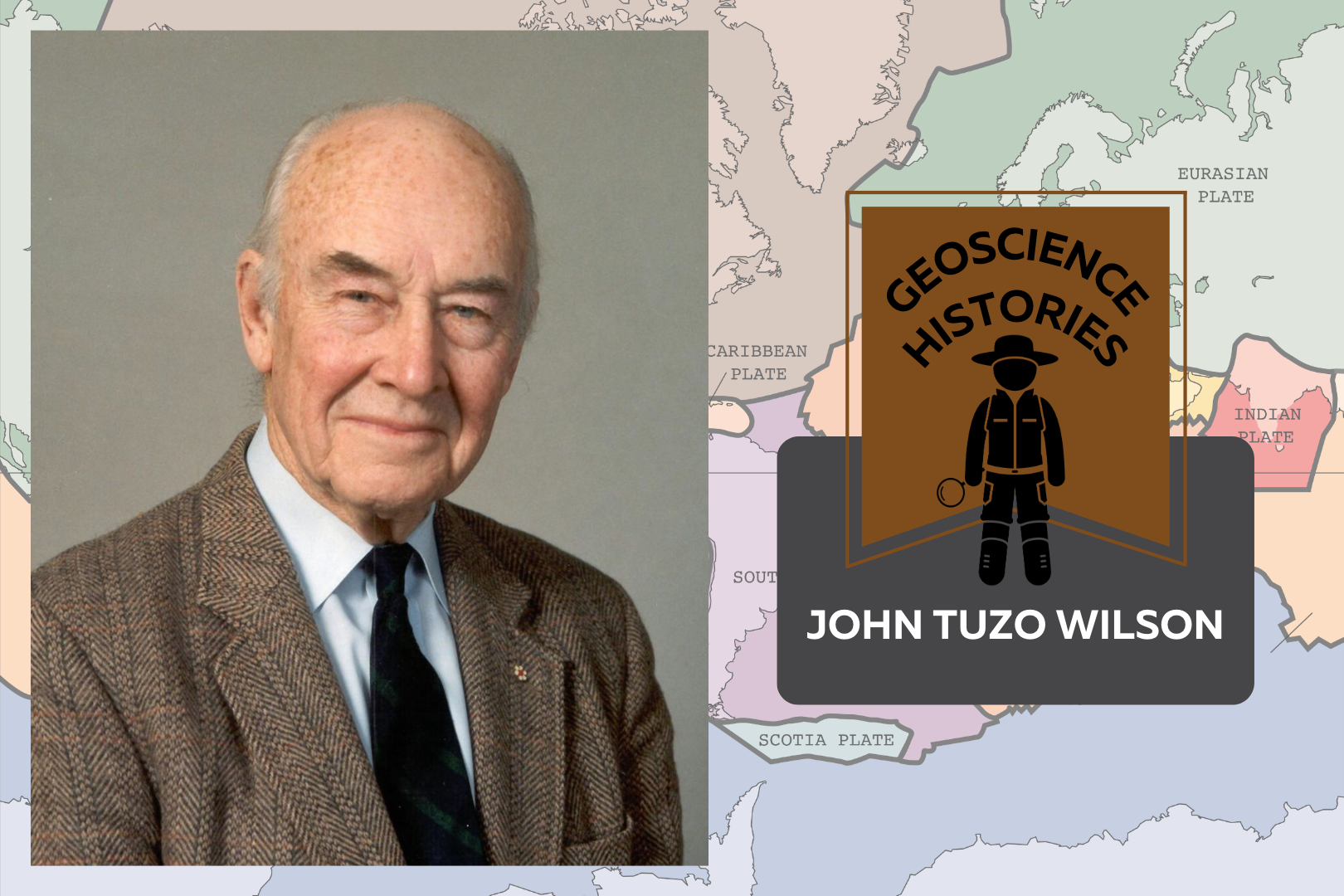
Headshot of John Tuzo Wilson beside text saying: Geoscience Histories: John Tuzo Wilson. In the background there is a colourful map of the world with the tectonic plates outlined

Geoscience Histories: John Tuzo Wilson

Canada’s history is full of geoscientists who have made important discoveries in the field of geoscience. Geoscientists work to help advance technology, solve problems, preserve the environment, and understand Earth’s processes. One important geologist in Canada’s history is John Tuzo Wilson, known for his contributions to the field of plate tectonics.  John was born in Ottawa, in 1908, to Robert Wilson and Annie Tuzo. His father worked for the Canadian government as an engineer and his mother was an adventurous mountain-climber. Annie had a mountain peak named after her, Mount Tuzo, after she and her guide, Christian Bohren, were the first people to ascend the peak. John’s interest in geology began when he was quite young, and he used to collect rocks and fossils on family trips growing up. John studied physics and geology in his undergrad at the University of Toronto (U of T), graduating in 1930. At the time there was no geophysics program at U of T, however, John found instruction wherever he could and did a joint degree instead. He then moved to England on a Massey Fellowship to study at Cambridge. John moved to Princeton for his Ph.D., completing field work on his own in the Beartooth Mountains in Montana.  After his studies, Tuzo Wilson worked for the Geological Survey of Canada as an Assistant Geologist. In 1938, John married Isabel Dickson in Ottawa. When World War II started, he joined the Royal Canadian Engineers, gaining rank to become a colonel. Isabel followed John to England to be closer to him during the war. They returned to Canada together in 1944 and he started a job as a Professor at the University of Toronto. It was here that John Wilson would spend the bulk of the rest of his career.  John Tuzo Wilson via Smorris123 at English Wikipedia, CC BY-SA 3.0, via Wikimedia Commons John’s research at U of T greatly influenced the field of plate tectonics. At the time, Alfred Wegener’s theory of continental drift was largely disputed. Wegener’s theory, published in the early 1900s, asserted that the continents move in relation to one another over long periods of time. But there were inconsistencies in his theory and a lack of evidence. John initially opposed the theory like most of his colleagues, but reconsidered his position later on. This reconsideration ultimately led to Wilson’s theory of plate tectonics.  One of John’s significant contributions to the theory of plate tectonics was the idea of “hot spots.” He drew inspiration from studying the Hawaiian Islands, theorizing that the islands were created as the Pacific tectonic plate moved northwest, over a magma plume in the mantle. This created the chain of volcanoes decreasing in size and intensity to the southwest. This theory resolved some of the contradictions in Wegener’s continental drift theory. Wegner’s theory asserted that volcanoes form solely as a result of movement at the edges of tectonic plates and so was highly disputed because of the lack of explanation for volcanoes located away from plate boundaries (such as Hawaii). Wilson’s new hot spot theory provided an explanation for why there are volcanoes in other places as well as at plate boundaries.  John’s second major discovery was that of transform faults. A transform fault occurs when two plates move past one another,  sometimes resulting in a build-up of stress (e.g., shear stress). Transform faults may cause landforms to break and move past each other, thereby looking offset from each other in aerial view. This new theory of faults explained the topography of mid-ocean ridges and greatly contributed to the larger theory of plate tectonics.  John continued to teach and research at U of T for many years, but even after he retired from the University, he continued to teach his theories, travelling to over 100 countries. He particularly loved travelling to China, and even wrote a book about his trip to China in 1958 entitled “One Chinese Moon.” He produced the tv series “Planet Earth,” and introduced many episodes, continuing his love for teaching. After Wilson retired, he became the director of the Ontario Science Centre, encouraging exploration and interest in science. He famously posted “please touch” signs on the exhibits. He wanted the centre to be a combination of artefacts and hands-on experiments, and often interacted with visitors and school groups. He also supported the introduction of travelling science exhibits in order to make science accessible to remote Ontario communities. The success of the travelling exhibits contributed to the creation of Science North in Sudbury, which Wilson supported.  John Tuzo Wilson’s many discoveries led to our current theory of plate tectonics. His willingness to test the boundaries of science is what gave him great success. His passion for teaching and love for student exploration has greatly impacted the effectiveness of science centres in Ontario.  Nick Eyles recently published a book about John Tuzo Wilson entitled “Tuzo: the unlikely revolutionary of plate tectonics.” It is an enlightening look at Tuzo’s life and career. APGOEF’s president Dr. Bill Pearson describes the book such: Nick has done a tremendous job pulling together a vast amount of historical information not just on the remarkable life and prodigious achievements of Tuzo Wilson but also documenting in fascinating detail the long and protracted battle between those that believed in a contracting earth versus those that believed in continental drift which eventually evolved into what we now know as plate tectonics…The book wonderfully documents the incredible technical revolution especially following WWII that revolutionized the science of geology and moved it rapidly forward…The account of his WWII service is outstanding, and Nick eloquently outlines how his experiences then gave Tuzo many lifelong skills in communication and leadership that would serve him well in future years…It is a fitting tribute to a remarkable man who is unquestionably Canada’s greatest geoscientist.  Dr. Bill Pearson Check out the book at the University of Toronto Press or Amazon. Sources: Brittanica: J. Tuzo Wilson The Canadian Encyclopedia: John Tuzo Wilson The Canadian Encyclopedia: John Tuzo Wilson’s Theory
Read More »
A pirate ship sailing into the sunset with a black flag with a photo of the earth on it. Text over the photo read: "Geoscience Today. Pirates and Geoethical privateers."

Pirates and Geo-Ethical Privateers

By Paul Hubley, P.Geo. “True Fact – the lack of pirates is causing global warming” – Forbes (2012) When Forbes Magazine published this graph along with the claim above, it caught my eye. In the graph, the average global temperature is increasing (on the vertical axis) as the number of pirates (on the horizontal axis) is decreasing. The reduction of pirates to “approximately” 17, roughly corresponding to the highest recorded temperature, is an oddly specific measurement (and my favourite part). There is even a handy timestamp along the curve and a familiar but outdated and partially obscured world map background for added authenticity. Taken together, the visual story woven by Forbes cleverly serves to reinforce some of our existing biases and our assumptions – it suggests that we need to pay attention as a society to this global issue of concern, that its all hands on deck concerning the increasing severity of the problem, its based on historical fact … and … global temperature rise is caused by an acute lack of pirates1. Geoscience publications are usually not awash with correlations of Earth systems and the activities of pirates, so this raised a red flag. Though as perhaps you’ve guessed, the graph is “tongue-in-cheek”, challenging those purveyors of “fact” to not confuse simultaneity with causation, in other words, to ensure that we take due care to link measured effects to their causes. It reminds us that we have a collective responsibility to ensure integrity in our data, use applicable scientific methods, and provide unbiased reporting – to stand on our moral and ethical footings.  Broadly, morals are guiding principles, and ethics speaks to rules, behaviours or actions. The graph’s issues of data, methods and communication cause us to drift us into ethical territory. It is reasons such as this that geoscientists (and other professionals) have a Code of Ethics to abide by, usually focused on honesty, integrity in data collection, due consideration of uncertainty using scientific methods and employing unbiased interpretation (etc.). Turns out that there is a Code for pirates too…   Context is Everything! Pirates in the Elizabethan era (the Golden Age of pirates, provided you weren’t Spanish) had codes of conduct to keep harmony on the ship and align the objectives of the crew. Bartholomew Roberts Shipboard Articles of 1721 consisted of a number of agreements between the Captain and crew. The articles were necessary as pirates were not governed by any other rules such as Naval regulations. For some aspects (stealing from each other, gambling, etc.) the rules were very tight, but generally all bets were off once on shore. One of the more interesting elements was Article 9, that is if injury should befall a pirate while on the job, they would be paid a sum commensurate with their injury – in other words, they had a meaningful worker’s compensation program.  Pirate captains were elected and could lose their position for abuse of their authority. However, aside from the agreed articles, there wasn’t much elaboration on what constituted abuse of ethics. Using a modification of Cressey’s Fraud Triangle (Source: David Bailey, 2015 (adapted from Cressey, 1951)), it’s clear that pirates already had the pressure and opportunity to move them into ethical risk territory when a ship was sighted – the promise of riches and glory saw to that. The only thing holding a pirate captain back from ethical shark-infested waters was rationalization2. But rationalization is a fickle passenger. At least, until society gets on board…  Canadian nautical society has a naughty history with piratical negotiations. Pirates receiving a Letter of Marque from the British Admiralty were thus commissioned as Privateers, notably during the War of 1812. These legal pirates were free to conduct their business provided their actions were aligned with the wider interests of society (i.e. the British Crown). One ship owner, Enos Collins, did rather well in 1812, becoming Canada’s wealthiest person; he also co-founded the Halifax Banking Company, a predecessor to the CIBC bank, using the spoils of privateering. If you’re in Halifax you can still see the oft-celebrated results of such shenanigans, starting at the Privateers Wharf (Sources: CIBC and East Coast Heritage. Photo by Thomas Goldsworthy Dutton via Wikimedia Commons). It is social context that allows a scurvy scallywag to turn into a prizewinning Privateer, without fundamentally changing their behaviours. Societal expectations (in the example above, articulated by the Crown) provide the necessary rationalization to justify naughty behaviour.   On the other hand, the inspiration of society can increase the strength of winds in a positive direction, creating neo (new) ethical expectations for the betterment of society – this became evident in the 1970s when the “Blue Marble” was first hoisted3. The Blue Marble Flag of the Earthship You have probably seen the Earth portion of this image without even noticing, as we take images like this for granted today. But it’s one of the most widely distributed print images in history.  It was this NASA photo taken from Apollo 17 in 1972 that became the essential symbol of the public’s collective imagination and expectations. It was widely circulated in the 1970s as a symbol, or flag of the Earth’s fragility, representing vulnerability and isolation in the limitlessness of space, a tiny Earthship alone in the vast ocean. The implied message was, without better care, the Earth would be replaced with a skull and crossbones – society no longer accepted the wanton polluting of the environment, and this trend continues today. This example demonstrates that societal awareness may push to shore as might a sustained wind.  Notably, the photo was not the first of its kind – a few years earlier there were similar photos available from NASA – but earlier photos failed to capture society’s collective imagination like this one, because they were not connected to society’s collective anxieties and will (therefore = shifting winds).  And so for our voyage, it is the 1972 Blue Marble photo that is selected as our Earthship flag.    These days many of us are on

Read More »